|
JAN - JUL: second-year
unknown |
RETURN TO AGE/SEX
OVERVIEW
|
JUL - DEC: after-hatch-year
unknown |
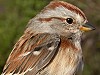
Body plumage provides no useful information
about age or sex, and molt limits are only occasionally obvious enough to be recognized on HY birds, therefore it is unwise to call any AHY based just on overall appearance.
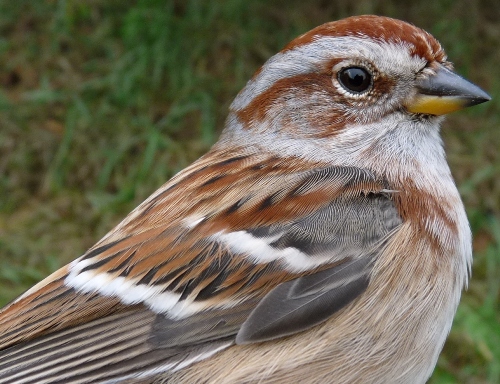
Photo by Marcel Gahbauer,
McGill Bird Observatory (QC), October 2009
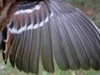
On AHY birds, the wing is dark and relatively uniform in condition (the greater coverts almost always appear distinctly darker). The primary coverts tend to be broader and more rounded than on HY birds, but this can be a subtle distinction.
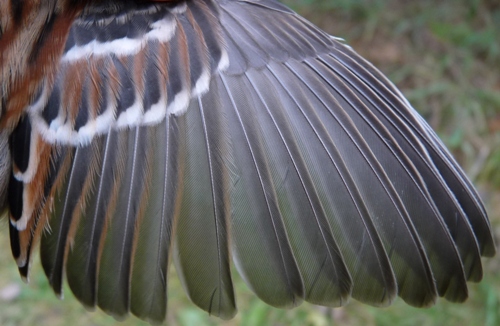
A typical AHY wing.
Photo by Marcel Gahbauer,
McGill Bird Observatory (QC), October 2009
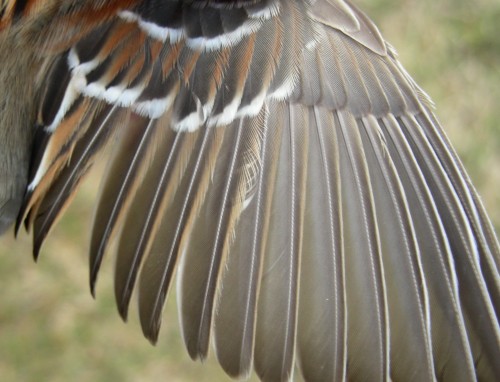
A slightly paler wing, but still showing a fairly uniform appearance. The primary coverts in
this example are particularly broad and rounded.
Photo by Marcel Gahbauer,
McGill Bird Observatory (QC), December 2006
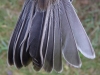
The outer rectrices tend to be quite broad and rounded.
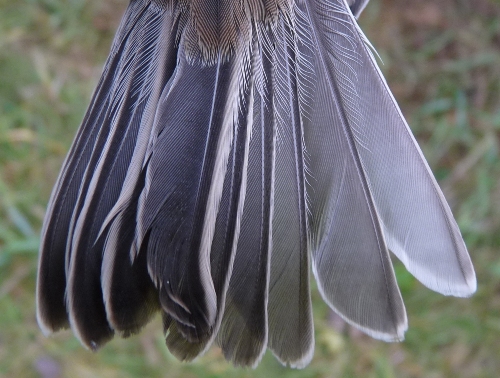
A fairly typical AHY tail.
Photo by Marcel Gahbauer,
McGill Bird Observatory (QC), October 2009
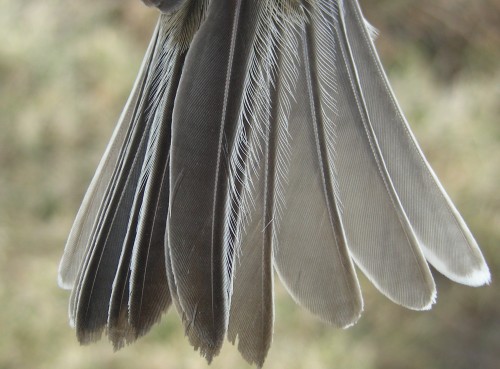
A slightly paler tail (corresponding to the paler wing in the previous section). Although the
central rectrices on this bird are a bit narrower, the outer rectrices are again broad and rounded.
Photo by Marcel Gahbauer,
McGill Bird Observatory (QC), December 2006
RETURN TO AGE/SEX
OVERVIEW
|
JUL - DEC: hatch-year
unknown |
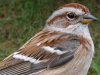
Occasionally molt limits can be seen on perched HY birds, but in most cases overall body plumage provides no useful clues to age. On average, HY birds may be slightly duller than AHY birds, but there is too much overlap for this criterion to be useful except in extreme cases.
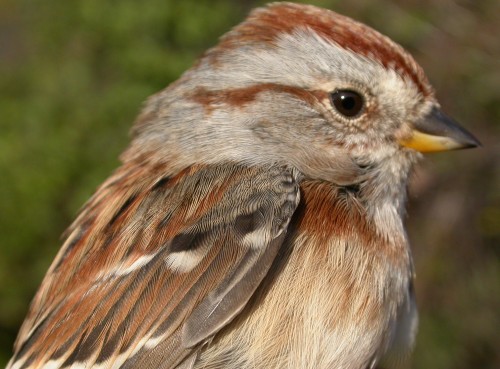
Photo by Marcel Gahbauer,
McGill Bird Observatory (QC), October 2005
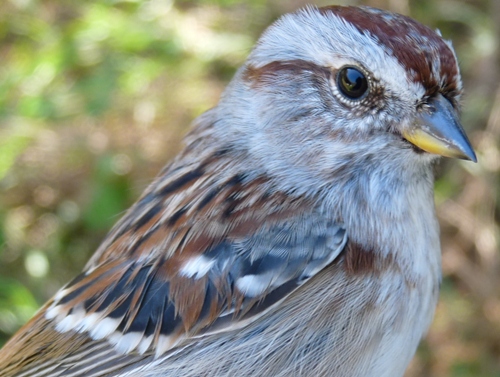
Photo by Marcel Gahbauer,
McGill Bird Observatory (QC), October 2009
On HY birds, the dark greater coverts and tertials contrast more sharply with the paler brown block of retained juvenile primary coverts, primaries, and secondaries. The primary coverts and outer primaries also tend to be somewhat narrower and more pointed than on AHY birds.
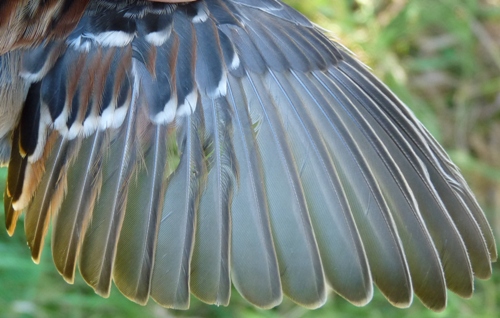
A typical HY wing, showing the contrast between the two blocks of feathers on the wing.
Note that there is a bit of brownish edging to the primary coverts on both HY and AHY
birds, and this is therefore not a particularly reliable trait to consider.
Photo by Marcel Gahbauer,
McGill Bird Observatory (QC), October 2009
Rectrices are typically
somewhat narrower and more pointed than on AHY birds, though the distinction can be somewhat subtle. In this
species tail wear tends to be less evident than in many other sparrows,
so many HY/SY individuals have relatively fresh looking rectrices.
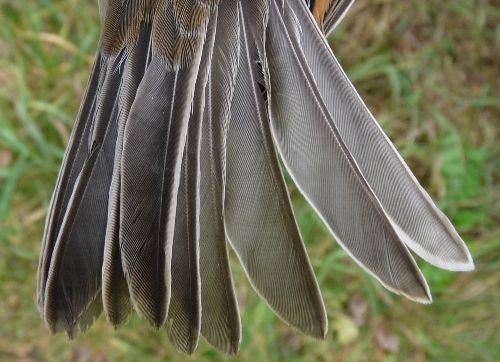
A typical HY tail, with the outer rectrices distinctly narrower and more tapered than
would be the norm for AHY birds.
Photo by Marcel Gahbauer,
McGill Bird Observatory (QC), October 2009
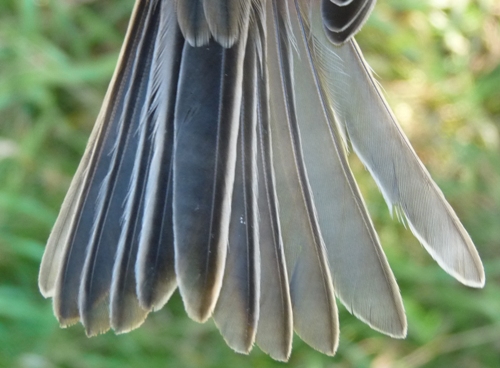
A slightly paler example, with outer rectrices not quite as pointed at the tip.
Photo by Marcel Gahbauer,
McGill Bird Observatory (QC), October 2009
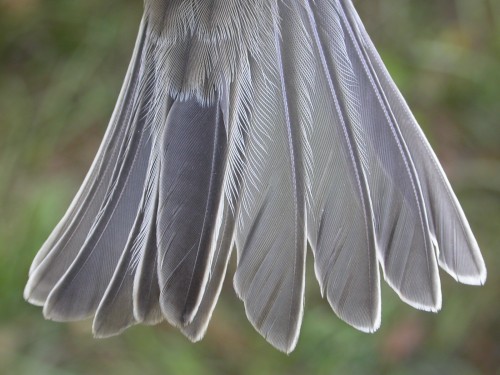
An example with even more rounded tips to the rectrices; this is sufficiently intermediate
to be inconclusive, and a distinct molt limit would be required to determine age as HY.
Photo by Marcel Gahbauer,
McGill Bird Observatory (QC), October 2005
RETURN TO AGE/SEX
OVERVIEW