|
Baltimore
Oriole / Oriole de Baltimore (Icterus galbula) |
 |
Introductory notes:
Although some age/sex classes (especially AHY/ASY males and most SY males) are easily distinguishable, others can be surprisingly tricky and require careful assessment of multiple characteristics. ASY females in spring can be particularly variable. |
QUICK TIPS:
| 1) In spring, look
at the greater coverts - on SY birds there is generally a moult limit within the greater coverts, or less commonly between the greater coverts and primary coverts. The primaries and secondaries are usually also brown and somewhat worn, with the inner secondaries contrasting with replaced greater coverts.
2) Look
at the rectrices - on HY/SY birds they are
narrow and pointed, while on AHY/ASY birds they are
broader and with a rounded tip; this feature is
particularly useful in fall when wing contrasts (for females) are less obvious, but can be very easy to spot in spring when SY birds often have a mix of juvenile and alternate feathers.
3) Only
identify sex after age has been determined - SY/AHY/ASY
males usually have a solid black head (some SY retain orange parts), but AHY/ASY
females can also have a very dark head with
variable amounts of orange, while SY females have a
yellowish head; HY birds can be variable in colour
and generally best sexed by wing chord, with males
>91 mm and females <91 mm
Species account updated January 2011 |
|
Ageing and sexing overview:
Ageing and sexing details:
|
JAN - JUL: after-second-year
male |
ASY
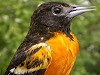
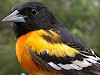
male Baltimore Orioles have a solid black back and head, and intense
orange underparts.
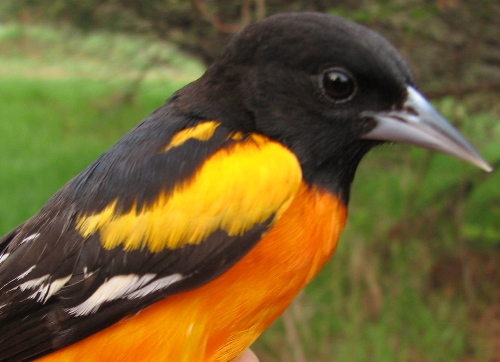
Typical ASY-M plumage.
Photo by Barbara Frei,
McGill Bird Observatory (QC), May 2008
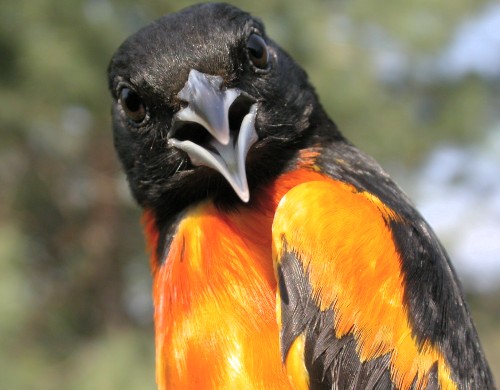
Some individuals may have less uniform coloration on the breast, like this ASY-M with
patches of reddish-orange tones.
Photo by Marcel Gahbauer,
McGill Bird Observatory (QC), May 2005
ASY
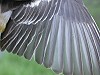
males have uniformly blackish primaries, secondaries, and coverts.
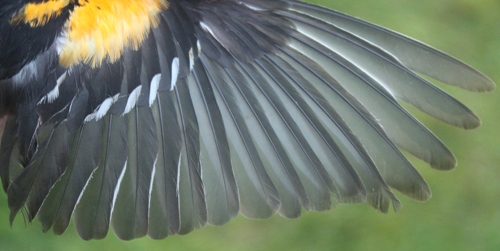
A typical ASY-M wing, fairly uniformly black, with orange lesser and median coverts and
distinct white tips to the greater coverts.
Photo by Peter Pyle, Braddock Bay Bird Observatory (NY), May 2010
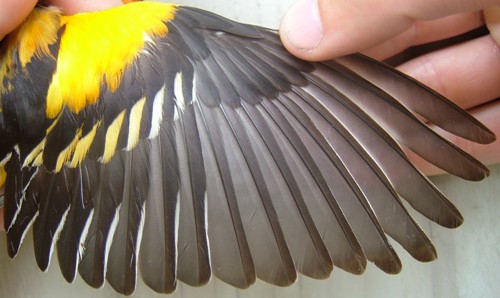
A particularly orange variant, similar to the example above except for the extent and colour
of the pale patches on the greater coverts.
Photo by Peter Pyle, MerryLea (IN), May 2005
ASY
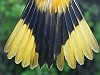
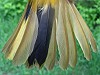
males have a distinctive tail pattern, with almost entirely black central rectrices, and yellow outer rectrices with black bases.
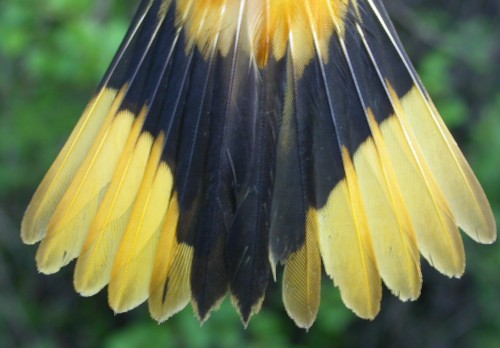
A typical ASY-M tail, showing a distinct "V" pattern of black and orange.
Photo by Marcel Gahbauer,
McGill Bird Observatory (QC), May 2006
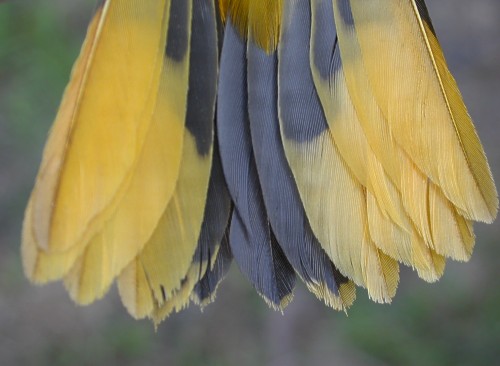
A view of the typical ASY-M pattern from the underside.
Photo by Marcel Gahbauer,
McGill Bird Observatory (QC), May 2005
RETURN TO AGE/SEX
OVERVIEW
|
JAN - JUL: after-second-year
female |
ASY
female Baltimore Orioles may be confused with SY males. Key
differences are on the head, back, and wings. The head of ASY females may range from largely yellow to dark brown, whereas on SY males they are dark brown to black. In addition to variability in head colour, the darkness of the breast may vary considerably among ASY females, as illustrated by the examples below.
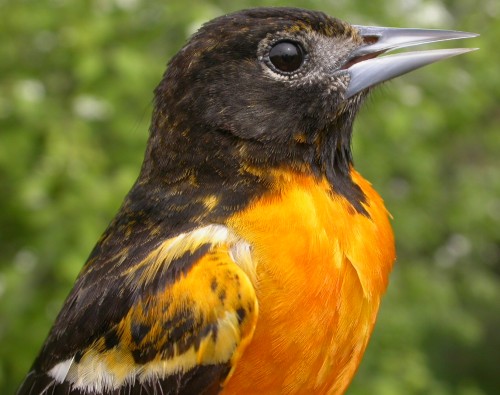
A particularly dark female, known to be at least in her sixth year at the time of this photo;
from this view alone, it could easily be confused with a pale SY male.
Photo by Marcel Gahbauer,
McGill Bird Observatory (QC), May 2006
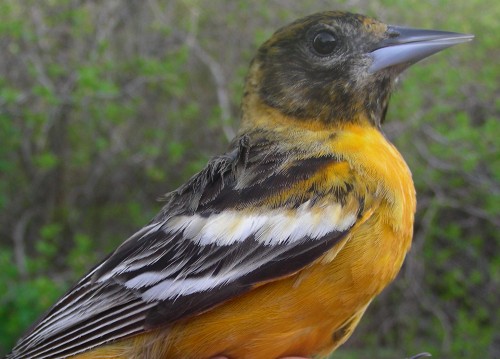
An intermediate (and more typical) ASY-F plumage, featuring a dark head mottled with
flecks of yellow, an orange-yellow breast, and a grayish-brown back.
Photo by Marie-Anne Hudson,
McGill Bird Observatory (QC), May 2007
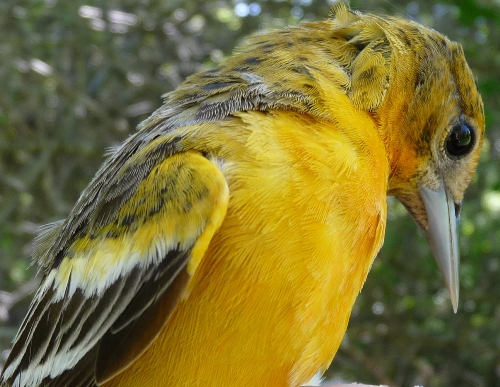
An unusually pale ASY-F, with minimal dark plumage on the head.
Photo by Marcel Gahbauer,
McGill Bird Observatory (QC), May 2010
ASY
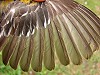
females generally have uniformly dark brown adult primaries, secondaries, and coverts.
However, there may appear to be a pseudolimit (compare these with SY-F examples), and there can be considerable variation in the overall quality and appearance of the wing, as illustrated by the examples below.
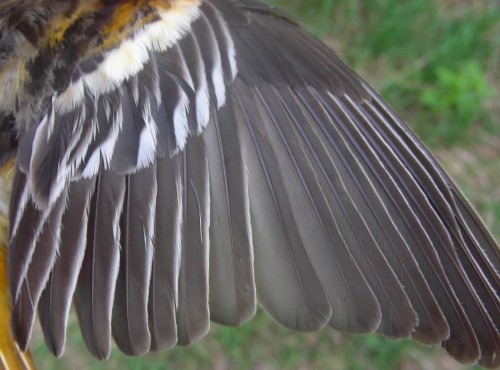
This is a "nice-looking" example, with wing feathers generally in good condition, with only a
bit of frayinge vident on the tertials, and a slight contrast between the greater coverts and the
tertials, but an overall relatively uniform dark appearance to the wing.
Photo by Marie-Anne Hudson,
McGill Bird Observatory (QC), May 2007
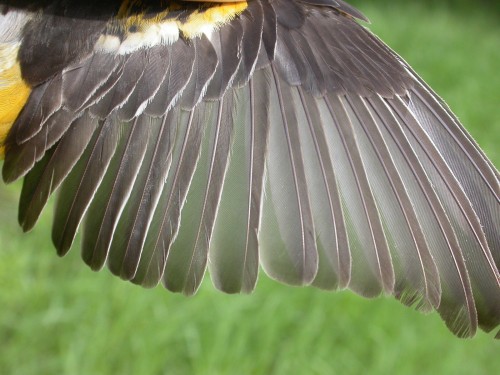
This photo illustrates a slightly paler wing, differing especially in terms of the amount of white
on the greater coverts.
Photo by Marcel Gahbauer,
McGill Bird Observatory (QC), May 2006
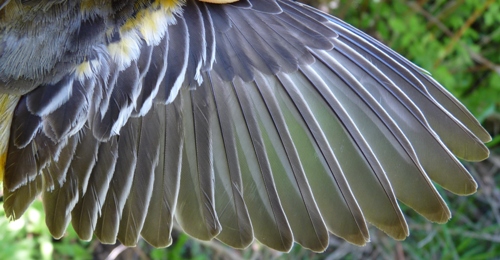
In this case the contrast between the greater coverts and inner secondaries is greater, but
there is still no distinct molt limit as evident on SY birds (this is a TY-F, having been banded
the previous spring as a SY-F).
Photo by Marcel Gahbauer,
McGill Bird Observatory (QC), May 2010
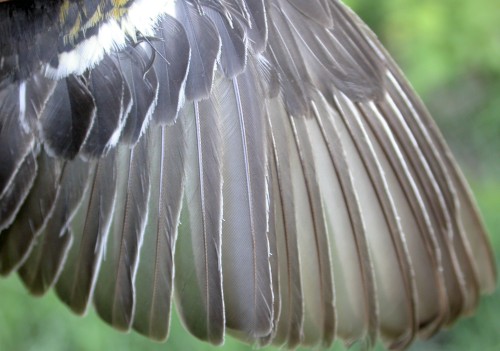
This is a particularly unusual example, with a rather worn-looking wing overall, and an apparent
contrast between the primaries and secondaries. However, it is also known to be an ASY-F, as
it was banded three years earlier.
Photo by Marcel Gahbauer,
McGill Bird Observatory (QC), May 2005
ASY
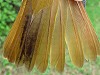
females have tail feathers that are variably dull orange to dark brown,
but not black; they are somewhat broader and more rounded than the rectrices of SY orioles.
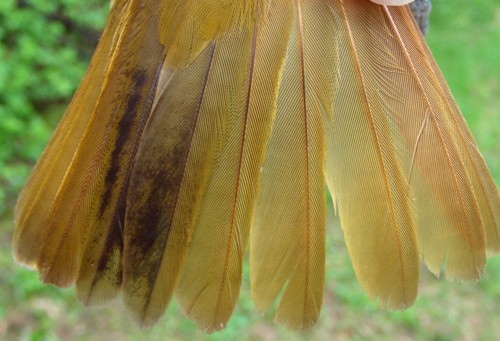
A relatively typical AHY-F tail, showing the broad and rounded shape of the rectrices, the
generally golden-brown tone of the tail, and patches of black concentrated toward the
central rectrices.
Photo by Marie-Anne Hudson,
McGill Bird Observatory (QC), May 2008
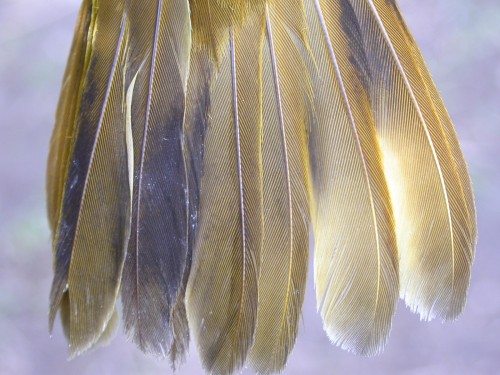
An older female (at least in her fifth year), showing a bit of paler yellow and black in the
outer rectrices.
Photo by Marcel Gahbauer,
McGill Bird Observatory (QC), May 2005
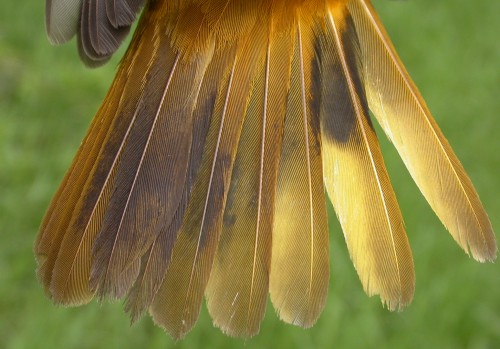
The same bird as above, one year later, with an even more pronounced pattern of yellow
and black on r5 in particular, beginning to approach the pattern typical of AHY-M.
Photo by Marcel Gahbauer,
McGill Bird Observatory (QC), May 2006
RETURN TO AGE/SEX
OVERVIEW
|
JAN - JUL: second-year
male |
SY
male Baltimore Orioles are largely black on the head and back, but usually
there is some orange/brown spotting within one or both areas. When
perched, brown juvenile feathers on the wing may contrast visibly with the
newly replaced black adult feathers.
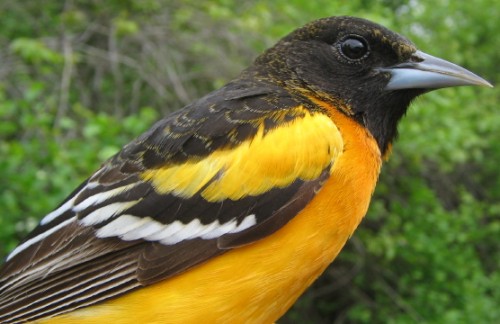
A typical SY-M, with a largely black head flecked with yellow tips to some feathers, and a
distinct contrast visible between the black greater coverts and tertials vs. rest of the wing.
Photo by Marie-Anne Hudson,
McGill Bird Observatory (QC), May 2006
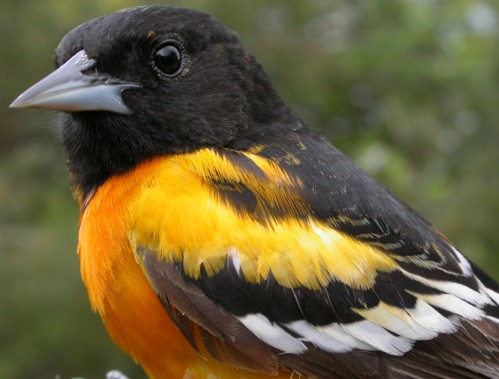
Another typical SY-M, again showing the contrast between fresh black alternate greater
coverts and retained juvenile feathers on the rest of the wing, but with a more solid black head.
Photo by Marcel Gahbauer,
McGill Bird Observatory (QC), May 2005
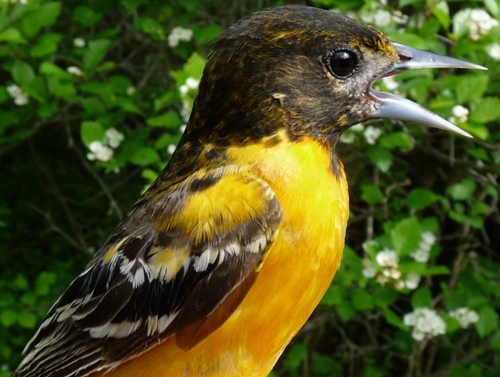
An example of a paler SY-M, with less black on the head and less orange on the breast, and
quite similar to the dark extreme of ASY-F, but note the molt limit among the greater coverts.
Photo by Marcel Gahbauer,
McGill Bird Observatory (QC), May 2010
SY
Baltimore Orioles typically show conspicuous molt limits on the wings,
most commonly within the greater coverts and/or between the primary coverts and greater coverts. The new black feathers
with distinct white edges contrast sharply with the uniformly brown
juvenile feathers that they replace.
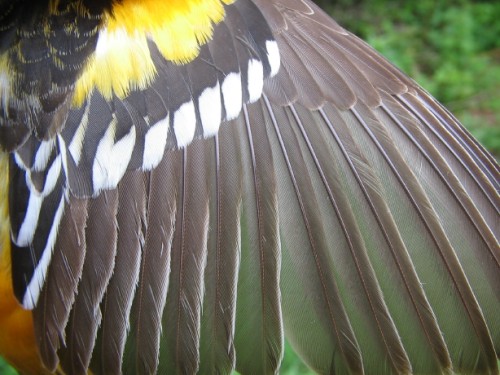
An example of particularly extensive prealternate molt, with all greater coverts and two tertials
replaced, as well as a full set of orange alternate median coverts.
Photo by Marie-Anne Hudson,
McGill Bird Observatory (QC), May 2006
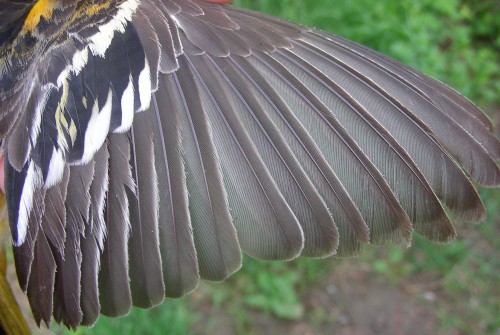
An intermediate example, with just over half of the greater coverts and just one tertial replaced
during the
prealternate molt, but no alternate feathers among the median coverts.
Photo by Marie-Anne Hudson,
McGill Bird Observatory (QC), May 2007
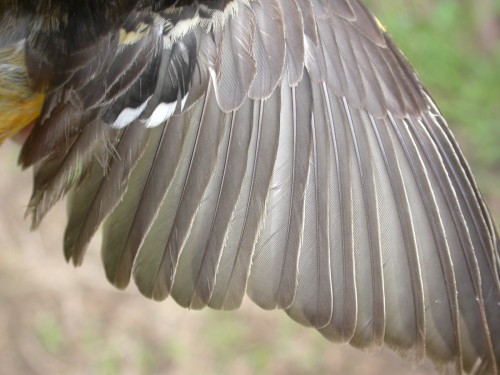
An unusually limited prealternate molt, with only two greater coverts replaced.
Photo by Marcel Gahbauer,
McGill Bird Observatory (QC), May 2005
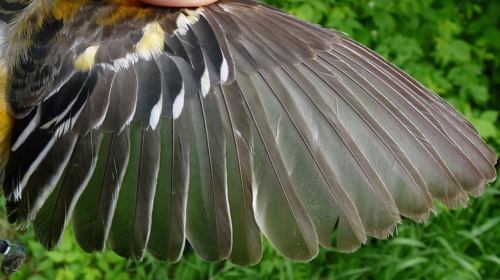
An odd pattern, with two central greater coverts skipped during the prealternate molt and
only a couple of randomly placed yellow alternate median coverts.
Photo by Marcel Gahbauer,
McGill Bird Observatory (QC), May 2010
The tail of SY males can be highly variable, as illustrated by the photos below (see captions for additional comments). While the specific patterns vary, any mixture of brownish-roange and black rectrices is in most cases indicative of an SY male.
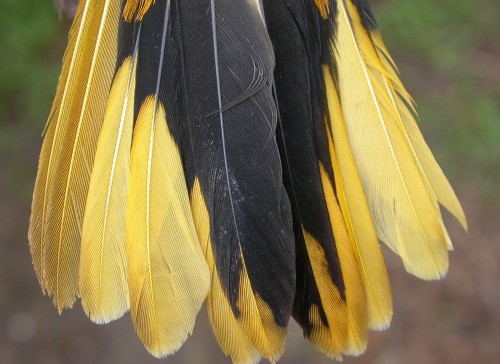
A particularly extensive prealternate molt, having replaced all rectrices except r5 and r6 on
the left side (and providing a nice illustration of contrast in shape, colour, and quality). This is
the same bird shown above, with the almost entirely black head.
Photo by Marcel Gahbauer,
McGill Bird Observatory (QC), May 2005
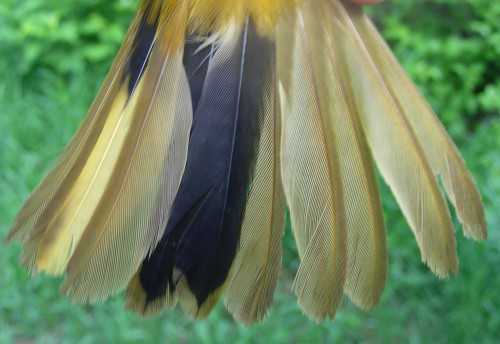
A much more limited molt, with only the central rectrices and r3 on the left side replaced.
Photo by Marie-Anne Hudson,
McGill Bird Observatory (QC), May 2007
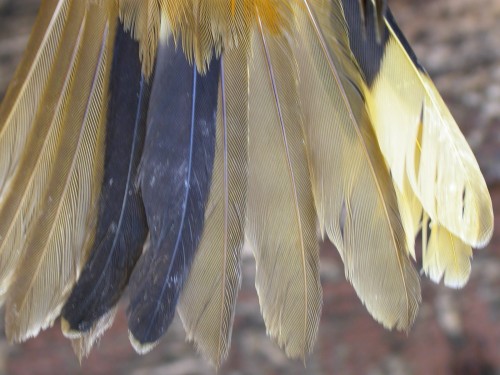
Another limited molt, in this case the central rectrices plus r5 and r6 on the right side (the
sequence of rectrix replacement on Baltimore Orioles appears to be quite variable).
Photo by Marcel Gahbauer,
McGill Bird Observatory (QC), May 2005
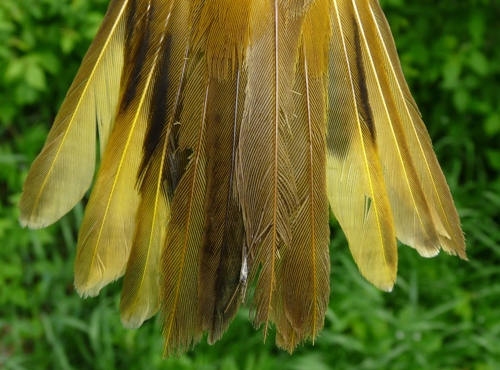
An even more odd pattern, with the central rectrices retained and very worn, but r4-r on the
left and r4-r5 on the right replaced during the prealternate molt (this is the same bird
with the irregular wing molt pattern).
Photo by Marcel Gahbauer,
McGill Bird Observatory (QC), May 2010
RETURN TO AGE/SEX
OVERVIEW
|
JAN - JUL: second-year
female |
SY
female Baltimore Orioles can usually be separated from other ages and sexes by
having a largely yellow head with minimal black spotting, and a dull
golden-brown back, though some are darker. Often conspicuous molt
limits on the wing can also be seen while the bird is perched.
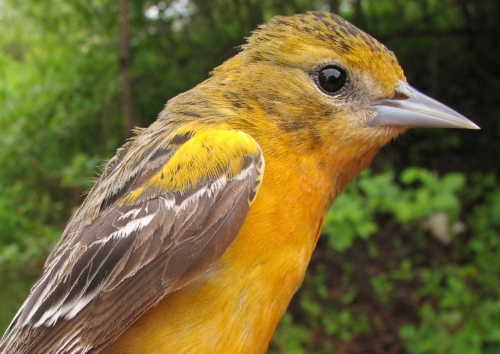
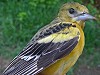
A relatively typical SY-F, although perhaps a bit more orange than average. Note the limited
dark plumage on the head, and the readily apparent molt limit on the wing.
Photo by Barbara Frei,
McGill Bird Observatory (QC), May 2008
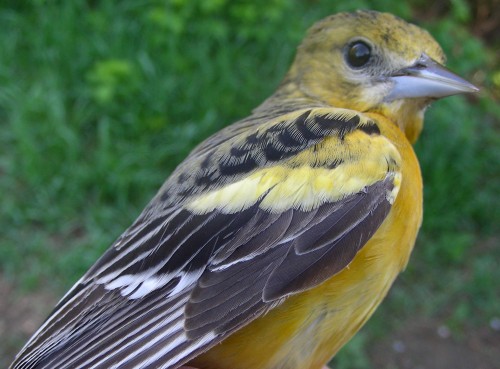
A more typical yellow below, but with a more extensive prealternate molt than the previous
bird, making the molt limit less apparent (in this case all greater coverts have been replaced).
Photo by Marie-Anne Hudson,
McGill Bird Observatory (QC), May 2007
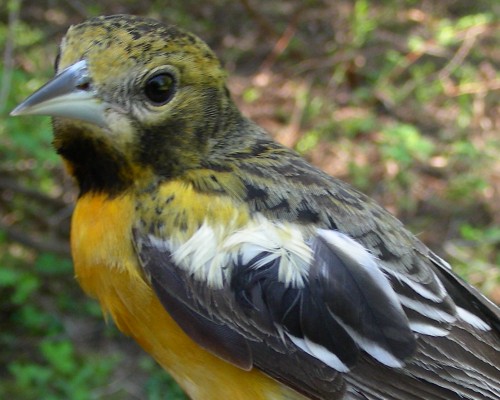
An unusually dark SY-F, already acquiring a fair amount of dark plumage on the head, but
overall still far paler (and also smaller) than a male.
Photo by Marie-Anne Hudson,
McGill Bird Observatory (QC), May 2008
SY
Baltimore Orioles typically show conspicuous molt limits on the wings,
most commonly within the greater coverts.
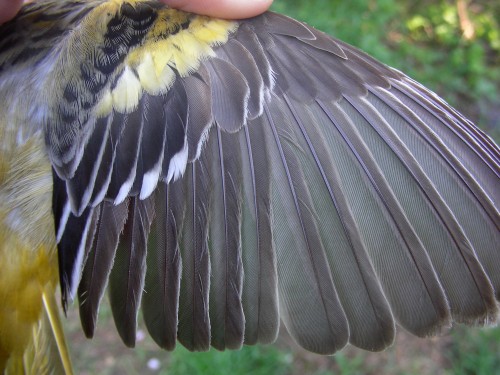
A relatively extensive prealternate molt, with over half of greater coverts replaced, as well as
two tertials, and all of the lesser and median coverts.
Photo by Marie-Anne Hudson,
McGill Bird Observatory (QC), May 2007
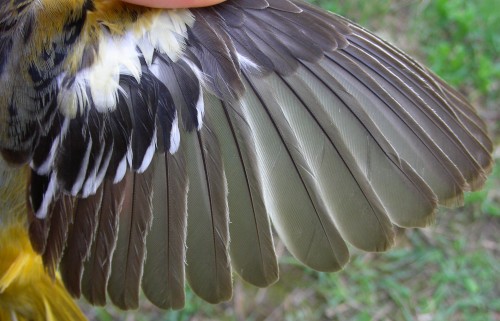
A similar pattern of replacement to the previous bird, but with the contrast even more
apparent because the secondaries are more faded and worn.
Photo by Marie-Anne Hudson,
McGill Bird Observatory (QC), May 2008
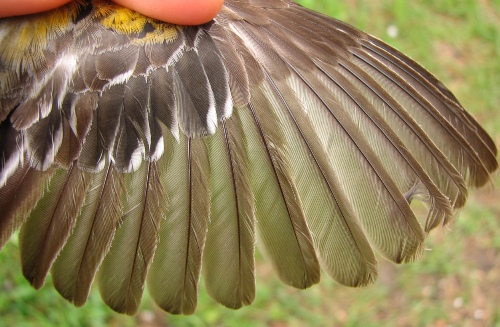
A much more limited molt, with only one tertial, some lesser coverts, and some greater
coverts (in an irregular pattern) replaced, and overall a quite worn appearance.
Photo by Barbara Frei,
McGill Bird Observatory (QC), May 2008
Female
Baltimore Orioles generally have yellow to brown tail feathers, with some
nearly black in parts on certain individuals. In SY females,
the outermost rectrices in particular tend to be tapered and abraded, and the tips may be quite frayed by spring.
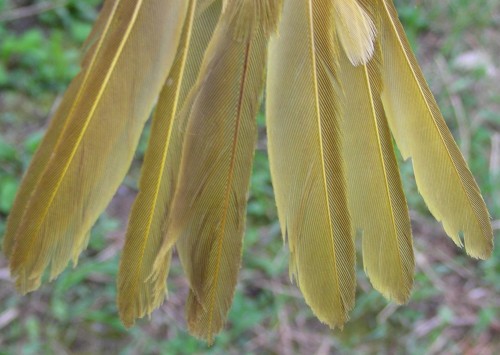
A SY-F tail without any rectrices replaced, and therefore very similar to what is seen on HY
birds, though a bit more worn.
Photo by Marie-Anne Hudson,
McGill Bird Observatory (QC), May 2008
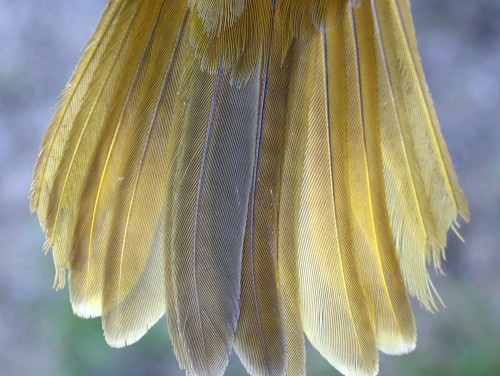
A more typical SY-F tail, with r1-r4 on both sides replaced with golden to brown rectrices,
contrasting sharply with the retained juvenile rectrices (r5-r6 on both sides), which in this case
have all broken at the tips and are very frayed along the edges.
Photo by Marcel Gahbauer,
McGill Bird Observatory (QC), May 2005
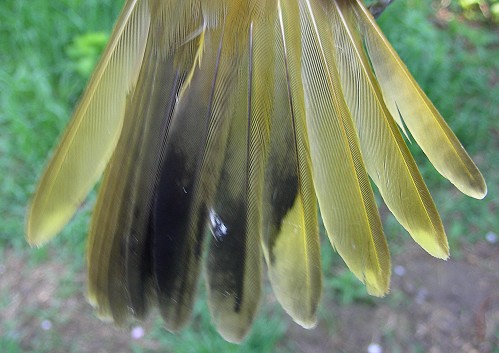
An example of a relatively uncommon case where it appears that all rectrices were replaced
during the prealternate molt, and there is a considerable amount of black on some of them. In
this
case, the tail is not helpful for ageing, and the wing is the only reliable feature to use (this
bird corresponds to the first one shown in the wing section, featuring a distinct molt limit).
Photo by Marie-Anne Hudson,
McGill Bird Observatory (QC), May 2007
RETURN TO AGE/SEX
OVERVIEW
|
JUL - DEC: after-hatch-year
male |
AHY male Baltimore Orioles
are easily recognizable, characterized by a solid blackish head and bold
orange underparts, without any distinctly brown plumage.
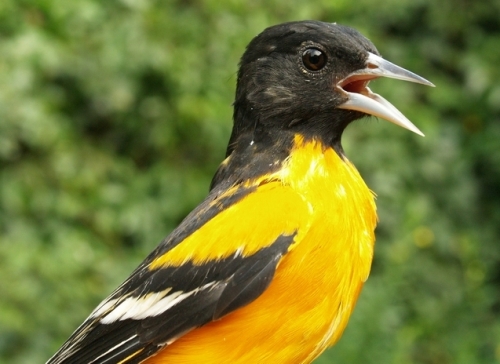
A relatively typical AHY-M
Photo by Simon Duval,
McGill Bird Observatory (QC), August 2010
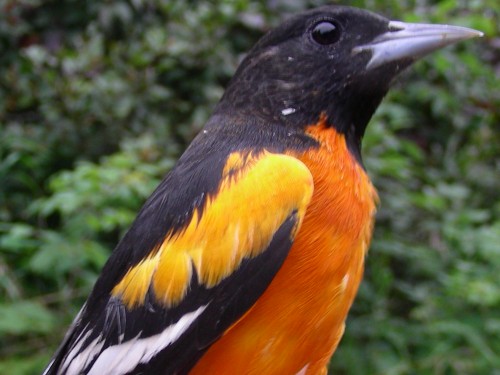
An individual with a somewhat darker orange breast
Photo by Marcel Gahbauer,
McGill Bird Observatory (QC), August 2007
The wing of AHY males is black with some white
edging, entirely lacking brown feathers.
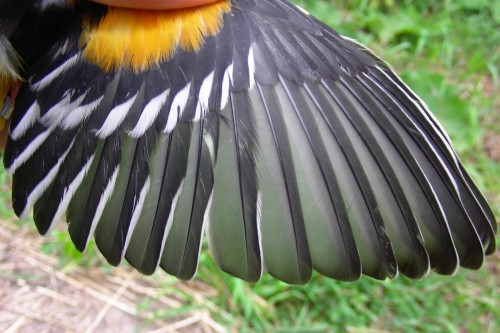
Typical AHY-M wing following completion of the prebasic molt.
Photo by Marcel Gahbauer,
McGill Bird Observatory (QC), August 2007
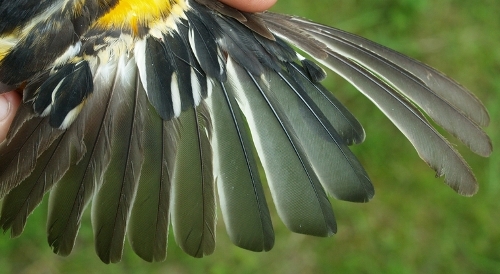
An example of a SY-M in the relatively early stages of prebasic molt, showing a distinct
contrast between the new primaries and the juvenile secondaries and outer primaries.
Photo by Simon Duval,
McGill Bird Observatory (QC), July 2010
The tail
of AHY males is black and orange, with black most extensive on the central rectrices.
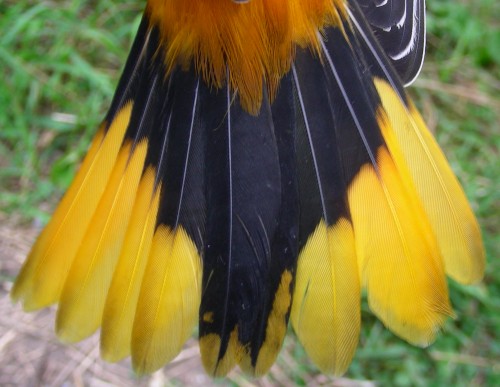
A fairly typical AHY-M tail pattern.
Photo by Marcel Gahbauer,
McGill Bird Observatory (QC), August 2007
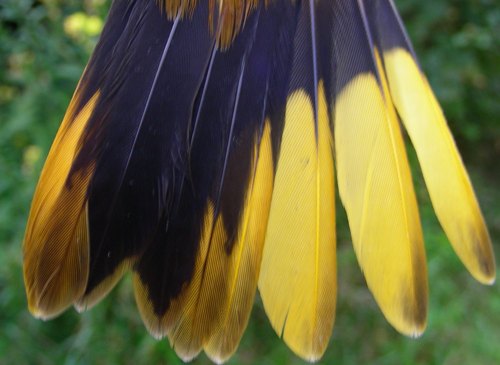
A variant pattern, with somewhat larger dusky patches near the tips of many rectrices.
Photo by Marcel Gahbauer,
McGill Bird Observatory (QC), August 2008
RETURN TO AGE/SEX
OVERVIEW
|
JUL - DEC: after-hatch-year
female |
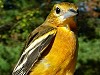
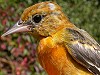
After-hatch-year females are similar to hatch-year Baltimore Orioles with respect to having an orange-brown head, and are most easily
separated by looking closely at the wing and tail.
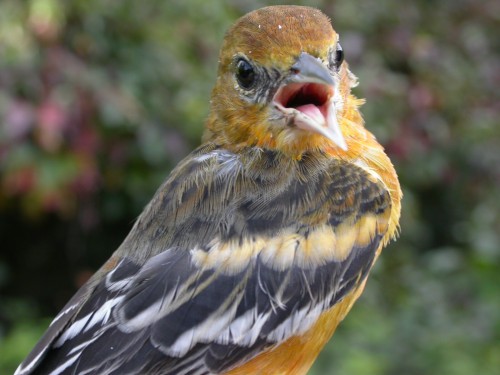
Photo by Marcel Gahbauer,
McGill Bird Observatory (QC), August 2005
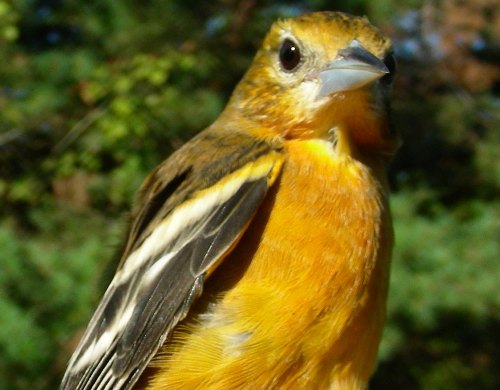
Photo by Marcel Gahbauer,
McGill Bird Observatory (QC), September 2008
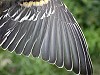
After-hatch-year females have a uniformly blackish tone to the wing, considerably darker than most hatch-year individuals, and lacking
visible molt limits.
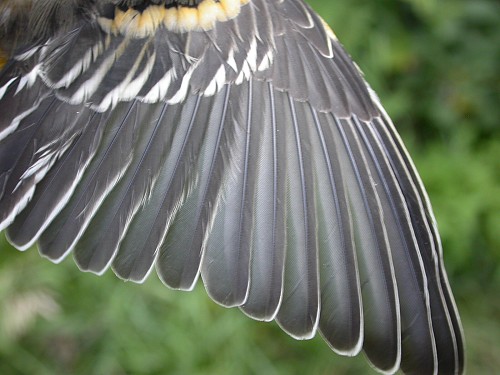
Photo by Marcel Gahbauer,
McGill Bird Observatory (QC), August 2005
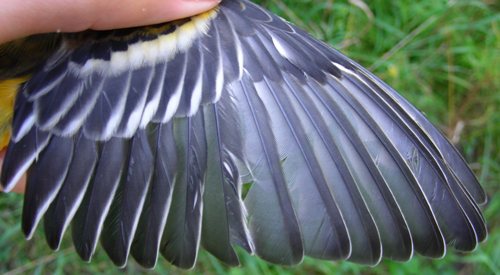
Photo by Marcel Gahbauer,
McGill Bird Observatory (QC), September 2008
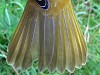
The tail can be useful for separating AHY females from HY individuals, as adults tend to have broader and more rounded rectrices,
as in the photo below.
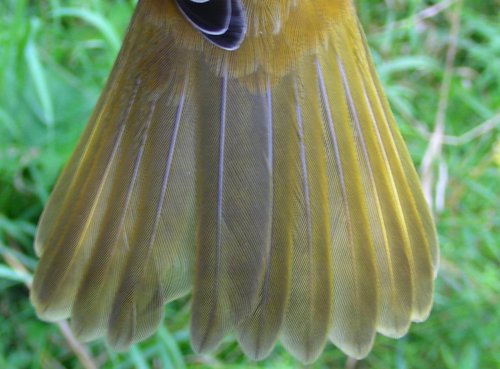
Photo by Marcel Gahbauer,
McGill Bird Observatory (QC), September 2008
|
JUL - DEC: hatch-year
male |
HY male Baltimore Orioles
can usually be aged easily by their tails, and can often be distinguished from
females by their brighter orange plumage on the head and breast, but this can be quite variable and wing
chord should be used to confirm sex (males >91 mm, females <91 mm).
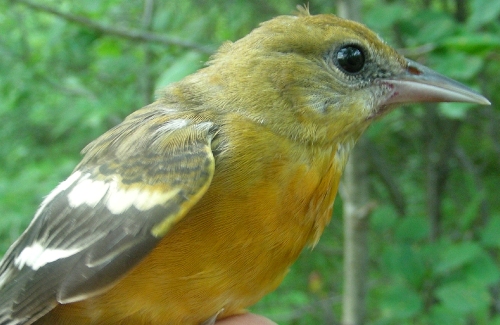
A relatively typical HY-M, showing a bit darker yellow on the breast than an average HY-F,
and
not as dull gray on the back. However, this is well within the range of variation of females,
and wing chord would be required to be confident in this being a male.
Photo by Simon Duval,
McGill Bird Observatory (QC), July 2009
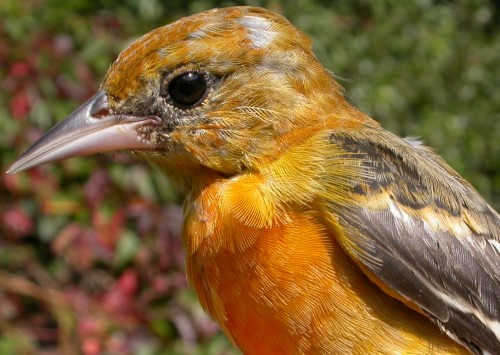
A particularly orange HY-M, but note the contrast between the replaced blackish lesser and
median coverts compared to the much paler brown greater coverts.
Photo by Marcel Gahbauer,
McGill Bird Observatory (QC), August 2005
The wing of HY males is dusky with some white edging,
and may on average be slightly darker than that of HY females, but not
enough so to be reliable.
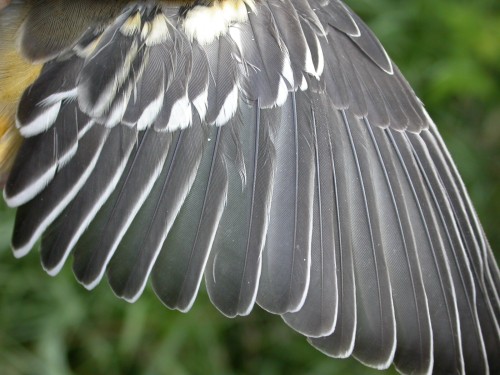
Photo by Marcel Gahbauer,
McGill Bird Observatory (QC), August 2005
The tail
of HY Baltimore Orioles of both sexes is dull brown with some orange
or yellow tinges, and with narrow and very tapered feathers.
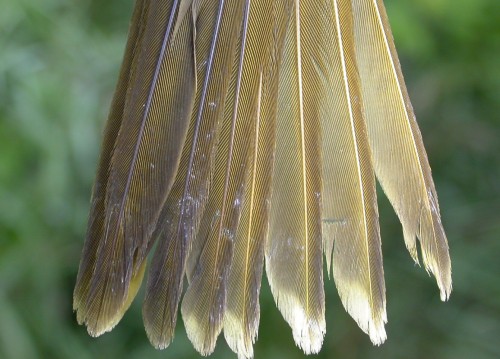
Photo by Marcel Gahbauer,
McGill Bird Observatory (QC), August 2005
RETURN TO AGE/SEX
OVERVIEW
|
JUL - DEC: hatch-year
female |
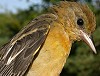
HY female Baltimore Orioles
are paler than all other age/sex classes, often with a grayish tinge to
the head and/or back. However, there can be considerable overlap in the
appearance of HY males and females; checking wing chord (females <91 mm,
males >91 mm) is advisable, especially since diet may influence plumage colour.
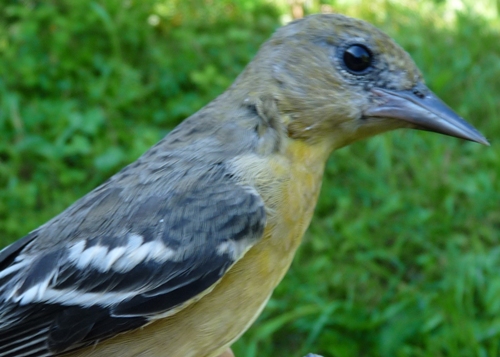
A fairly typical HY-F, pale yellow below and grayish above.
Photo by Marcel Gahbauer,
McGill Bird Observatory (QC), August 2009
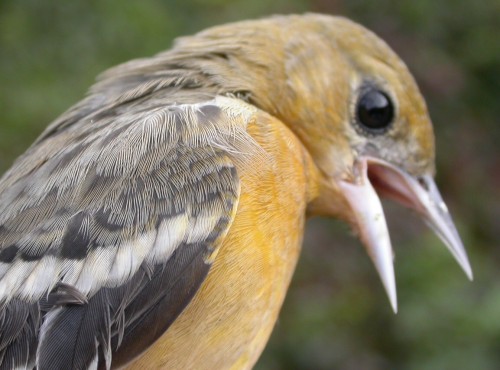
This individual has a touch more orange on the breast, but is still largely gray on the back.
Photo by Marcel Gahbauer,
McGill Bird Observatory (QC), August 2005
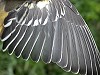
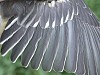
The wing of HY females is generally a dull dusky
colour with white edging on some feathers, and is rarely distinguishable
from that of HY males.
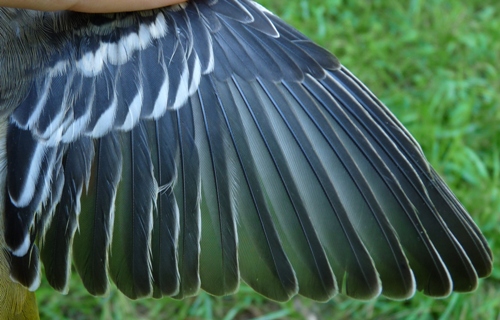
This wing is unusually dark for a HY-F, but the wing chord was short (88 mm) and the overall
appearance was pale.
Photo by Marcel Gahbauer,
McGill Bird Observatory (QC), August 2009
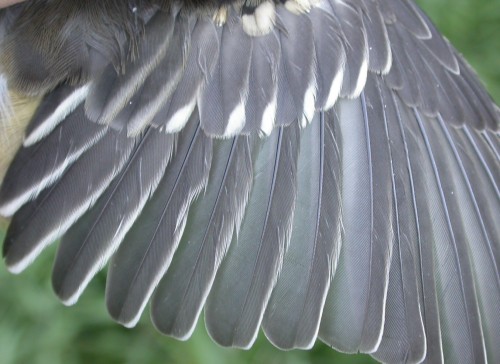
This wing shows the more typical colour for a HY-F; note the contrast between the greater
coverts and the much dark replaced median covert above.
Photo by Marcel Gahbauer,
McGill Bird Observatory (QC), August 2005
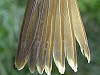
The tail
of HY females is usually comprised of narrow and tapered feathers, dull
brown with some orange tinges.
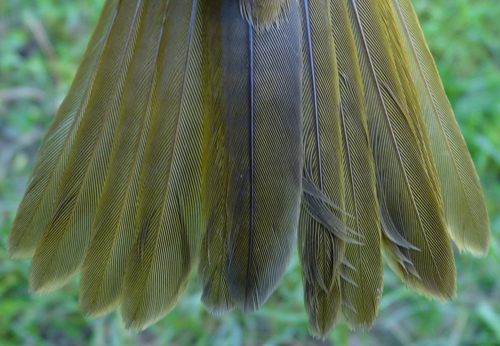
In some cases, the tail is entirely golden-brown, without any traces of yellow (this photo is of
the same bird with the unusually dark wing).
Photo by Marcel Gahbauer,
McGill Bird Observatory (QC), August 2009
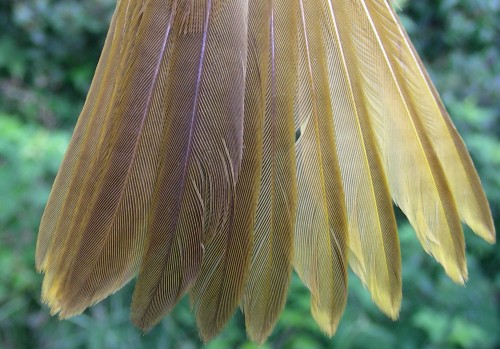
More commonly, at least the outer rectrices have some yellow; note that in this example
the feathers are more tapered than in the previous one.
Photo by Marie-Anne Hudson,
McGill Bird Observatory (QC), August 2007
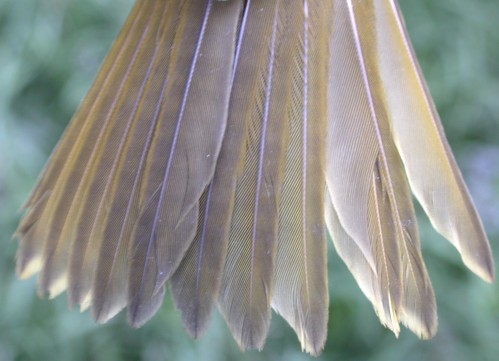
A third example, somewhat intermediate with respect to colour, but with even more markedly
tapered rectrices, and with growth bars showing across most of the tail.
Photo by Marcel Gahbauer,
McGill Bird Observatory (QC), August 2005
RETURN TO AGE/SEX
OVERVIEW
|