|
|
McGILL BIRD OBSERVATORY |
||||||||||||||||||||||||||||||
NOTE: This species account has been moved to Piranga to allow for improved comparison among examples.
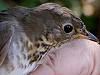
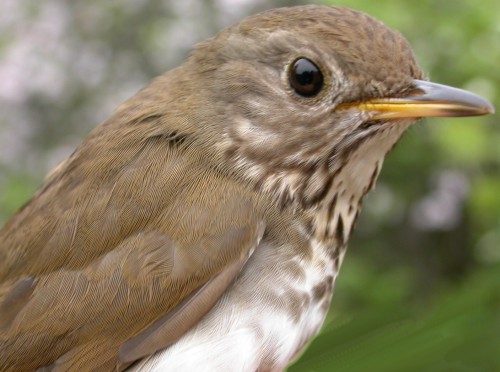
Ageing and sexing details: Bicknell's Thrushes vary little by age in terms of overall appearance, and sex can be determined only be checking for a brood patch or cloacal protuberance.
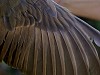
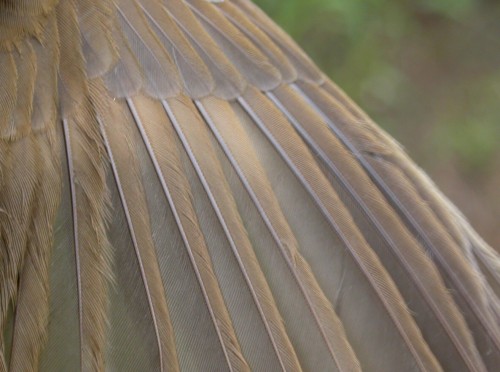
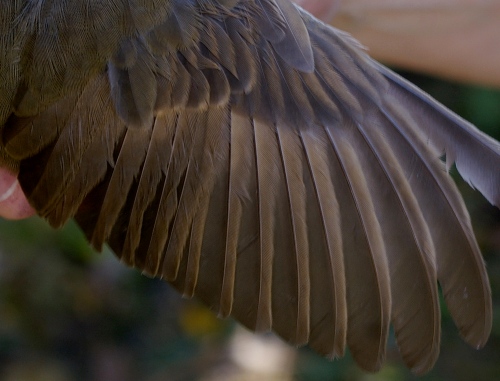
ASY Bicknell's Thrushes have a uniformly brown wing, without pale tips on any greater coverts. The outermost primary is narrow and 4-10 mm shorter than the adjacent primary coverts.
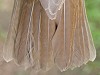
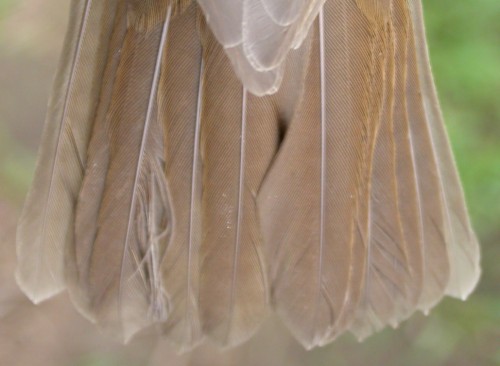
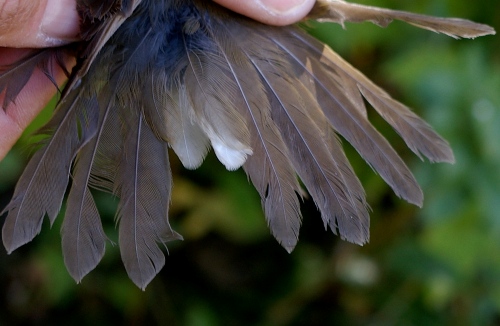
ASY Bicknell's Thrushes have relatively broad rectrices.
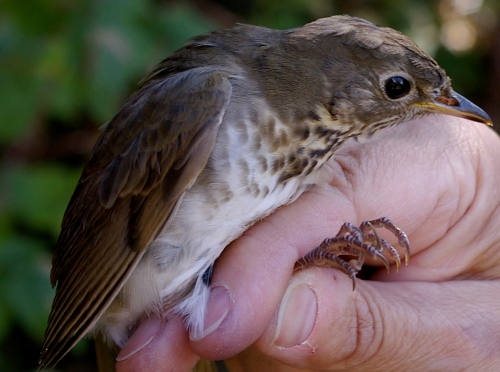
Overall plumage is rarely helpful in ageing Bicknell's Thrushes, but in some cases SY individuals have readily visible pale tips to their retained juvenile greater coverts, which are a diagnostic feature.
SY Bicknell's Thrushes retain at least half of their juvenile greater coverts, which usually have a pale tip or shaft streak. Also, p10 is broader and more rounded than on ASY birds, and although usually also shorter than the primary coverts, the difference in length is usually smaller (0-6 mm).
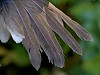
SY Bicknell's Thrushes have relatively narrow rectrices, that often show show somewhat more wear in spring than those of ASY birds.
Overall appearance usually cannot be used to identify AHY Bicknell's Thrushes, since the pale tips to the greater coverts that may be used to distinguish HY individuals are not always readily visible.
AHY Bicknell's Thrushes have uniformly brown wings, without pale tips or shaft streaks on any of the greater coverts. Additionally, p10 is narrow, pointed, and substantially shorter (by 4-10 mm) than the primary coverts.
AHY Bicknell's Thrushes have broad rectrices with relatively blunt tips, although there can be a slight point right at the end of the shaft.
Overall plumage is rarely helpful in ageing Bicknell's Thrushes, but with a good view of the wing of a perched individual, it may be a possible to spot the pale tips to their retained juvenile greater coverts, which are a diagnostic feature.
HY Bicknell's Thrushes usually have a molt limit among the greater coverts, with up to several inner coverts replaced that are slightly darker and lack any pale markings, contrasting with the retained outer juvenile greater coverts that have pale tips or shaft streaks. Additionally, p10 is relatively broad, rounded, and only slightly shorter (by 0-6 mm) than the adjacent primary coverts..
HY Bicknell's Thrushes have narrow and relatively pointed rectrices.
|