Ageing and sexing details:
|
JAN - JUL: after-second-year
male |
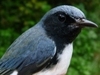
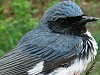
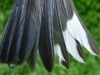
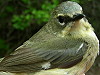
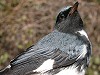
ASY males can be easily recognized by their uniformly blue and black upperparts and the very large white patch on the primaries.
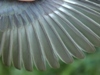
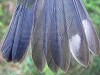
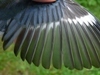
ASY males have blackish wings with blue edging and an extensive bold white patch on the primaries.
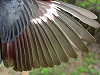
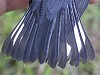
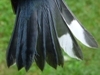
ASY males have blackish rectrices that are relatively broad and rounded, with blue edging.
RETURN TO AGE/SEX
OVERVIEW
|
JAN - JUL: after-second-year
female |
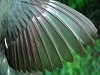
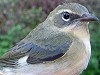
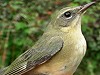
Female Black-throated Blue Warblers are readily separated from males by overall plumage; ASY females generally can be told apart from SY females by having a larger white patch on the primaries, but whenever possible, wing and tail should be consulted to verify age.
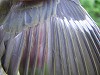
On ASY females, the primary coverts are similar in colour and wear to the greater coverts, and have some greenish edging, while the white patch on the primaries is distinct and moderately extensive.
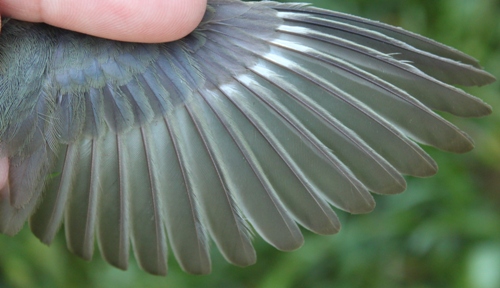
Photo by Peter Pyle,
Braddock Bay Bird Observatory (NY), May 2010
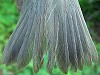
ASY females have bluish-green rectrices that are relatively broad, and may have some white on the outermost two feathers.
RETURN TO AGE/SEX
OVERVIEW
|
JAN - JUL: second-year
male |
SY males can usually be quickly recognized by patches of green or brown plumage amid the otherwise blue and black upperparts.
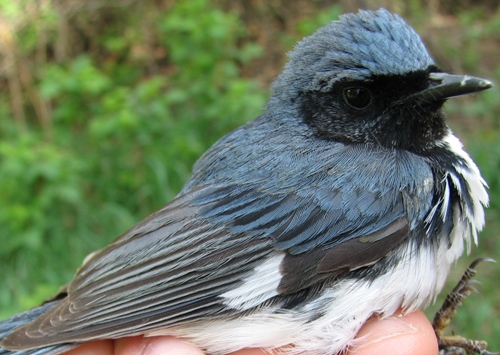
A typical SY male, with the brownish primary coverts contrasting with the blue and black back.
Photo by Barbara Frei,
McGill Bird Observatory (QC), May 2007
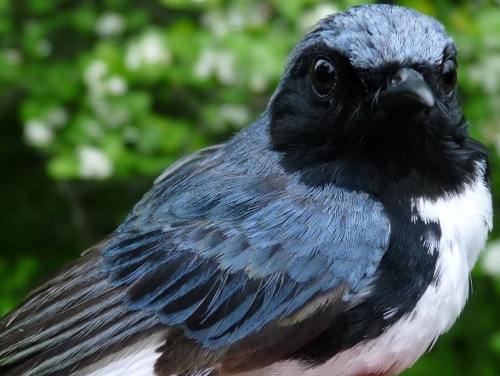
Another example highlighting the brownish primary coverts.
Photo by Marcel Gahbauer,
McGill Bird Observatory (QC), May 2010
HY males have a distinct molt limit between replaced greater coverts and retained juvenile primary coverts.
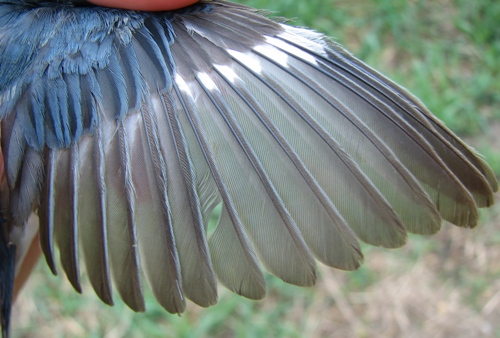
A typical SY male wing, with blue-edged greater coverts contrasting with duller primary
coverts that have minimal edging, and with an intermediate amount of white on the primaries.
Photo by Barbara Frei,
McGill Bird Observatory (QC), May 2007
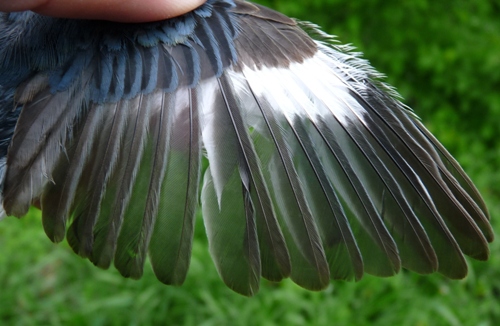
A more dramatic contrast, thanks to very faded tertials also contrasting with the replaced
greater coverts, and also an unusually large white patch for a SY male.
Photo by Marcel Gahbauer,
McGill Bird Observatory (QC), May 2010
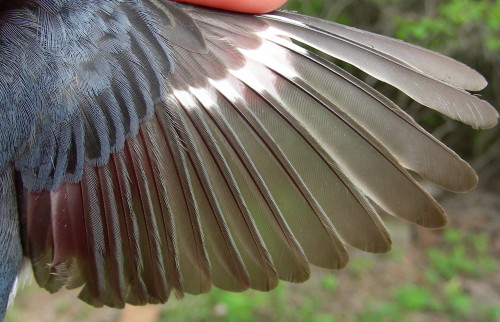
Another typical SY male, showing the contrast between the blue-edged greater coverts
and the more brownish tone of the rest of the wing.
Photo by Marie-Anne Hudson,
McGill Bird Observatory (QC), May 2009
SY males have relatively dark rectrices with some blue edging; the amount of white does not differ appreciably from that on after-second-year males. Outer rectrices are relatively narrow and pointed compared to ASY males.
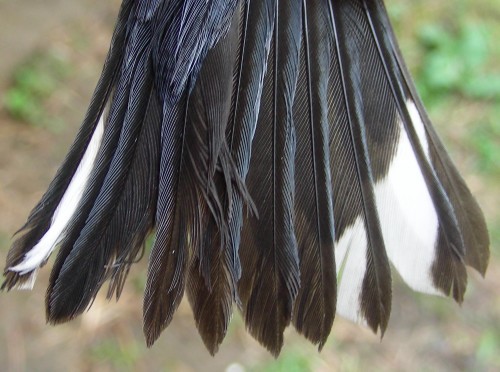
An SY male tail with blue-edged dark feathers, and a particularly pointed tip
to the outermost rectrices.
Photo by Marie-Anne Hudson,
McGill Bird Observatory (QC), May 2008
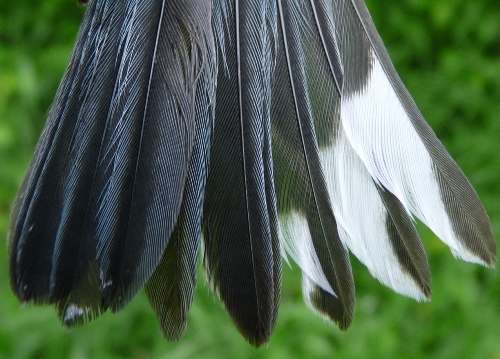
Another example, again with narrow rectrices, but somewhat less pointed.
Photo by Marcel Gahbauer,
McGill Bird Observatory (QC), May 2010
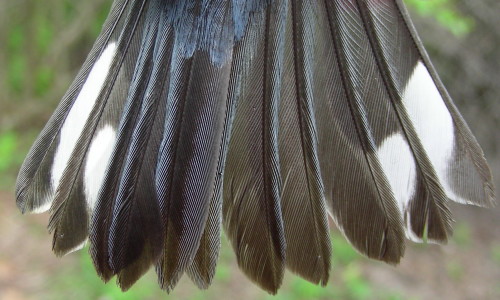
A somewhat duller/browner example.
Photo by Marie-Anne Hudson,
McGill Bird Observatory (QC), May 2009
RETURN TO AGE/SEX
OVERVIEW
|
JAN - JUL: second-year
female |
SY females are very similar to ASY females, most easily separated by examination of the wing and tail.
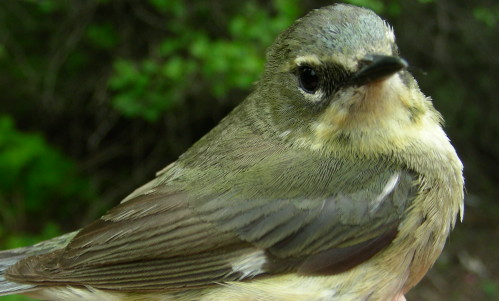
An SY female with an intermediate-sized white primary patch, requiring age to be
verified through examination of the open wing and/or tail.
Photo by Marie-Anne Hudson,
McGill Bird Observatory (QC), May 2009
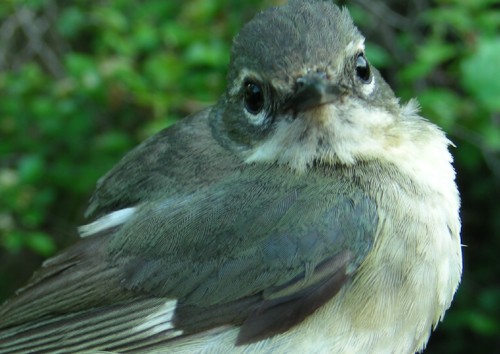
Another SY female with a somewhat intermediate white primary patch.
Photo by Marie-Anne Hudson,
McGill Bird Observatory (QC), June 2009
SY females have a subtle molt limit between the greater and primary coverts, and the white patch on the primaries is small or occasionally even absent.
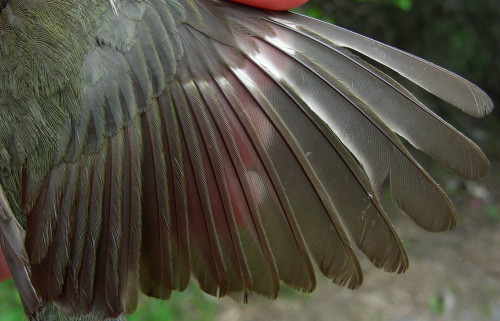
An SY wing showing a slight contrast between the green-edged greater coverts and
duller primary coverts; note also the small white patches limited to a few primaries.
Photo by Marie-Anne Hudson,
McGill Bird Observatory (QC), May 2009
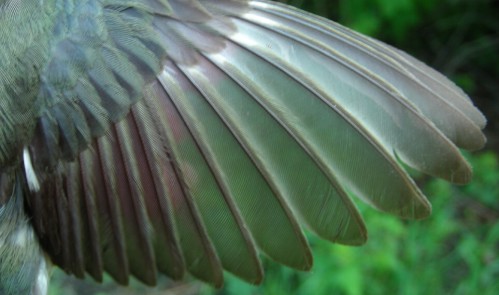
Another example, again with the molt limit subtle, and the limited extent of the white
patch representing a more readily visible ageing criterion.
Photo by Marie-Anne Hudson,
McGill Bird Observatory (QC), June 2009
SY females have dull grayish-brown rectrices with little or no bluish edging. The outer rectrices are relatively narrow and pointed.
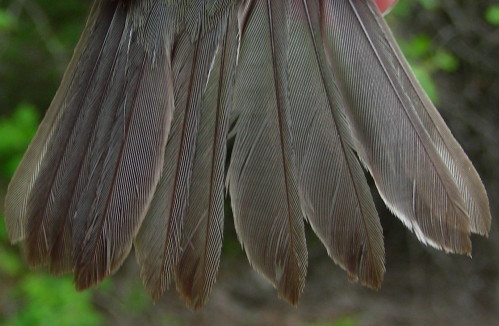
An SY tail in relatively good condition, but still distinctly narrow and pointed.
Photo by Marie-Anne Hudson,
McGill Bird Observatory (QC), May 2009
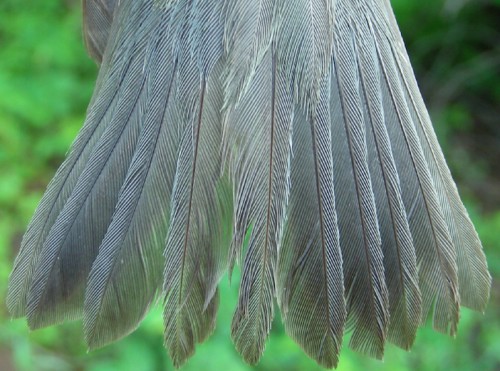
A somewhat more worn tail, especially the central rectrices. This example shows a bit more
bluish edging, but note again the narrow and pointed shape of the rectrices.
Photo by Marie-Anne Hudson,
McGill Bird Observatory (QC), June 2009
RETURN TO AGE/SEX
OVERVIEW
|
JUN - DEC: after-hatch-year
male |
AHY males can be easily recognized by their
uniformly blue and black upperparts and the very large white patch on
the primaries.
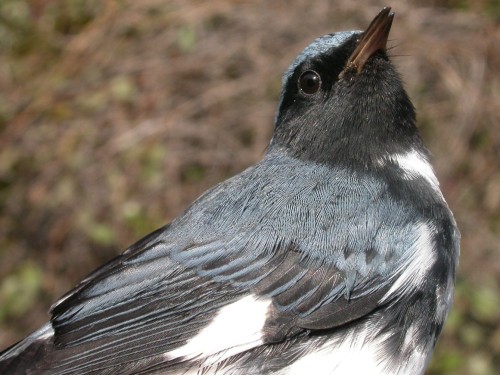
A typical AHY male, entirely blue, black, and white, lacking any trace of green and brown
typically visible on HY males.
Photo by Marcel Gahbauer,
McGill Bird Observatory (QC), September 2005
AHY males have blackish wings with blue edging and an extensive bold white patch on the primaries.
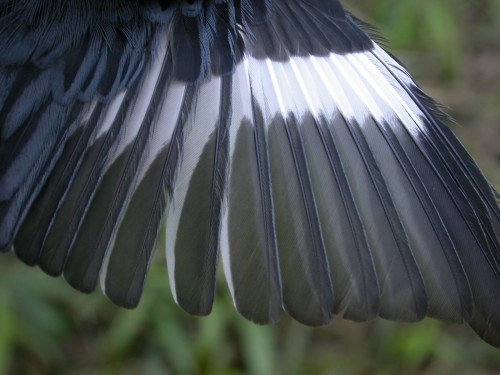
Photo by Marcel Gahbauer,
McGill Bird Observatory (QC), September 2005
AHY males have blackish rectrices that are relatively broad and rounded, with blue edging.
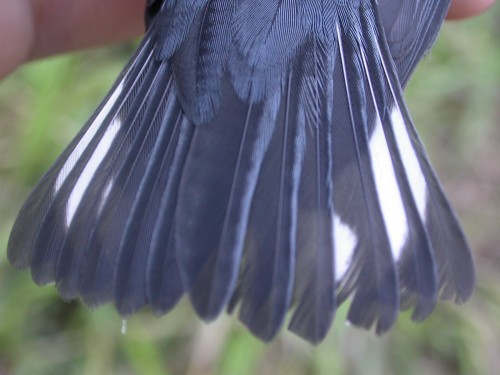
Photo by Marcel Gahbauer,
McGill Bird Observatory (QC), September 2005
RETURN TO AGE/SEX
OVERVIEW
|
JUN - DEC: after-hatch-year
female |
Female Black-throated Blue Warblers are readily separated from males by overall plumage; AHY females generally can be told apart from HY females by having a larger white patch on the primaries, but whenever possible, wing and tail should be
consulted to verify age.
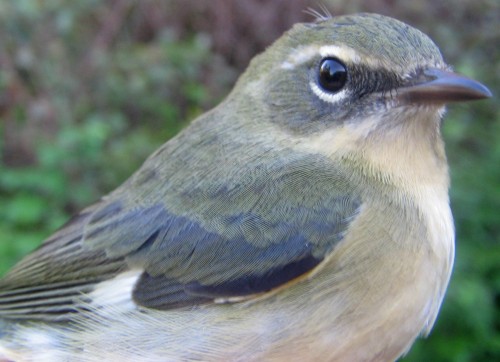
Photo by Marcel Gahbauer,
McGill Bird Observatory (QC), September 2005
On AHY females, the primary coverts are similar in colour and wear to the greater
coverts, and have some greenish edging, while the white patch on the primaries is distinct and extensive.
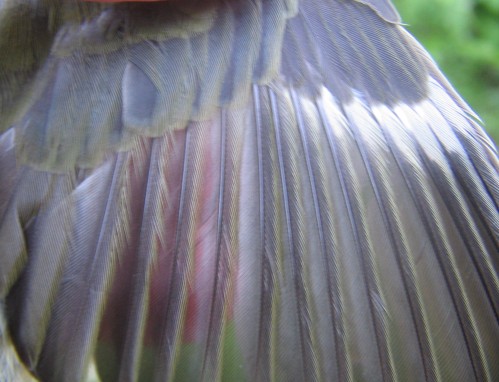
Photo by Marcel Gahbauer,
McGill Bird Observatory (QC), August 2005
AHY females have bluish-green rectrices that are relatively broad, and may have some white on the outermost two feathers.
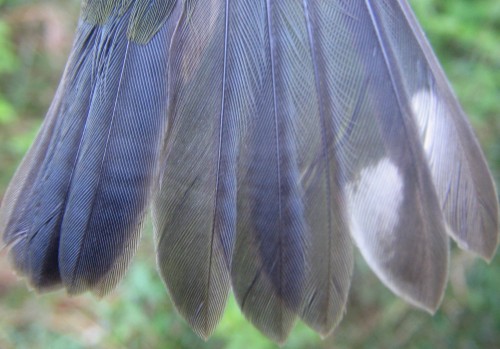
Photo by Marcel Gahbauer,
McGill Bird Observatory (QC), August 2005
RETURN TO AGE/SEX
OVERVIEW
|
JUN - DEC: hatch-year
male |
HY
males are usually easily separable from older males by having greenish or brownish feathers on the back and/or wings, contrasting with the blue and black plumage.
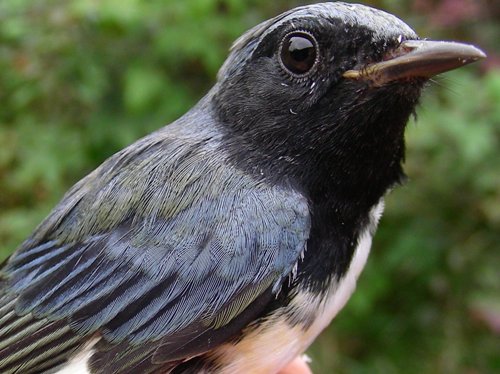
A typical HY male, with some greenish feathers on the back and also green edging to
the primary coverts.
Photo by Marcel Gahbauer,
McGill Bird Observatory (QC), September 2008
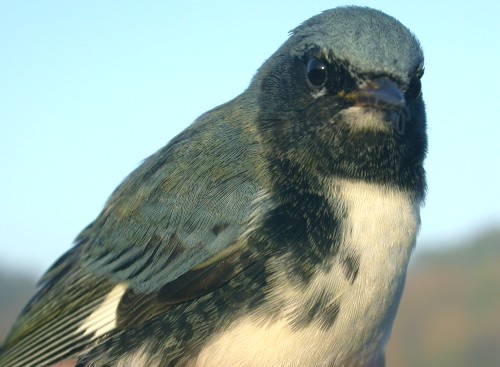
A somewhat paler individual with respect to pale mottling in the throat, but again there is
some green on the back and wing.
Photo by Marcel Gahbauer,
McGill Bird Observatory (QC), September 2004
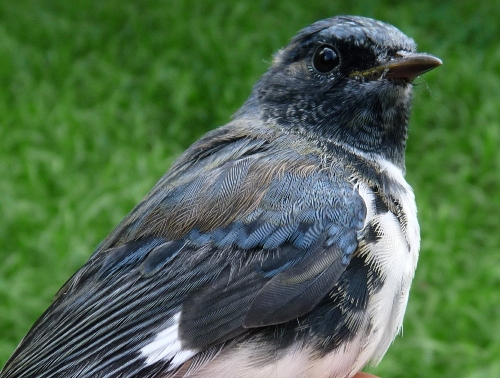
A somewhat unusual variant, with brown on the back instead of green, and a rather
mottled throat.
Photo by Marcel Gahbauer,
McGill Bird Observatory (QC), September 2009
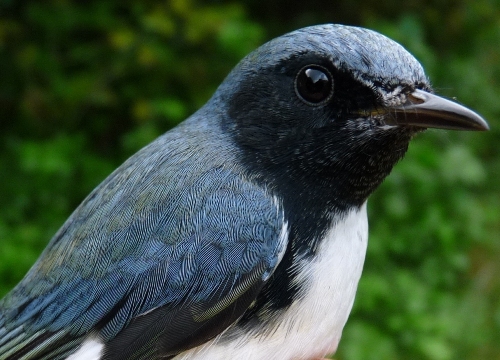
A particularly "good-looking" HY male, with only a trace of green on the back, but note
the green edging on the partly exposed alula covert.
Photo by Marcel Gahbauer,
McGill Bird Observatory (QC), August 2009
On HY males the open wing shows a distinct molt limit between the blue-edged greater coverts and the much duller primary coverts that either lack edging or have some faint greenish edging. The extent of the white patch on the primaries is also usually smaller than on AHY males.
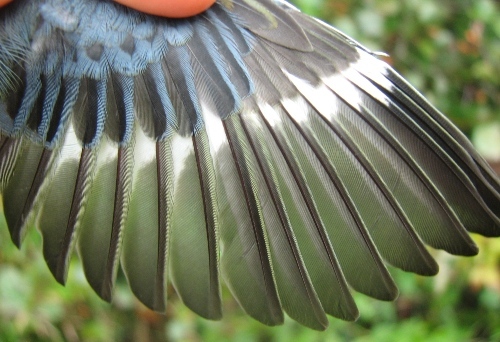
A typical HY male, with bold blue edging on the greater coverts (and median coverts)
contrasting with the duller
juvenile feathers on the rest of the wing.
Photo by Barbara Frei,
McGill Bird Observatory (QC), September 2007
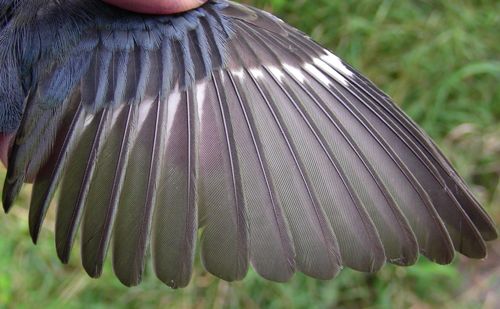
Another HY male, with a somewhat more grayish-blue tinge, but again with the greater
coverts contrasting distinctly with the primary coverts, primaries, and secondaries.
Photo by Marcel Gahbauer,
McGill Bird Observatory (QC), September 2008
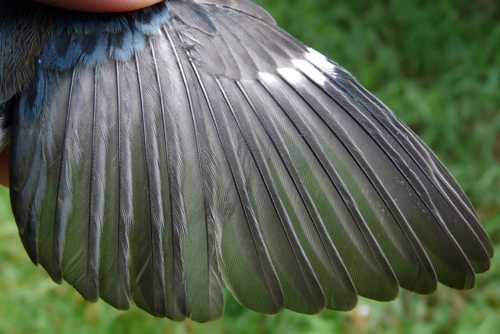
An HY male undergoing its preformative molt, with the blue-edged greater coverts
just growing in, contrasting with a very dull grayish-brown remainder of the wing.
Photo by Marcel Gahbauer,
McGill Bird Observatory (QC), September 2009
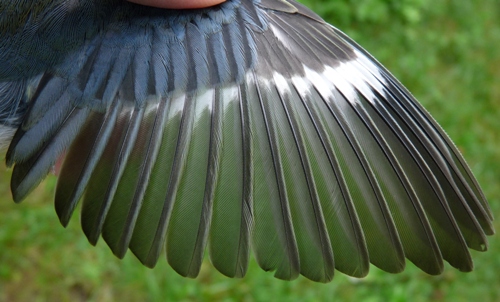
Another HY male, showing the same molt limit as in other examples, but this time also
with blue edging on the tertials.
Photo by Marcel Gahbauer,
McGill Bird Observatory (QC), August 2009
HY males have grayish to blackish rectrices with some blue edging, and a moderate amount of white. The outer rectrices are typically somewhat narrower and more pointed than those of AHY Black-throated Blue Warblers.
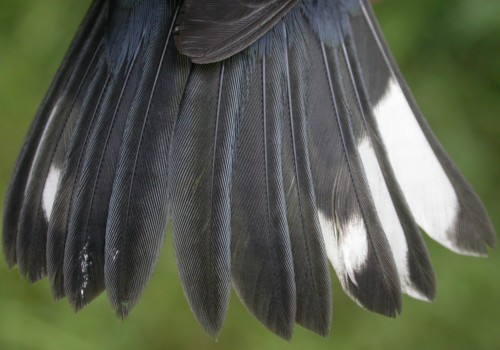
A typical HY male tail.
Photo by Marcel Gahbauer,
McGill Bird Observatory (QC), August 2005
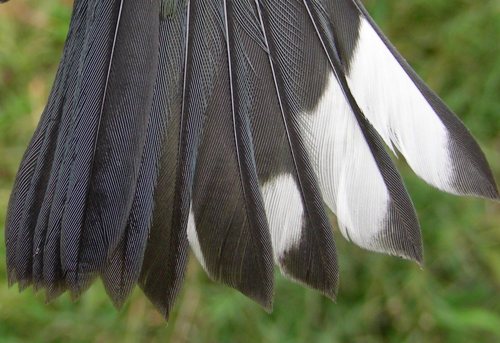
An example with unusually exaggeratedly pointed rectrices.
Photo by Marcel Gahbauer,
McGill Bird Observatory (QC), September 2008
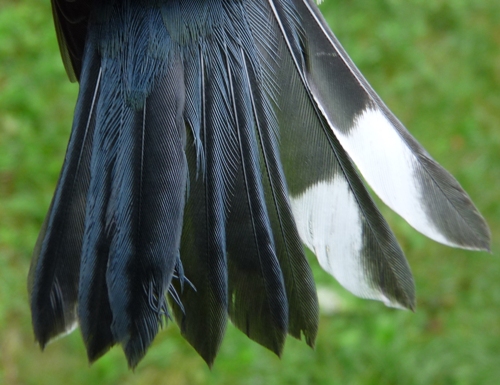
Another example with rather pointed rectrices; in this case the white patches are limited
to the outermost two rectrices, but the central rectrices have more blue edging than in
previous examples.
Photo by Marcel Gahbauer,
McGill Bird Observatory (QC), August 2009
RETURN TO AGE/SEX
OVERVIEW
|
JUN - DEC: hatch-year
female |
HY females are very similar to older females in older appearance, with the reduced white patch on the primaries often the only hint available for ageing without having to look at the open wing or tail.
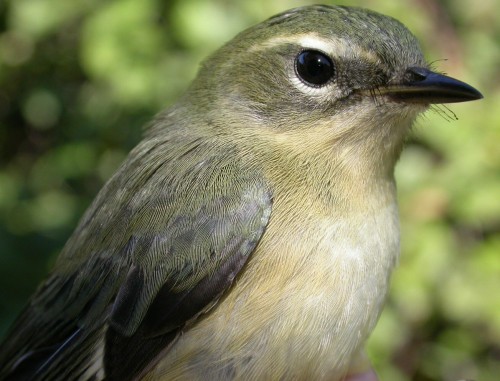
A typical HY female, with just a hint of a white patch on the primaries.
Photo by Marcel Gahbauer,
McGill Bird Observatory (QC), September 2005
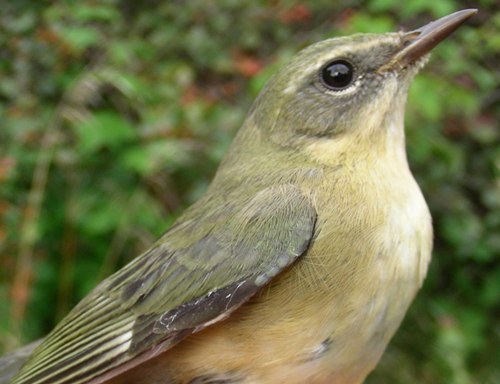
Another HY female recognizable by its very limited white primary patch.
Photo by Marcel Gahbauer,
McGill Bird Observatory (QC), September 2008
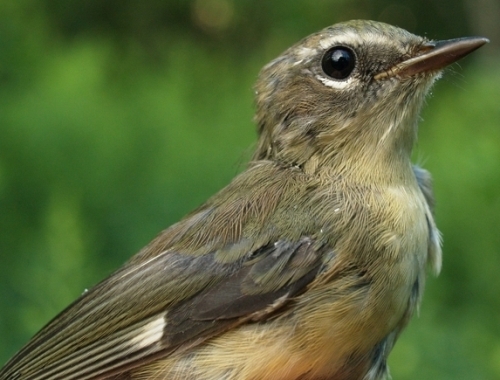
An HY female with a slighly larger white patch on the primaries, sufficiently intermediate
to warrant confirmation of age using the open wing and tail.
Photo by Simon Duval,
McGill Bird Observatory (QC), July 2010
HY females show a limited extent of white on the primaries below the primary coverts, and may also have rusty tips on the tertials. There is generally a molt limit between the greenish greater coverts and duller grayish-brown primary coverts, but the contrast is not nearly as obvious as on males.
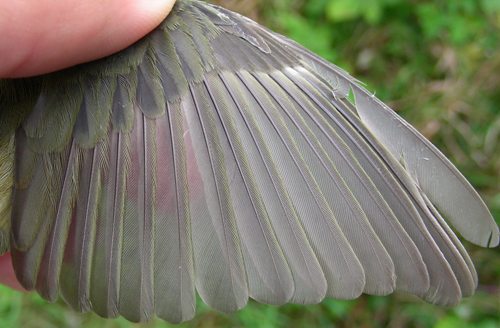
An HY female wing with barely any white on the primaries, and a slight contrast between
the green-edged greater coverts and duller primary coverts.
Photo by Marcel Gahbauer,
McGill Bird Observatory (QC), September 2008
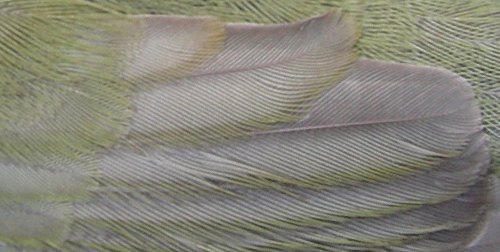
A closeup of the tertials, highlighting the rusty tips.
Photo by Marcel Gahbauer,
McGill Bird Observatory (QC), September 2008
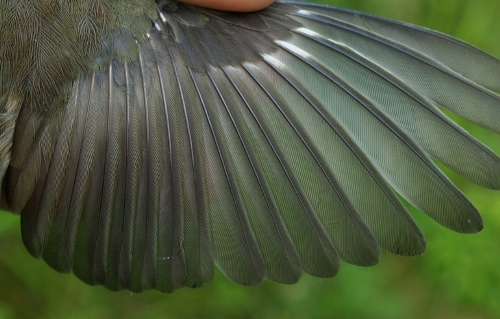
An example showing a limited amount of white on the primaries; this individual was
photographed during its preformative molt, with the greater coverts just growing in.
Photo by Simon Duval,
McGill Bird Observatory (QC), July 2010
HY females have uniformly dull rectrices that are generally narrow and often rather pointed.
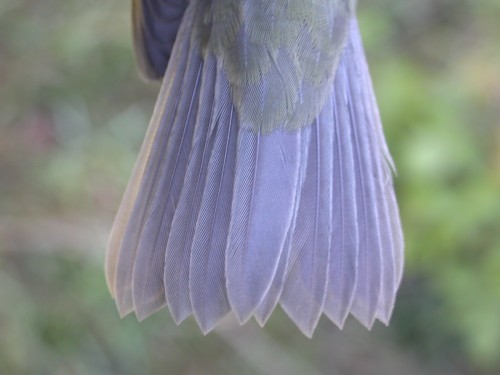
An example highlighting the pointed shape of juvenile rectrices.
Photo by Marcel Gahbauer,
McGill Bird Observatory (QC), October 2005
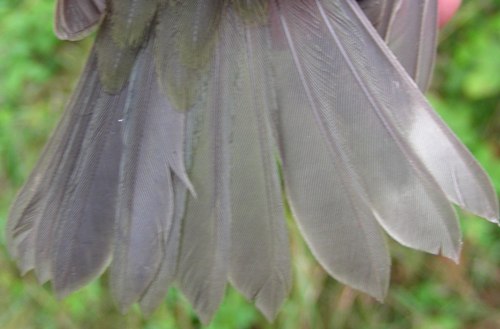
An example showing that the outermost rectrix occasionally has an indistinct pale patch.
Photo by Marcel Gahbauer,
McGill Bird Observatory (QC), September 2008
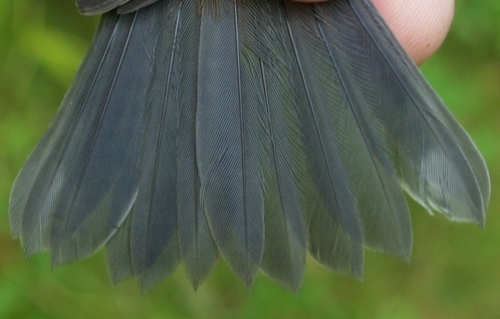
Another HY female, with slightly broader feathers, but again only a faint and indistinct
pale patch
on the outermost rectrices.
Photo by Simon Duval,
McGill Bird Observatory (QC), July 2010
RETURN TO AGE/SEX
OVERVIEW