 |
Introductory notes:
Common Redpoll is a challenging species, as there is considerable variability within age and sex classes; in general age and sex should be determined only if multiple criteria agree. While the larger rostrata and smaller flammea subspecies differ primarily in size, ageing and sexing cues may also vary. In addition, keep in mind that Hoary Redpoll is quite similar. |
QUICK TIPS:
This
species is quite variable, and multiple
characteristics are often required to be confident about
age and sex; use caution if criteria do not consistently agree:
| |
HY/SY
female |
HY/SY male |
AHY/ASY female |
AHY/ASY male |
|
Cheeks |
entirely lacking pink,
or lightly freckled pink |
lightly freckled pink |
lightly to moderately
freckled pink |
moderately to heavily
freckled pink |
|
Breast |
entirely lacking pink or with at most couple of
small patches of pink-edged feathers |
usually 5-50% of feathers edged pink;
occasionally none |
usually 5-50% of feathers edged pink;
occasionally none |
pink/red predominates |
|
Flanks |
entirely lacking pink or with at most couple of
small patches of pink-edged feathers |
usually 5-50% of feathers edged pink;
occasionally none |
usually 5-50% of feathers edged pink;
occasionally none |
pink/red predominates |
|
Rump |
entirely lacking pink or at most a few
pink-edged feathers |
usually light to moderate pink, occasionally
absent |
usually light to moderate pink, occasionally
absent |
usually light to moderate pink, occasionally
absent |
| Undertail coverts |
moderate to large dark centre to longest feathers |
moderate dark centre to longest feathers |
moderate dark centre to longest feathers |
moderate dark centre to longest feathers |
|
Outer rectrices |
relatively narrow and pointed |
relatively narrow and pointed |
relatively broad and rounded |
relatively broad and rounded |
|
Primary coverts |
brown with minimal pale edging; outer ppcov
narrow |
brown with minimal pale edging; outer ppcov
narrow |
dark
brown with gray edging; outer ppcov broad |
dark
brown with gray edging; outer ppcov broad |
Greater
coverts |
often showing a moult limit |
often showing a moult limit |
uniform in appearance |
uniform in appearance |
Table
adapted in part from the "Redpoll Pink Code" developed by
Martha Caskey for Innis Point Bird Observatory,
using specimens at the Canadian Museum of Nature,
Gatineau, Quebec |
Species account updated January 2011 |
Ageing and sexing overview:
|
July - December: |
AHY - M
Breast and flanks predominantly pink/red; no molt limit among greater coverts; outer rectrices
relatively broad and rounded |
|
|
|
AHY - F
Light to moderate extent of pink on breast and flanks;
no molt limit among greater coverts; outer rectrices relatively broad
and rounded |
|
|
|
HY - M
Light to moderate extent of pink on breast and flanks;
molt limit among greater coverts; outer rectrices relatively narrow
and pointed |
|
|
|
HY - F
Pink on cheeks, flanks, breast, and rump absent or
limited; molt limit among greater coverts; outer rectrices relatively narrow and pointed; may have very broad dark centre to undertail coverts |
|
|
|
|
Ageing and sexing details:
|
JAN-JUL: after-second-year
male |
The easiest way to recognize
after-second-year males is by the extensive pink-red wash that dominates
the breast and flanks, but tail and especially wing should be checked too whenever possible.
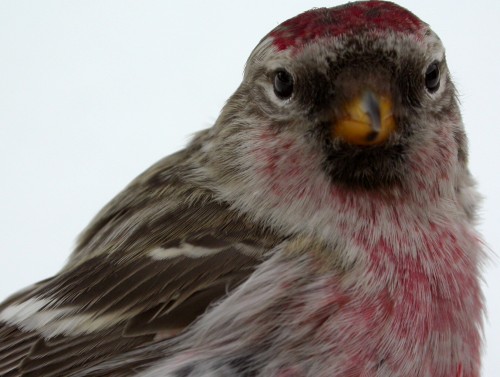
Photo by Marcel Gahbauer,
McGill Bird Observatory (QC), March 2006
The outer primary coverts are broad and rounded, and not contrasting substantially in colour or condition with the alula or greater coverts (note that the photo below is actually a bit misleading with respect to colour, as the difference between the primary and greater coverts was overemphasized by lighting).
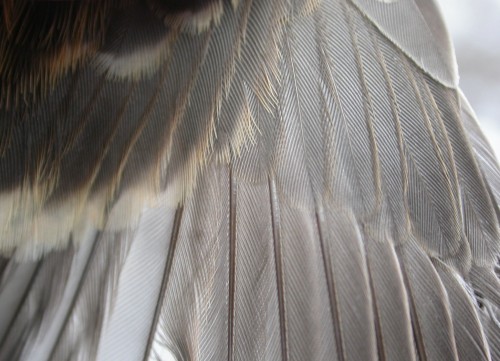
Photo by Marcel Gahbauer,
McGill Bird Observatory (QC), March 2006
The outer rectrices are relatively broad, but still taper to a relatively pointed tip, therefore the distinction compared to second-year individuals is rather subtle.
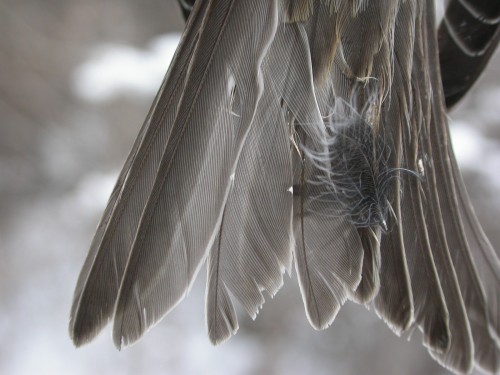
Photo by Marcel Gahbauer,
McGill Bird Observatory (QC), March 2006
RETURN TO AGE/SEX
OVERVIEW
|
JAN-JUL: after-second-year
female |
After-second-year
females can show a variable amount of pink; age is better determined using wing and tail criteria, and
subsequently sex (if possible) by the extent of pink plumage.
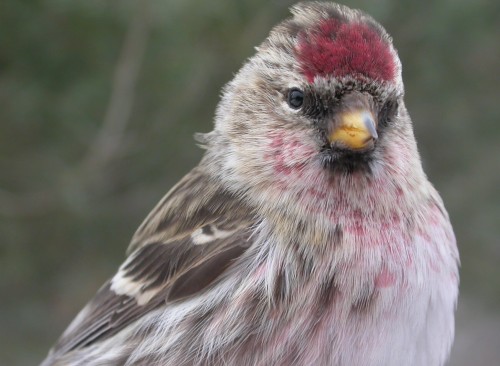
An ASY female with a fairly extensive amount of pink on the breast and face.
Photo by Marcel Gahbauer,
McGill Bird Observatory (QC), January 2006
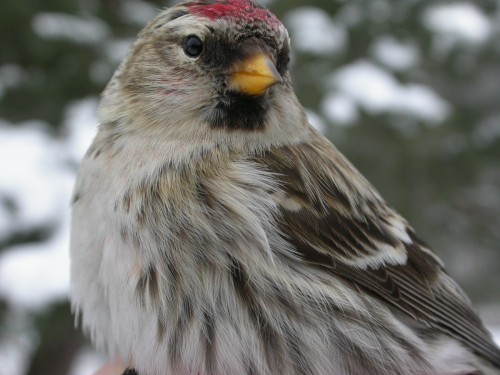
An ASY female at the opposite extreme, with only a trace of pink on the cheeks and flank.
Photo by Marcel Gahbauer, McGill Bird Observatory (QC), January 2006
The broad and rounded primary coverts are indicative of an
after-second-year bird; note that while distinct edging is expected, it
may not always be evident.
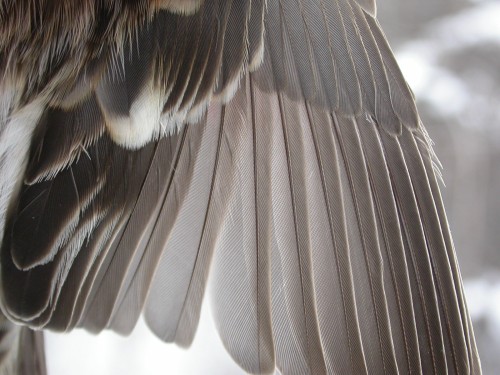
Photo by Marcel Gahbauer,
McGill Bird Observatory (QC), January 2006
The outer rectrices are broad, and while often fairly tapered and similar to those of second-year birds, they may on occasion be relatively rounded at the tip as in the photo below, which is more suggestive of an older bird.
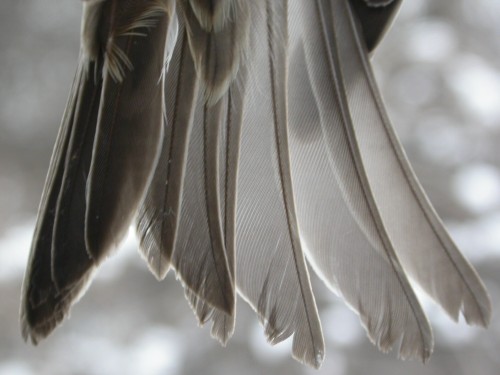
Photo by Marcel Gahbauer,
McGill Bird Observatory (QC), January 2006
RETURN TO AGE/SEX
OVERVIEW
|
JAN-JUL: second-year
male |
Second-year
males can have a variable amount of pink; age is better determined using wing and tail
criteria, and subsequently sex (if possible) by the extent of pink
plumage.
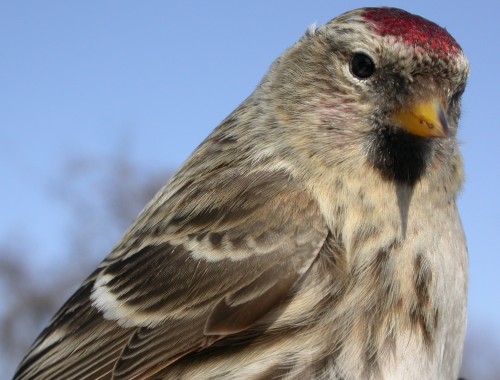
A lightly coloured SY male, with only a hint of pink on the cheeks and breast.
Photo by Marcel Gahbauer,
McGill Bird Observatory (QC), January 2006
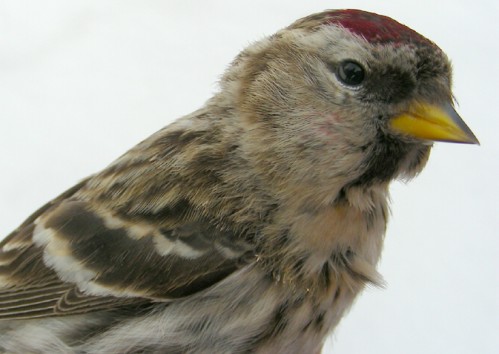
Another relatively pale SY-male, with only a bit of pink on the cheeks and breast.
Photo by Marie-Anne Hudson,
McGill Bird Observatory (QC), March 2009
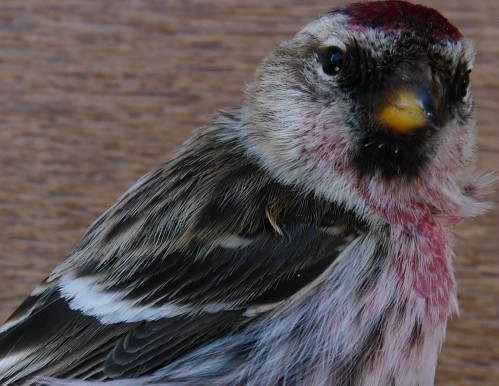
A more colourful SY male, especially on the breast.
Photo by Marcel Gahbauer,
Water Valley (AB), April 2009
Although molt limits are expected among the greater coverts, these can be subtle; in general, the wing is not as useful for ageing Common Redpolls as it is for many other passerines, since the shape and colour of the primary coverts differs little by age and feather quality tends to be good regardless of age.
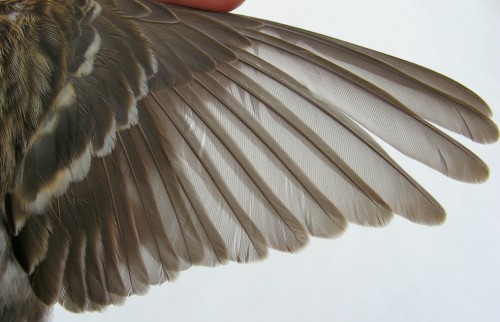
Note the molt limit between the inner three greater coverts with broader white tips and the
others that are only slightly paler, but with less white edging. Overall though the wing is
relatively uniform and could easily be mistaken for ASY.
Photo by Marie-Anne Hudson,
McGill Bird Observatory (QC), April 2009
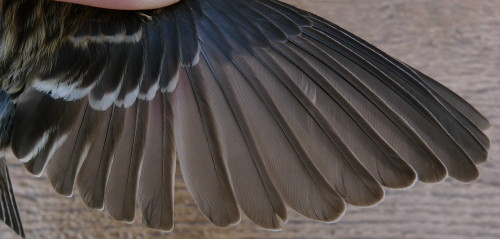
Another overall dark wing with a very subtle molt limit; in this case the contrast is most readily
apparent between the tertials and adjacent secondaries.
Photo by Marcel Gahbauer, Water Valley (AB), April 2009
The outer rectrices are on average somewhat narrower on second-year birds, and
typically more pointed toward the tip, but the distinction can be
slight.
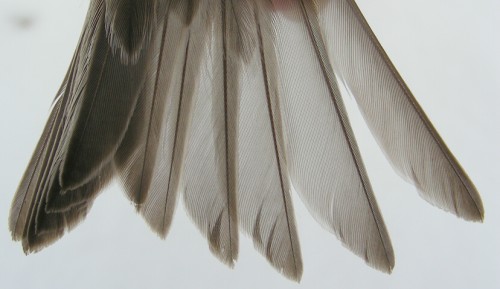
A typical SY tail, slightly pointed, but not very distinct from a typical ASY shape.
Photo by Marie-Anne Hudson,
McGill Bird Observatory (QC), April 2009
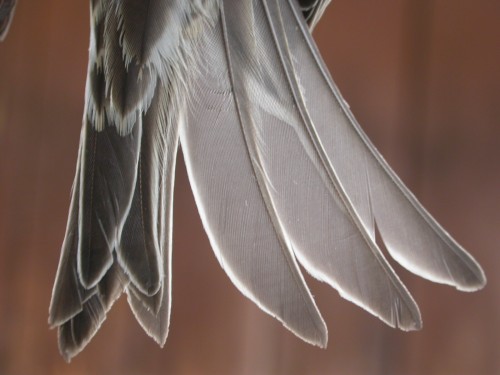
An example where it appears that the central rectrices have been prematurely replaced,
as they are somewhat darker and fresher than the others; this can be taken as an
indicator of an SY bird, as older individuals replace the entire tail during the prebasic molt.
Photo by Marcel Gahbauer,
McGill Bird Observatory (QC), January 2006
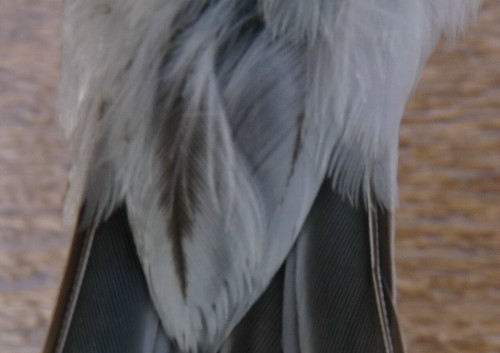
An example of the relatively indistinctly-edged and moderately extensive dark centre
to the longest undertail covert.
Photo by Marcel Gahbauer, Water Valley (AB), April 2009
RETURN TO AGE/SEX
OVERVIEW
|
JAN-JUL: second-year
female |
Any Common Redpoll entirely lacking pink is
necessarily a second-year female, but some may also have a small amount
of pink on the cheeks, breast, flanks, or rump.
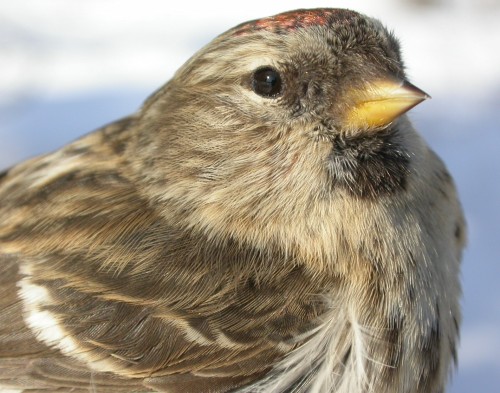
Note the near absence of pink on the breast and cheeks, as well as the relatively dull and
restricted red cap on this SY female.
Photo by Marcel Gahbauer,
McGill Bird Observatory (QC), January 2006
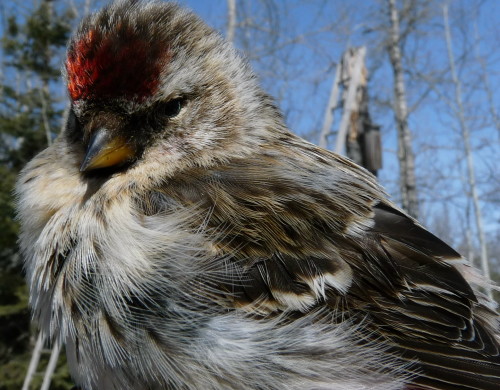
This SY female has a more prominent cap, and a hint of pink in the cheeks and breast.
Photo by Marcel Gahbauer, Water Valley (AB), April 2009
As noted for SY males, molt limits commonly occur among the greater coverts, but may be difficult to spot, and the wing is otherwise quite similar between SY and ASY redpolls.
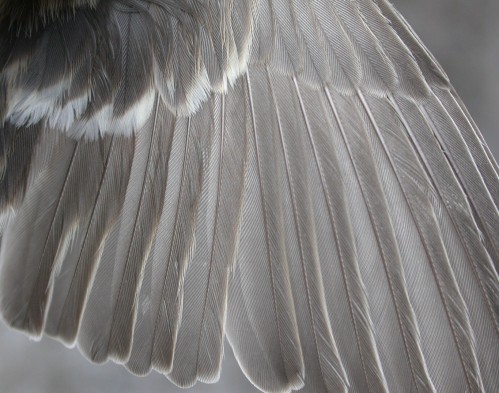
In this case, all except the outermost two greater coverts (shorter, and with somewhat buffier
tips) appear to have been replaced.
Photo by Marcel Gahbauer,
McGill Bird Observatory (QC), January 2006
The outer rectrices are on average somewhat narrower and more pointed on SY redpolls, but there is considerable overlap with ASY birds. SY females can sometimes be most readily recognized if they have very wide dark marks on their undertail coverts.
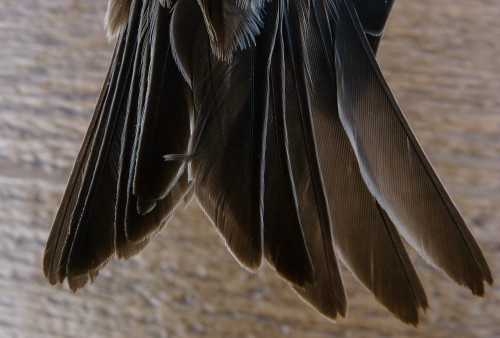
Relatively broad rectrices that could be confused with those of an ASY redpoll, but see
the corresponding undertail coverts in the photo below.
Photo by Marcel Gahbauer, Water Valley (AB), April 2009
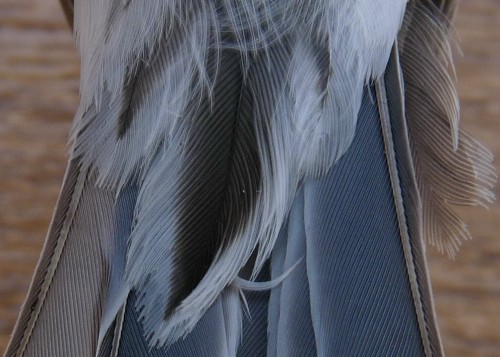
The very broad dark centre to the longest undertail covert is a trait only found on
SY females (though it is not always this large, and may overlap with the pattern of
other age/sex classes, i.e. only presence of this feature is useful).
Photo by Marcel Gahbauer, Water Valley (AB), April 2009
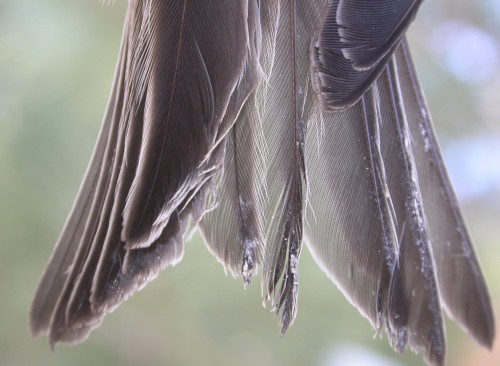
A somewhat more typical SY tail, showing more tapered outer rectrices.
Photo by Marcel Gahbauer,
McGill Bird Observatory (QC), January 2006
RETURN TO AGE/SEX
OVERVIEW
|
JUL - DEC: after-hatch-year
male |
RETURN TO AGE/SEX
OVERVIEW
RETURN TO AGE/SEX
OVERVIEW
|
JUL - DEC: hatch-year
female |
RETURN TO AGE/SEX
OVERVIEW
|