Ageing and sexing details:
|
JAN - JUL: after-second-year
unknown |
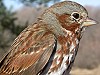
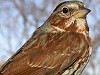
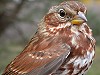
Body plumage provides no useful information
about sex, which can be determined only during the breeding season by
brood patch or cloacal protuberance. Eastern ASY birds may have a more
richly rusty brown appearance than SY birds, on average, but this is not
reliable - wing and tail should be evaluted to determine age.
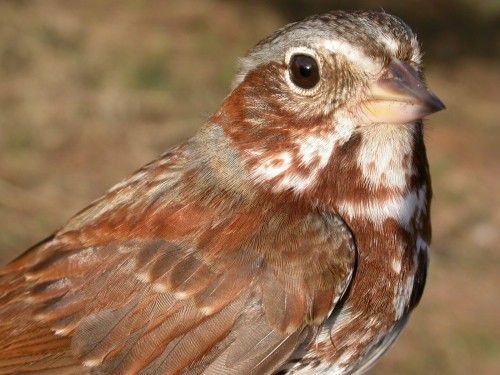
Photo by Marcel Gahbauer,
McGill Bird Observatory (QC), April 2006
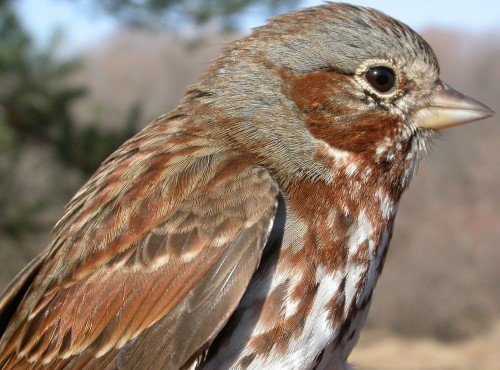
Photo by Marcel Gahbauer, McGill Bird Observatory (QC), April 2006
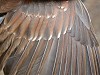
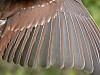
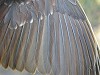
ASY Fox Sparrows have relatively broad primary coverts typically showing some brown edging, but this can be variable and especially in spring may not be reliably distinct from SY individuals. ASY individuals also have wings that are somewhat more uniform in appearance, but this too can be a subtle difference from SY birds, and some intermediates are better left as AHY in spring.
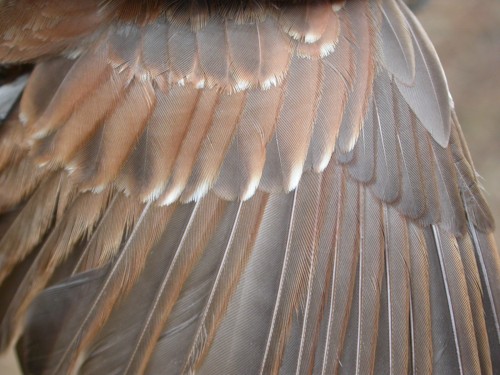
An eastern Fox Sparrow showing broad primary coverts with little edging, but a relatively
uniform appearance to the wing overall.
Photo by Marcel Gahbauer,
McGill Bird Observatory (QC), April 2006
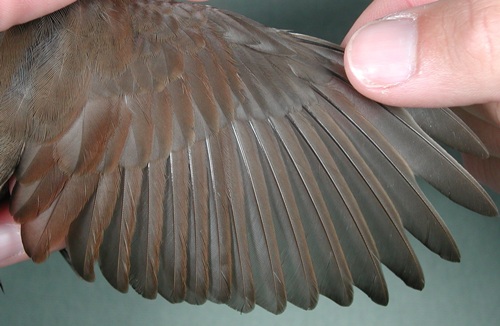
A western Fox Sparrow, with no apparent edging to the primary coverts, but again with
a very uniform appearance to the wing overall.
Photo by Peter Pyle,
Big Sur Ornithology Lab (CA), April 2007
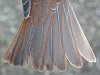
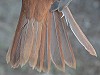
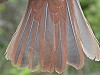
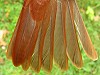
Rectrices are broad and fairly truncate on ASY birds.
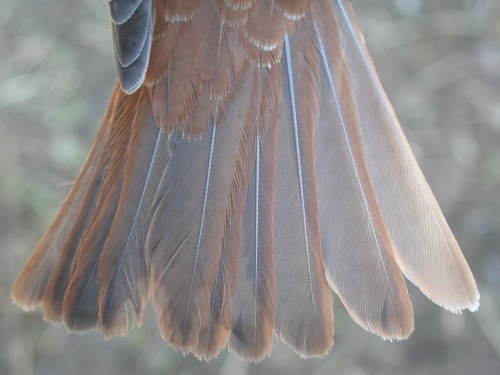
Photo by Marcel Gahbauer,
McGill Bird Observatory (QC), April 2006
RETURN TO AGE/SEX
OVERVIEW
|
JAN - JUL: second-year
unknown |
Body plumage provides no useful information
about sex, which can be determined only during the breeding season by
brood patch or cloacal protuberance. Eastern SY birds may have a somewhat less
rusty brown appearance than ASY birds, on average, but this is not
reliable - wing and tail should be evaluted to determine age.
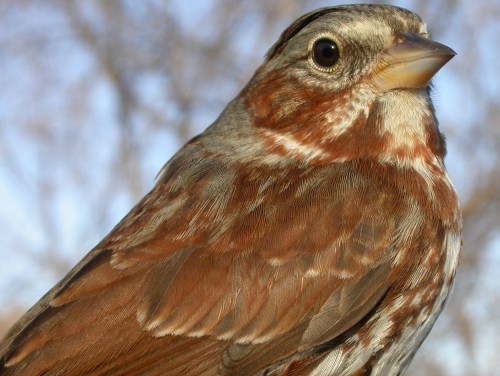
Photo by Marcel Gahbauer,
McGill Bird Observatory (QC), April 2006
SY birds have narrower and more pointed primary coverts, generally lacking edging, and there is usually at least a slight contrast between the fresher greater coverts and the juvenile feathers comprising the remainder of the wing.
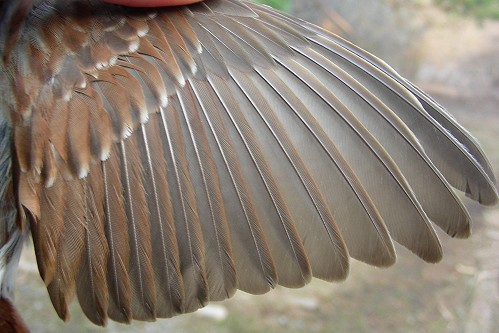
A typical SY wing, with narrow and pointed primary coverts, and a uniform block formed by
the primary coverts, primaries, and secondaries, contrasting with the fresher greater coverts.
Photo by Marie-Anne Hudson,
McGill Bird Observatory (QC), April 2008
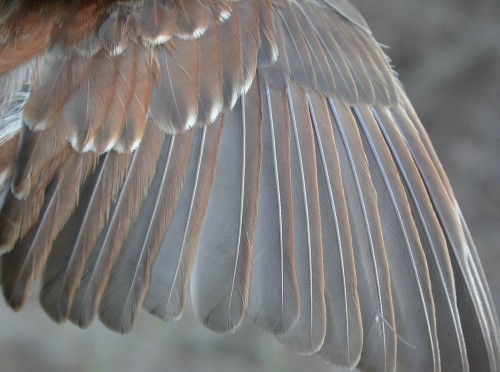
Another example, where the shape of the primary coverts is more intermediate, and the
overall condition of the wing is suggestive of a SY individual, but far from conclusive;
this individual was identified as SY on the basis of its distinctly juvenile tail, but
considering the wing alone would be best classified as AHY.
Photo by Marcel Gahbauer,
McGill Bird Observatory (QC), April 2006
SY birds have narrow and tapered rectrices, usually appearing more worn
than those of ASY birds.
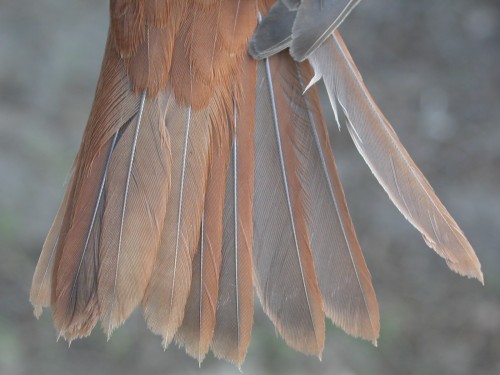
A distinctly SY tail, with narrow, pointed, and worn rectrices. This photo corresponds to the
indistinct wing in the
previous section.
Photo by Marcel Gahbauer,
McGill Bird Observatory (QC), April 2006
RETURN TO AGE/SEX
OVERVIEW
Body plumage provides no useful information
about sex, which can be determined only during the breeding season by
brood patch or cloacal protuberance. Eastern AHY birds may have a more
rusty brown appearance than HY birds, on average, but this is not
reliable - wing and tail should be evaluted to determine age.
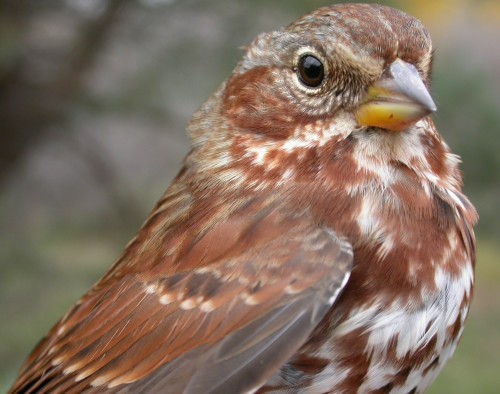
Photo by Marcel Gahbauer,
McGill Bird Observatory (QC), October 2005
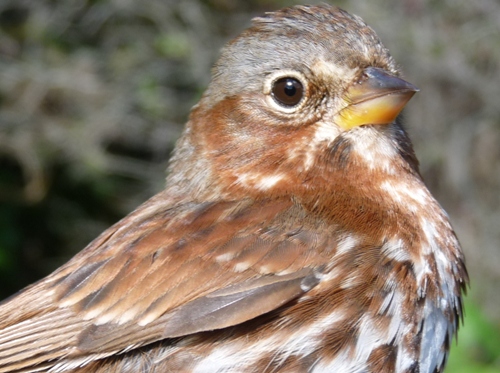
Photo by Marcel Gahbauer,
McGill Bird Observatory (QC), October 2009
ASY Fox Sparrows have relatively broad primary coverts, usually with some edging, and the wing has a relatively uniform appearance, including a fair bit of rusty edging on the primaries and secondaries.
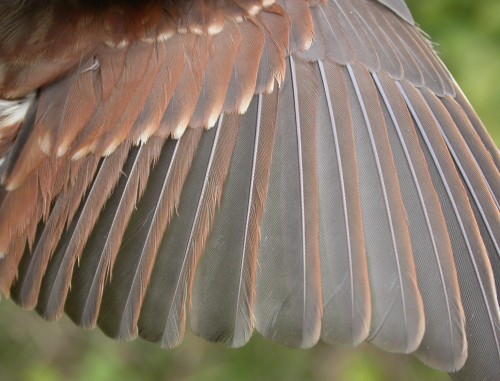
Photo by Marcel Gahbauer,
McGill Bird Observatory (QC), October 2005
Rectrices are broad and fairly truncate on ASY birds.
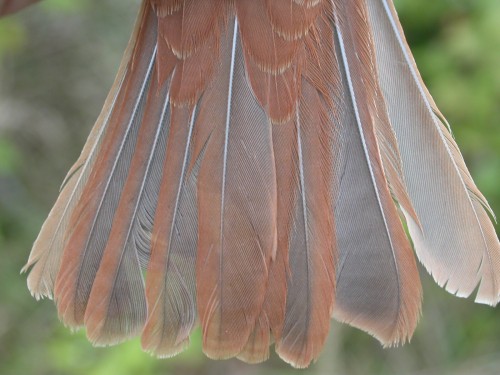
Photo by Marcel Gahbauer,
McGill Bird Observatory (QC), October 2005
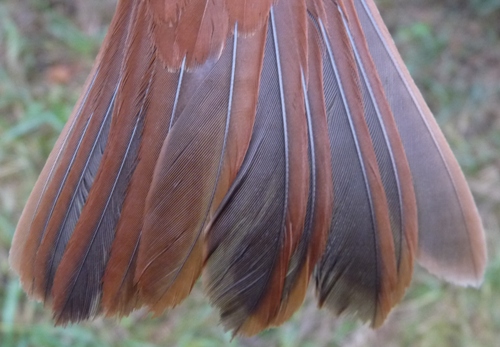
Photo by Marcel Gahbauer,
McGill Bird Observatory (QC), October 2009
RETURN TO AGE/SEX
OVERVIEW
HY birds may on average have a less rusty brown
appearance than AHY birds, but this is not reliable - wing
and tail should be evaluated to determine age. Sex cannot be
determined for HY birds.
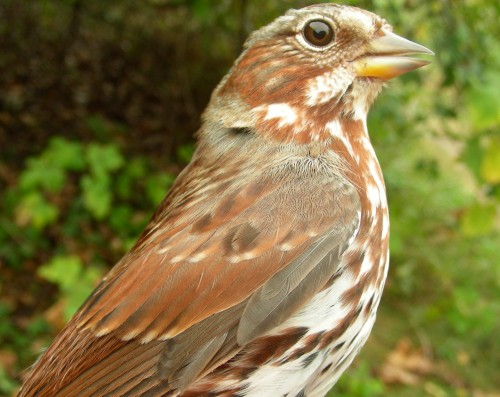
A typical HY eastern Fox Sparrow.
Photo by Marie-Anne Hudson,
McGill Bird Observatory (QC), October 2007
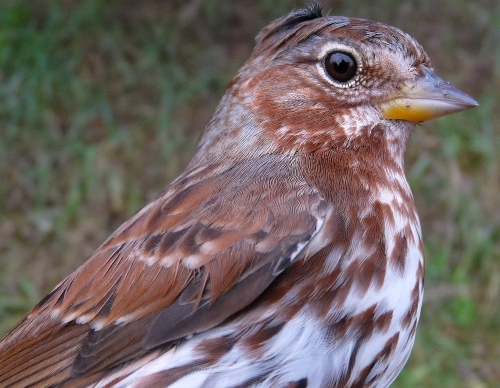
Photo by Marcel Gahbauer,
McGill Bird Observatory (QC), October 2009
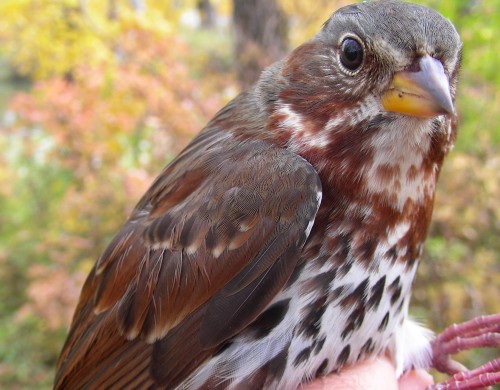
An Alberta bird; note the darker spots over most of the underparts, contrasting with the
more rusty spots on the throat and upper breast.
Photo by Marcel Gahbauer,
Inglewood Bird Sanctuary (AB), September 2007
HY birds have narrower primary coverts with limited edging. The greater coverts, primaries, and secondaries all tend to have less rusty edging than on AHY birds, though the extent is variable.
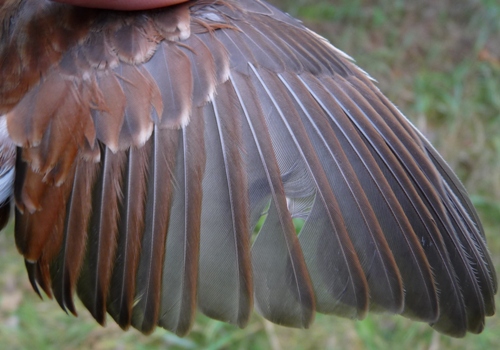
A typical HY Fox Sparrow, with somewhat narrow primary coverts, and somewhat less
rusty edging across most of the wing than on AHY individuals.
Photo by Marcel Gahbauer,
McGill Bird Observatory (QC), October 2009
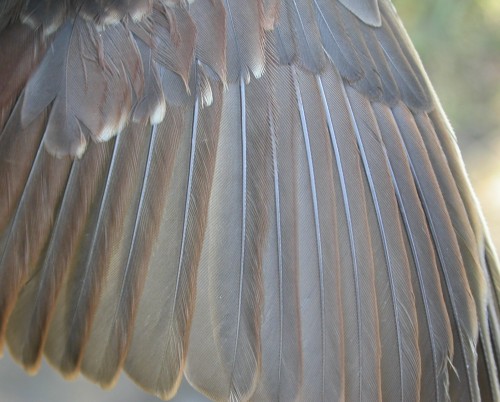
A particularly dull individual, with minimal rusty edging anywhere on the wing.
Photo by Marcel Gahbauer,
McGill Bird Observatory (QC), October 2005
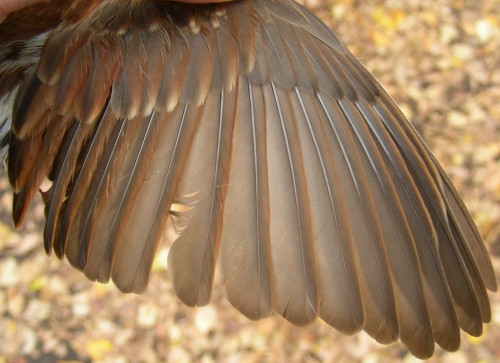
An Alberta bird, somewhat darker on the wing overall.
Photo by Marcel Gahbauer, Inglewood Bird Sanctuary (AB), September 2007
HY birds
tend to have relatively narrow and tapered rectrices, although there are some intermediates to beware of.
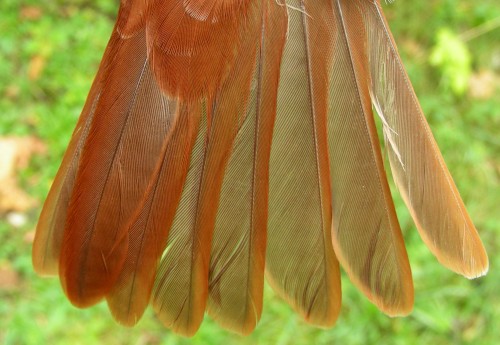
An intermediate example, which would require examination of the wing or skull
ossification to be confident about age.
Photo by Marie-Anne Hudson,
McGill Bird Observatory (QC), October 2007
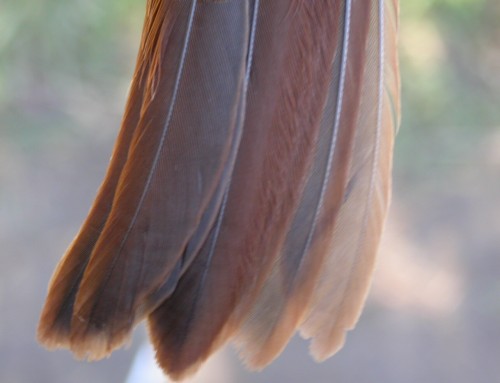
A somewhat more typically tapered HY tail, although a bit difficult to see in this pose.
Photo by Marcel Gahbauer,
McGill Bird Observatory (QC), October 2005
RETURN TO AGE/SEX
OVERVIEW