 |
Introductory notes:
Gray-cheeked Thrush is quite similar to Bicknell's Thrush, and should be identified with care in areas where both may occur. HY/SY Gray-cheeked Thrushes are often easy to recognize if their retained juvenile feathers have distinct pale tips or shaft streaks, but since these can wear over time, confirming an AHY/ASY bird can be more difficult, especially by spring.
|
QUICK TIPS:
| 1) Look
at the greater coverts - the presence of buffy-white
tips or shaft streaks indicates a HY/SY bird, however the
absence of buffy-white shaft streaks is NOT an
entirely reliable indicator of AHY/ASY, as some HY/SY
birds may lack these markings
2) Consider the shape of the rectrices - they are narrow and relatively tapered on HY/SY birds, but broad and relatively rounded on AHY/ASY birds
3) Examine
the outermost primary (p10) - on HY/SY birds it
is broad, rounded and 3-7 mm shorter than the primary
coverts, while on AHY/ASY birds it is narrow,
pointed, and 5-12 mm shorter than the primary coverts
Species account updated February 2011 |
|
Ageing and sexing overview:
Ageing and sexing details:
|
JAN - JUL: after-second-year
unknown |
Gray-cheeked Thrushes vary little by age, and sex can be determined only by checking for a brood patch or cloacal protuberance. .
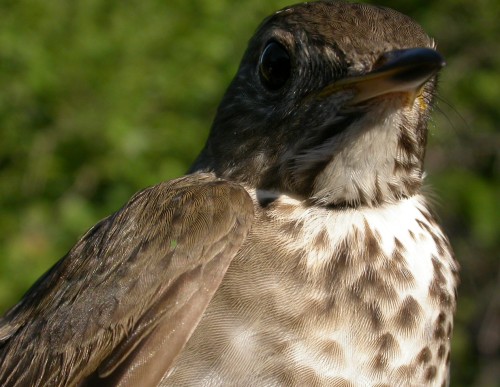
Photo by Marcel Gahbauer,
McGill Bird Observatory (QC), May 2006
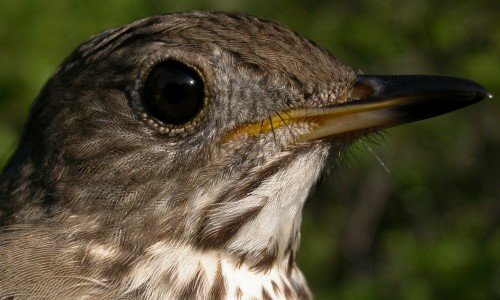
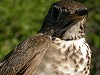
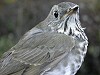
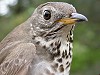
A closeup of the head, highlighting the gray cheek. While the facial pattern of Bicknell's
Thrush is similar, the colour of the lower mandible can be used to separate the two species,
with Gray-cheeked Thrush being paler at the base, and black from the midpoint outward.
Photo by Marcel Gahbauer,
McGill Bird Observatory (QC), May 2006
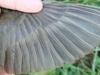
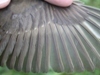
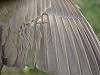
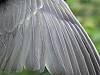
ASY Gray-cheeked Thrushes have a uniformly brown wing, without pale tips on any greater coverts. The outermost primary is narrow and 5-12 mm shorter than the primary coverts.
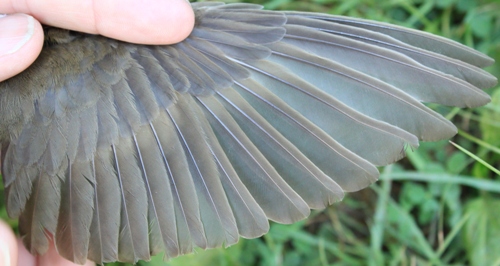
A typical ASY wing, uniformly brown, and with a short p10.
Photo by Peter Pyle, Braddock Bay Bird Observatory (NY, May 2010
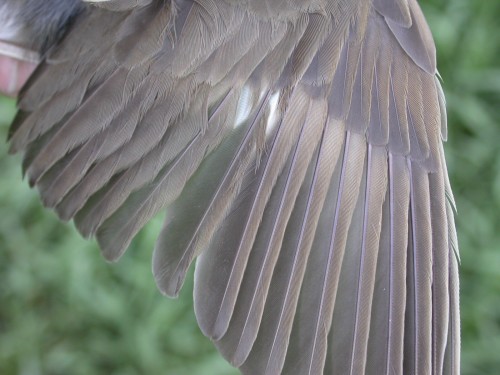
A closer view of a different bird, highlighting the narrow and short p10.
Photo by Marcel Gahbauer,
McGill Bird Observatory (QC), May 2006
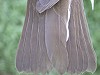
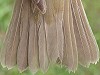
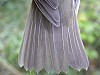
ASY Gray-cheeked Thrushes have relatively broad rectrices.
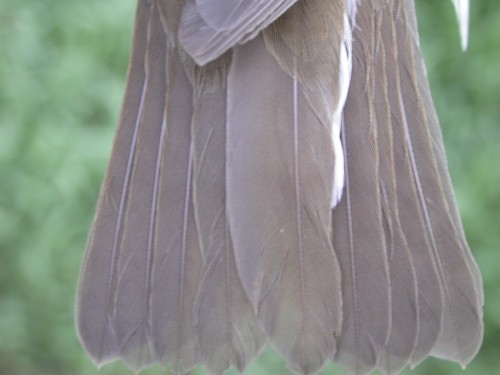
An ASY tail with relatively broad rectrices; like many of the Catharus thrushes, adult
rectrices may have a small point at the tip.
Photo by Marcel Gahbauer,
McGill Bird Observatory (QC), May 2006
RETURN TO AGE/SEX
OVERVIEW
|
JAN - JUL: second-year
unknown |
Overall plumage is rarely helpful in ageing Gray-cheeked Thrushes, but in some cases SY individuals have readily visible pale tips to their retained juvenile greater coverts, which are a diagnostic feature.
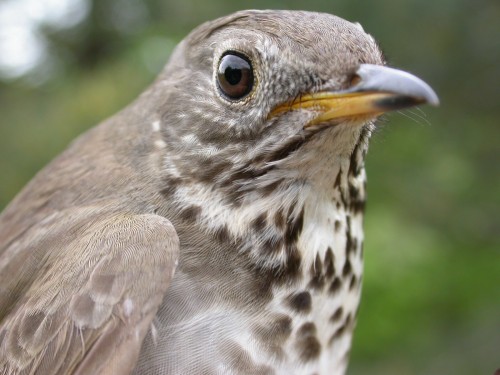
A view from which the greater coverts are not visible, and age cannot be determined. Note
that the lower mandible is sufficiently yellow to warrant careful review of other features to
rule out the possibility of Bicknell's Thrush.
Photo by Marcel Gahbauer,
McGill Bird Observatory (QC), May 2005
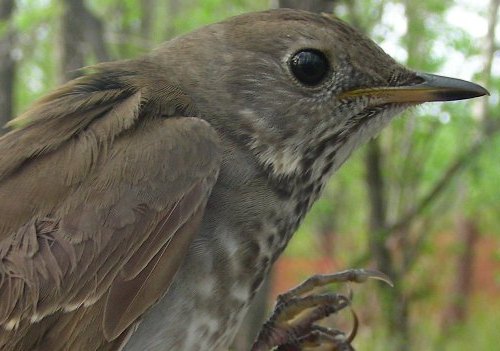
An SY Gray-cheeked Thrush easily aged by the presence of pale tips on the greater coverts.
Photo by Marcel Gahbauer, Inglewood Bird Sanctuary (AB), May 2008
SY Gray-cheeked Thrushes retain at least half of their juvenile greater coverts, which usually have a pale tip or shaft streak. Also, p10 is broader and more rounded than on ASY birds, and although still shorter than the primary coverts, the difference in length is usually smaller (3-7 mm).
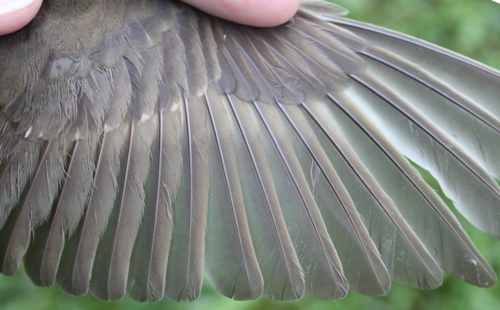
A typical SY Gray-cheeked Thrush, with pale tips visible on most of the greater coverts,
and a rounded p10 that is moderately shorter than the primary coverts.
Photo by Peter Pyle, Braddock Bay Bird Observatory (NY, May 2010
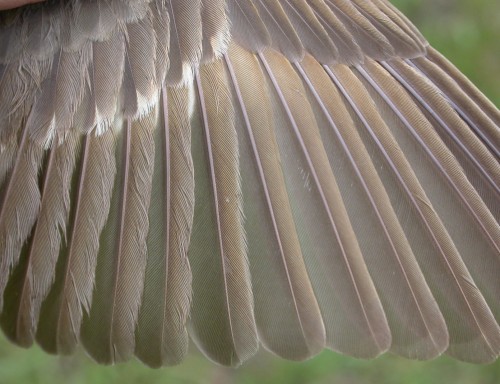
An example in which the pale shaft streaks on the retained juvenile greater coverts
are particularly prominent.
Photo by Marcel Gahbauer,
McGill Bird Observatory (QC), May 2005
SY Gray-cheeked Thrushes have relatively narrow rectrices, that often show somewhat more wear in spring than those of ASY birds.
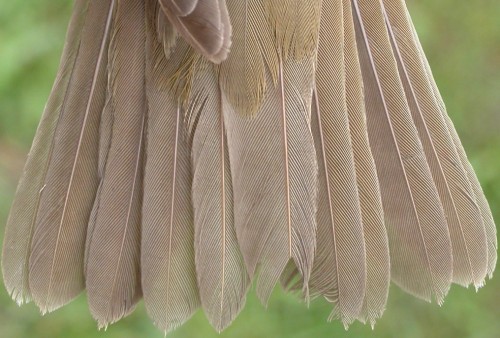
A typical SY tail, with relatively narrow recrices and a bit of wear at the tip of most of them.
Photo by Marcel Gahbauer,
McGill Bird Observatory (QC), May 2005
RETURN TO AGE/SEX
OVERVIEW
|
JUL - DEC: after-hatch-year
unknown |
Overall appearance usually cannot be used to identify AHY Gray-cheeked Thrushes, since the pale tips to the greater coverts that may be used to distinguish HY individuals are not always readily visible.
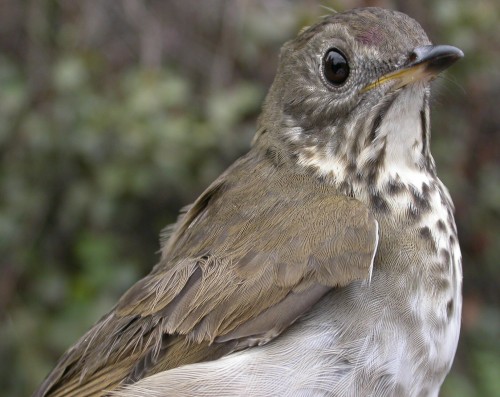
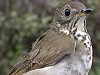
A typical AHY Gray-cheeked Thrush.
Photo by Marcel Gahbauer,
McGill Bird Observatory (QC), September 2005
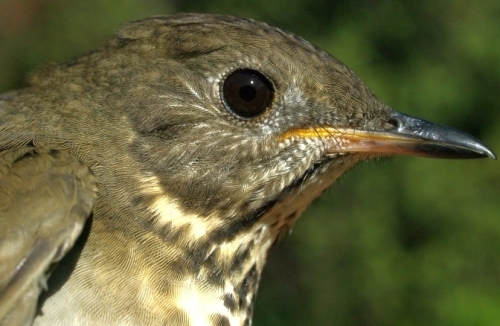
As in spring, the bill provides a good way to separate Gray-cheeked and Bicknell's
Thrushes; the pale base and dark tip shown above are typical for Gray-cheeked.
Photo by Marcel Gahbauer,
McGill Bird Observatory (QC), September 2005
AHY Gray-cheeked Thrushes have uniformly brown wings, without pale tips or shaft streaks on any of the greater coverts. Additionally, p10 is narrow, pointed, and substantially shorter (by 5-12 mm) than the primary coverts.
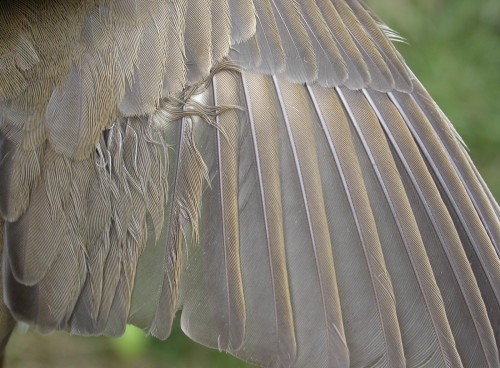
A typical AHY wing (although p10 is unfortunately not visible in this photo).
Photo by Marcel Gahbauer,
McGill Bird Observatory (QC), September 2005
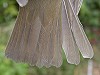
AHY Gray-cheeked Thrushes have broad rectrices with relatively blunt tips, although there can be a slight point right at the tip of the shaft.
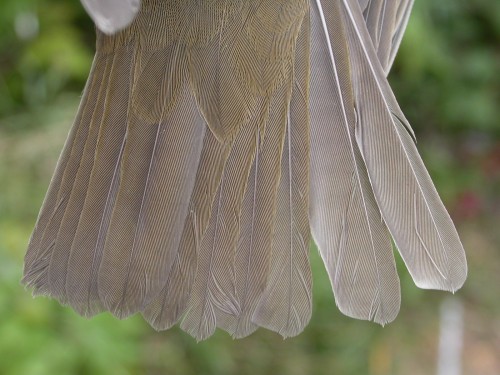
A typical AHY tail.
Photo by Marcel Gahbauer,
McGill Bird Observatory (QC), September 2005
RETURN TO AGE/SEX
OVERVIEW
|
JUL - DEC: hatch-year
unknown |
Overall plumage is rarely helpful in ageing Gray-cheeked Thrushes, but with a good view of the wing of a perched individual, it may be possible to spot the pale tips to their retained juvenile greater coverts, which are a diagnostic feature.
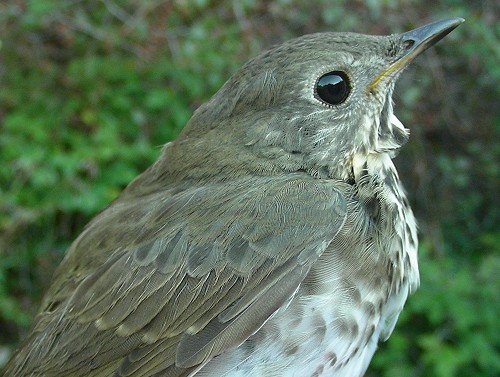
A typical HY Gray-cheeked Thrush, recognizable by the pale tips on most
of its greater coverts.
Photo by Marie-Anne Hudson,
McGill Bird Observatory (QC), September 2007
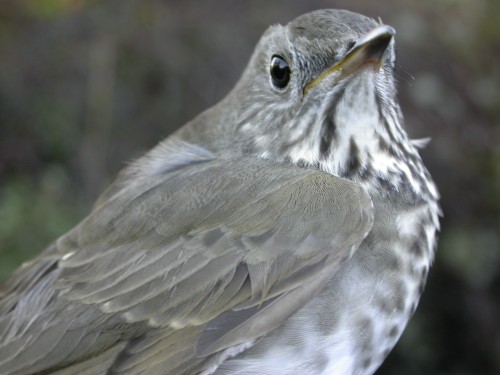
Another example, with the pale tips relatively subtle, but still distinct enough to
permit identification of this as an SY individual from this view.
Photo by Marcel Gahbauer,
McGill Bird Observatory (QC), September 2005
HY Gray-cheeked Thrushes usually have a molt limit among the greater coverts, with up to several inner coverts replaced that are slightly darker and lack any pale markings, contrasting with the retained outer juvenile greater coverts that have pale tips or shaft streaks. Additionally, p10 is relatively broad, rounded, and long on HY individuals (only 3-7 mm shorter than the primary coverts).
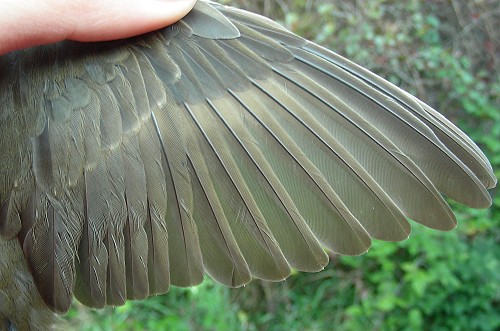
Photo by Marie-Anne Hudson, McGill Bird Observatory (QC), September 2007
HY Gray-cheeked Thrushes have narrow and relatively pointed rectrices.
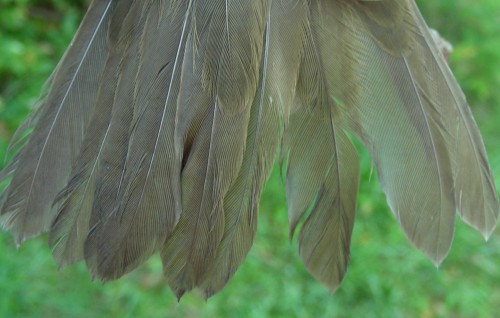
A typical HY Gray-cheeked Thrush tail, with the rectrices distinctly narrow and pointed.
Photo by Marie-Anne Hudson, McGill Bird Observatory (QC), September 2007
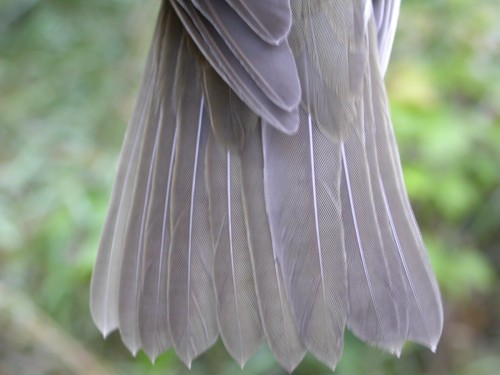
Another example, showing even more pointed rectrices.
Photo by Marcel Gahbauer,
McGill Bird Observatory (QC), September 2005
RETURN TO AGE/SEX
OVERVIEW
|