|
Gray
Catbird / Moqueur chat (Dumetella carolinensis) |
 |
Introductory notes:
Although Gray Catbirds of all ages and sexes look quite similar overall, several features can be used to distinguish HY/SY individuals from older birds. Molt limits among the greater coverts are usually the most distinct and reliable feature, but colour of the iris and mouth lining can also be helpful, as are the loose and fluffy grayish undertail coverts as long as they are retained.
|
QUICK TIPS:
1) Check
the undertail coverts - on some HY/SY birds they
are mottled with gray, while on AHY/ASY birds
they are uniformly rusty (but note that this may be the case for HY birds too, especially in the west)
2) Examine the greater coverts - most HY/SY birds
have a molt limit with paler/browner outer coverts
contrasting with dark gray fresh inner coverts, while AHY/ASY
birds have no moult limit
3) Check the
iris - on HY/SY birds it is grayish to
reddish-brown, while on AHY/ASY birds it is
maroon; this may not be reliable by spring
4) Check
the upper mandible lining - on HY/SY birds it is
mostly pale, while on AHY/ASY birds it is
mostly black
Species account updated January 2011
|
|
Ageing and sexing guidelines:
Ageing and sexing details:
|
JAN - JUN: after-second-year
unknown |
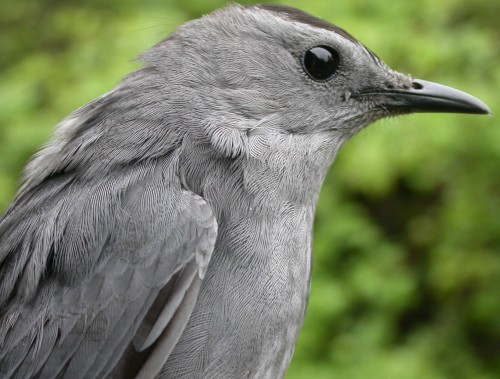
ASY catbirds have a solid dark to blackish crown,
and undertail coverts that are uniformly rufous. Sexes are indistinguishable
by plumage, but can be identified by brood patch or cloacal
protuberance during the breeding season.
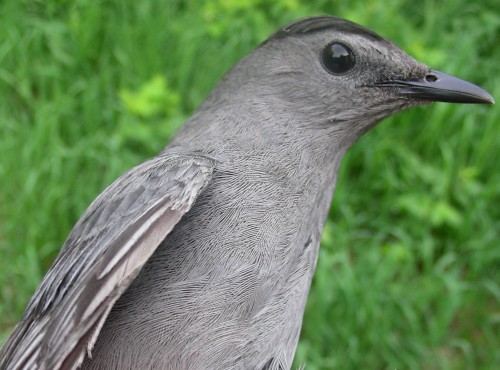
Photo by Marie-Anne Hudson,
McGill Bird Observatory (QC), May 2007
In this view, the solid gray of the wing is evident, where on a SY catbird there would
in many cases be a molt limit with contrastingly brown juvenile feathers.
Photo by Marcel Gahbauer,
McGill Bird Observatory (QC), May 2006
The wing of ASY catbirds is uniformly gray.
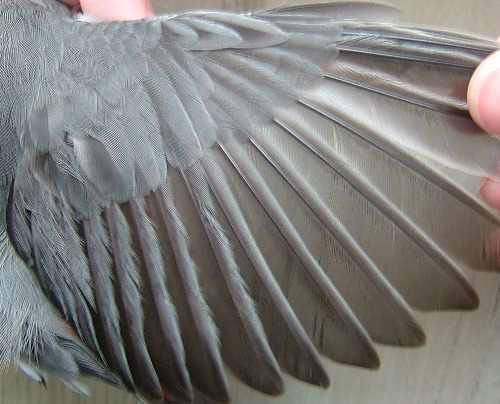
In some cases, the gray extends to distinct pale edging on the primary coverts.
Photo by Peter Pyle, MerryLea (IN), May 2005
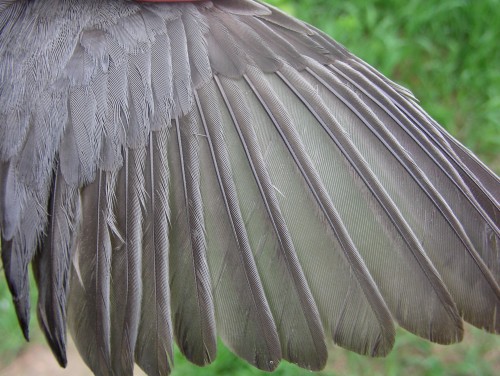
More commonly, the primary coverts show a bit of a pseudolimit with the paler gray greater
coverts, but note that the entire wing still has a relatively uniform grayish tone.
Photo by Marie-Anne Hudson,
McGill Bird Observatory (QC), May 2007
The shape of the rectrices varies less by age than in many other passerines, but on average ASY catbirds do have somewhat broader and more rounded outer rectrices. The undertail coverts are normally mostly to entirely rust-coloured.
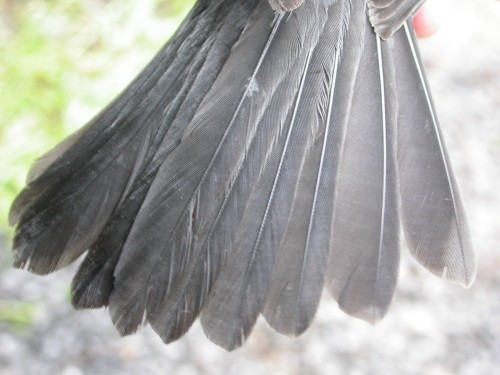
A typical ASY catbird tail.
Photo by Marcel Gahbauer,
McGill Bird Observatory (QC), May 2006
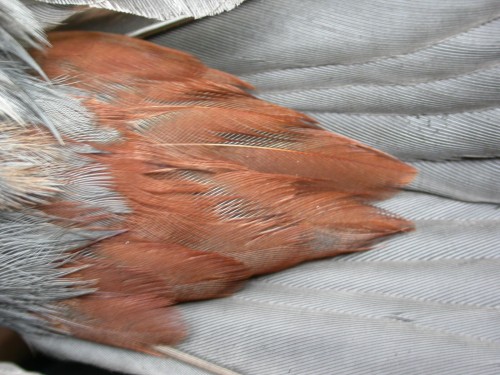
Typical undertail coverts, mostly rusty with only a trace of gray mixed in.
Photo by Marcel Gahbauer, McGill Bird Observatory (QC), May 2006
RETURN TO AGE/SEX
OVERVIEW
|
JAN - JUN: second-year
unknown |
SY Gray Catbirds often have a somewhat paler/browner cap than ASY individuals, but others are similar to older birds in this regard. Age in spring is best assessed by checking for molt limits on the wing. During the
breeding season, approximately mid-May to late July at MBO, CP/BP can be
used to identify sex.
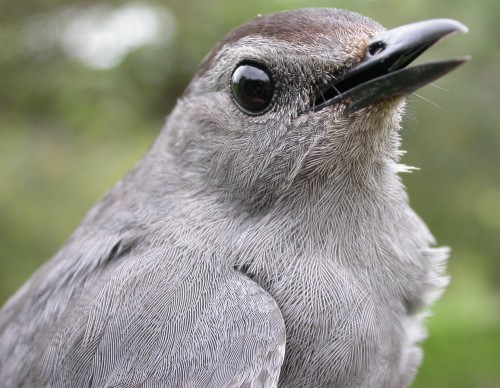
This individual has a relatively brownish cap, especially pale toward the forehead, which
provides a good clue to it being an SY catbird.
Photo by Marcel Gahbauer,
McGill Bird Observatory (QC), May 2005
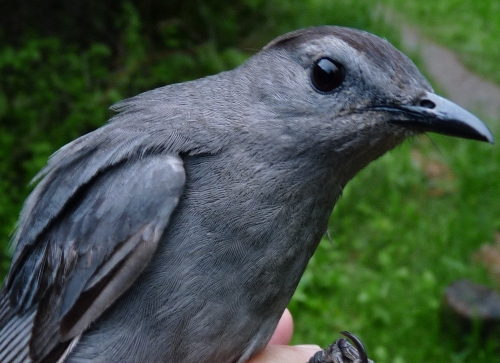
The cap of this individual is also relatively dull; although not particularly distinct, the molt
limit on the wing can be seen to some extent from this angle.
Photo by Marcel Gahbauer,
McGill Bird Observatory (QC), May 2010
Second-year Gray Catbirds can be most easily aged by molt limits on the wing. Typically the primary coverts, primaries, and secondaries form a block of brownish-gray retained juvenile feathers, contrasting with some to all replaced gray tertials and greater coverts. The photos below illustrate some of the variability in the extent of the preformative moult, with respect to replacing greater coverts and tertials.
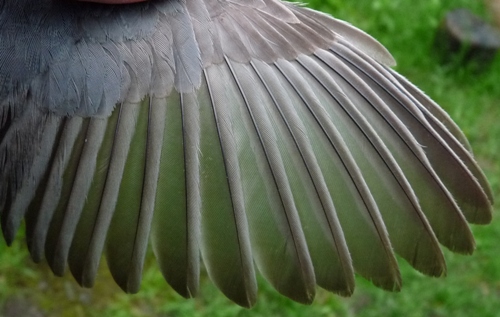
This photo clearly shows the contrast between the innermost four formative greater coverts,
which are longer and distinctly gray compared to the retained juvenile coverts that are more
brownish (note that an outer greater covert has also been replaced, this type of pattern
appears somewhat more common in Gray Catbirds than most other passerines).
Photo by Marcel Gahbauer,
McGill Bird Observatory (QC), May 2010
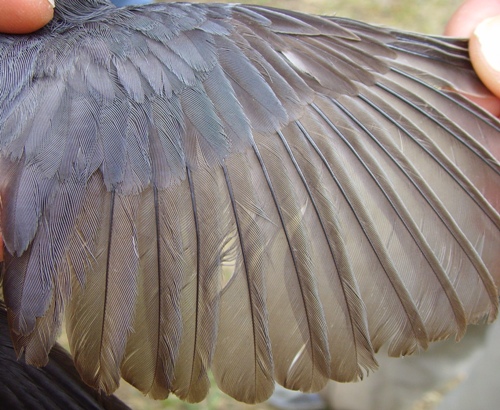
An example of a more extensive preformative molt, with nearly all of the greater
coverts having been replaced, as well as the inner two tertials.
Photo by Peter Pyle, MerryLea (IN), May 2007
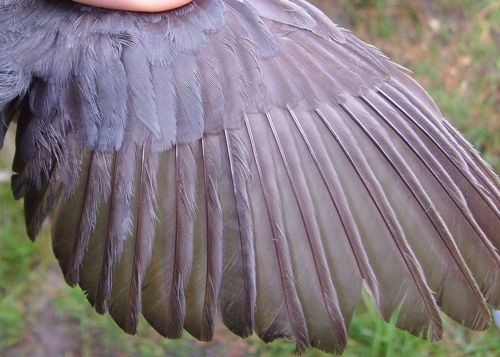
Another variation on the pattern, with roughly half of the greater coverts replaced, as well
as the carpal covert; it also appears that the first secondary may have been prematurely
replaced (unknown whether the same pattern was present on the other wing).
Photo by Peter Pyle, MerryLea (IN), May 2007
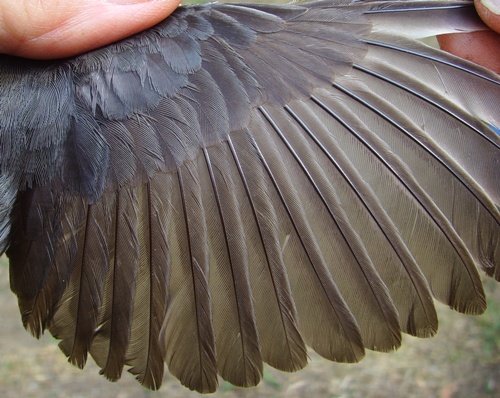
A particularly limited molt, with only the innermost couple of greater coverts (as well as the
median and lesser coverts) replaced, showing a stark contrast between gray and brown.
Photo by Peter Pyle, MerryLea (IN), May 2007
The
tail, or more specifically the undertail coverts, can represent a shortcut
to ageing Gray Catbirds. While most individuals replace all their
undertail coverts in their preformative molt, some do not, and retention of largely gray plumage there is indicative of a second-year bird. The outer rectrices also tend to be somewhat
more abraded and tapered than on ASY individuals, a characteristic which
may be used to complement other criteria, especially for individuals where molt limits on the wing are indistinct.
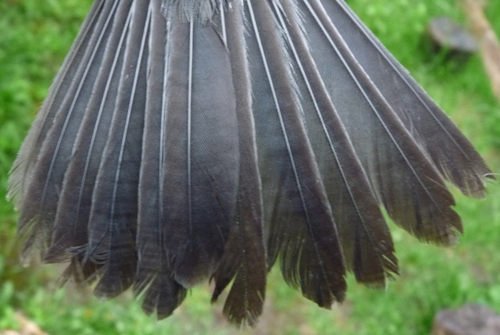
Photo by Marcel Gahbauer,
McGill Bird Observatory (QC), May 2010
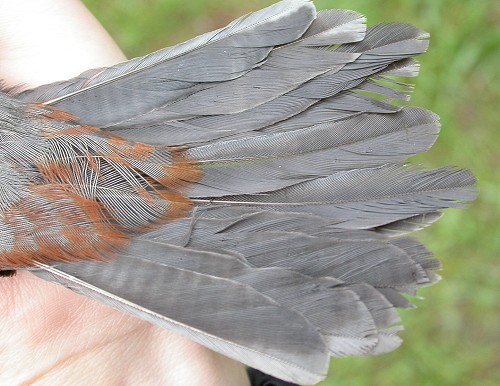
An example of an SY catbird that appears to not have replaced its undertail coverts during
the preformative molt; note also the relatively narrow outer rectrices.
Photo by Marcel Gahbauer,
McGill Bird Observatory (QC), May 2005
RETURN TO AGE/SEX
OVERVIEW
|
JUN - DEC: after-hatch-year
unknown |
AHY Gray Catbirds have a solid dark cap (though usually not black as often described). However, age is in most cases more readily determined by looking for molt limits on the wing, or detecting juvenile undertail coverts. Mouth lining (black for AHY) and iris colour (maroon for AHY) can also be useful in fall. Sex cannot be determined outside of the breeding season.
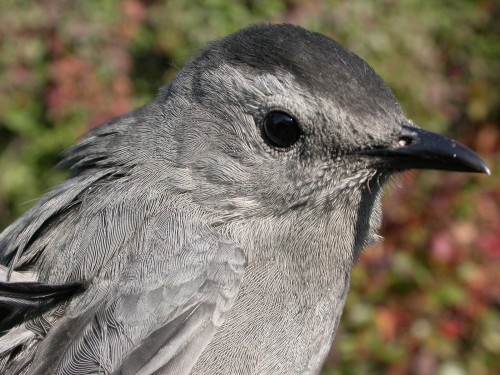
A typical AHY Gray Catbird.
Photo by Marcel Gahbauer,
McGill Bird Observatory (QC), September 2005
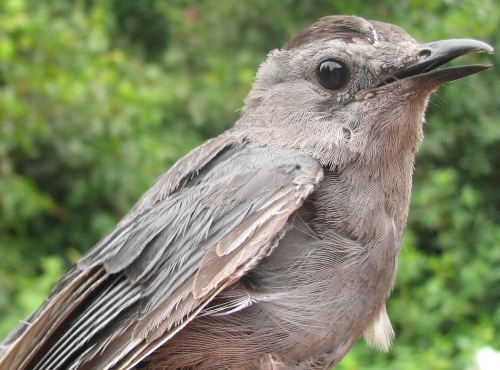
An AHY Gray Catbird in the midst of its prebasic molt; based on the pale crown with a
brownish tone and the distinctly brown retained feathers on the wing, this is very
likely a second-year individual going through its first prebasic molt.
Photo by Barbara Frei,
McGill Bird Observatory (QC), August 2007
AHY Gray Catbirds have uniformly gray wings, but
in late summer or early fall the molt limits on HY birds can be subtle, and therefore it is best to also consider other features (e.g. iris, mouth lining, undertail) when determining age.
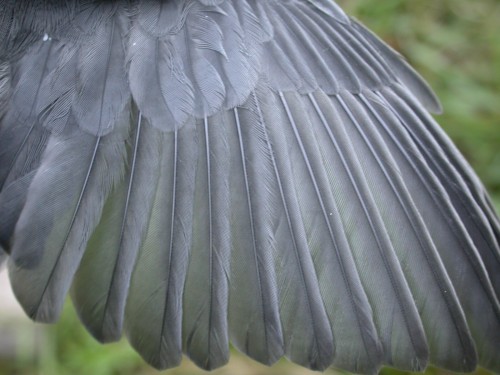
A typical AHY wing, showing uniformly gray plumage.
Photo by Marcel Gahbauer,
McGill Bird Observatory (QC), September 2005
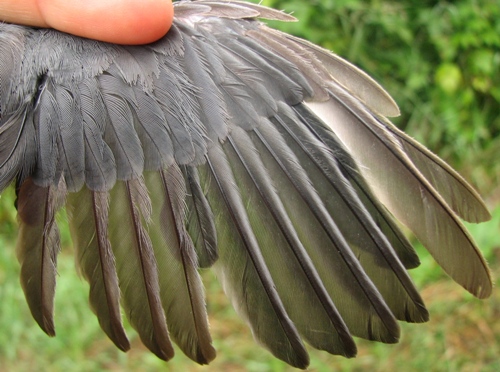
An AHY catbird undergoing its prebasic molt; considering the stark contrast between the
fresh gray plumage and the brown and very worn old feathers, it is likely second-year.
Photo by Barbara Frei,
McGill Bird Observatory (QC), August 2007
The rectrices of AHY
catbirds are generally relatively broad and rounded, and the undertail coverts are typically uniformly rusty.
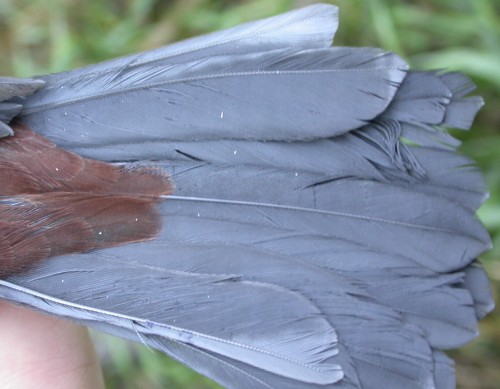
A Gray Catbird in fall with such uniformly rusty undertail coverts is very likely an AHY bird,
but since some HY catbirds also have minimal gray in this feather tract, it should not be
used as a certain indicator of age.
Photo by Marcel Gahbauer,
McGill Bird Observatory (QC), September 2005
RETURN TO AGE/SEX
OVERVIEW
|
JUL - DEC: hatch-year
unknown |
Gray Catbirds can be aged as HY by an unusually large variety of criteria, but most are either subtle, somewhat inconsistent, or difficult to assess except when in the hand, therefore it is best to consider multiple features. The wing and tail/undertail (discussed separately below) are usually the most informative for age, but in good light, a grayish to reddish-brown iris is also typical of HY catbirds. In the hand, the mouth lining (pale, sometimes mottled with black) is a useful clue, as is skull pneumatization, which is incomplete in HY catbirds until at least late fall. Sex of HY catbirds cannot be determined.
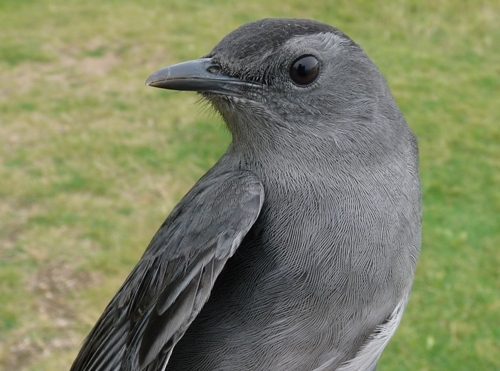
A typical view of a Gray Catbird in which it is difficult to see any characteristics that
provide reliable clues about age.
Photo by Marcel Gahbauer, Cypress Hills Provincial Park (AB), August 2010
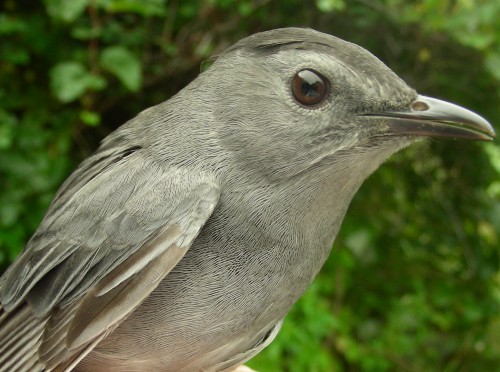
In this example, the contrast between replaced gray coverts and retained brown juvenile
wing feathers is visible to some extent, and the cap is also quite dull and pale.
Photo by Marie-Anne
Hudson, McGill
Bird Observatory (QC),
August 2007
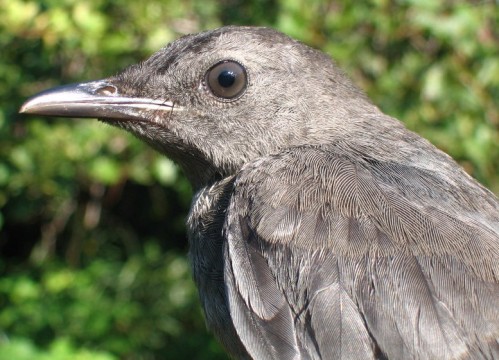
This photo nicely illustrates a distinctly gray iris on a rather young HY catbird.
Photo by Seabrooke Leckie, McGill Bird Observatory (QC), August 2006
There is usually a molt limit among the greater coverts on HY Gray Catbirds, but since all feathers are relatively fresh in fall, the contrast can be less readily evident than it tends to be in spring.
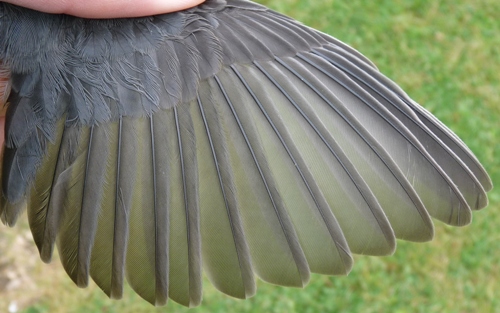
In this case the preformative molt has been fairly extensive, with two tertials, the carpal
covert, and all but the outermost three greater coverts replaced, with their bluish-gray
colour contrasting with the duller gray of the rest of juvenile feathers on the rest of the wing.
Photo by Marcel Gahbauer, Cypress Hills Provincial Park (AB), August 2010
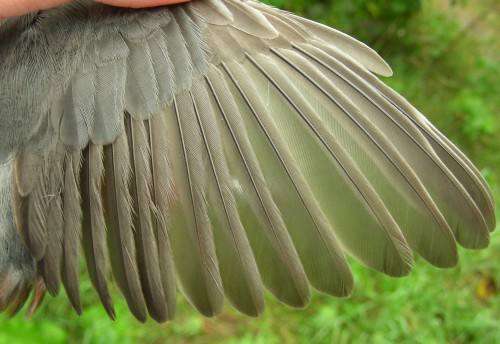
A somewhat different pattern, in which all of the greater coverts but none of the tertials have
been replaced, presenting a classic "block pattern" of replaced gray formative feathers
contrasting quite well with the brownish-gray juvenile primary coverts, primaries, and secondaries.
Photo by Marie-Anne Hudson, McGill Bird Observatory (QC), August 2007
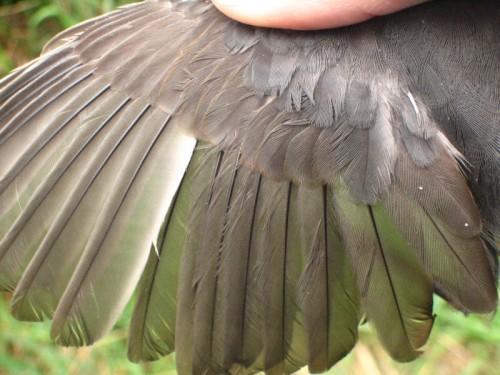
An example of a much more limited preformative molt, with only the median coverts and
the innermost greater covert replaced; again the retained feathers are distinctly more brown.
Photo by Seabrooke Leckie, McGill Bird Observatory (QC), September 2006
Although the shape of the rectrices differs less by age than in some other passerines, HY catbirds tend to have somewhat narrower outer rectrices. Growth bars across the entire tail are also quite common in HY catbirds. Loosely textured
and largely gray undertail coverts are also a good indicator of an HY catbird, as long as they remain present.
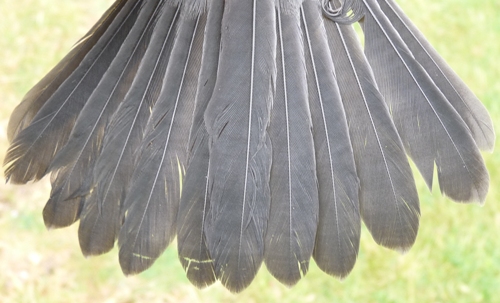
A tail with somewhat intermediate rectrix shape, but with strong growth bars
across the entire tail.
Photo by Marcel Gahbauer, Cypress Hills Provincial Park (AB), August 2010
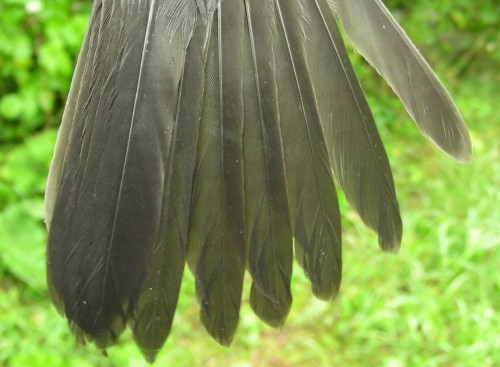
The outer rectrices in this case are more typically narrow.
Photo by Marie-Anne Hudson, McGill Bird Observatory (QC), August 2007 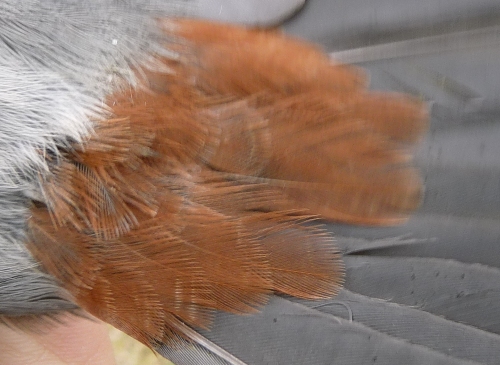
An example of an HY catbird that already has largely rusty undertail coverts, and
therefore needs to be aged by considering other criteria.
Photo by Marcel Gahbauer, Cypress Hills Provincial Park (AB), August 2010
RETURN TO AGE/SEX
OVERVIEW
|
JUN - AUG: juvenile
unknown |
Juvenile
Gray Catbirds are overall gray, sometimes with a bit of faint barring on the
breast. The crown may begin to have some contrastingly dark feathers. This
general appearance, in combination with loose undertail coverts, allows
juveniles to be reliably identified.
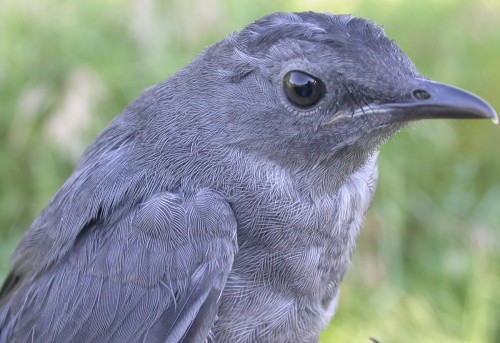
Photo by Marcel Gahbauer,
McGill Bird Observatory (QC), July 2005
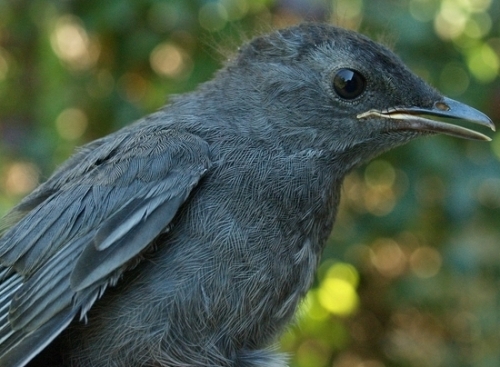
Photo by Simon Duval,
McGill Bird Observatory (QC), August 2010
The
wings of juvenile Gray Catbirds are generally uniform in colour, and are
not particularly informative for ageing.
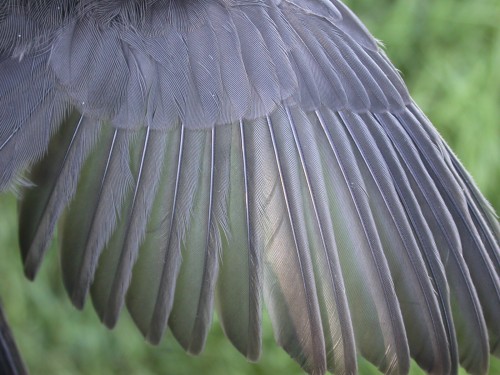
Photo by Marcel Gahbauer,
McGill Bird Observatory (QC), July 2005
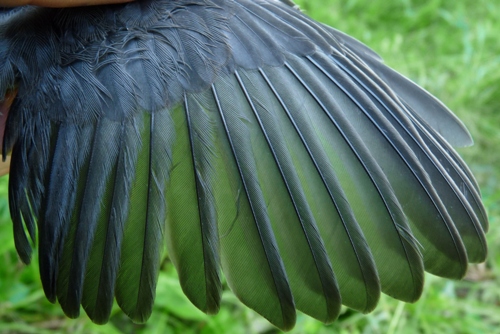
Photo by Simon Duval,
McGill Bird Observatory (QC), August 2010
Juvenile
Gray Catbirds are easily recognizable by their loosely textured undertail
coverts, which are primarily gray, with usually only a bit of rufous
showing.
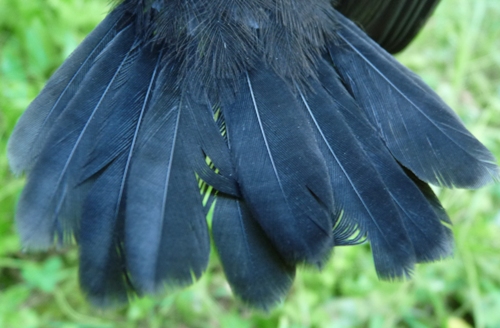
Photo by Simon Duval,
McGill Bird Observatory (QC), August 2010
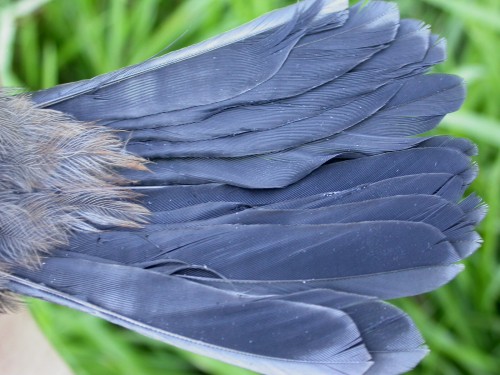
Photo by Marcel Gahbauer,
McGill Bird Observatory (QC), July 2005
RETURN TO AGE/SEX
OVERVIEW
|