 |
Introductory notes:
Hermit Thrush is distinguished from most other Catharus thrushes by its contrastingly rusty tail, but beware that Bicknell's Thrush can appear similar in this regard; Hermit Thrush can be told apart by its darker bill. Usually HY/SY Hermit Thrushes can be recognized by the pale shaft streaks on retained juvenile greater coverts, but by spring these can be faint on some individuals.
|
QUICK TIPS:
| 1) Look
at the greater coverts - the presence of buffy-white tips or
shaft streaks indicates a HY/SY bird, however the
absence of buffy-white markings is NOT an
entirely reliable indicator of AHY/ASY, as some HY/SY
birds may lack these markings
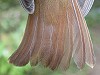
2) Consider the shape of the rectrices - they are narrow and relatively tapered on HY/SY birds, but broad and relatively rounded on AHY/ASY birds
3) Examine
the outermost primary (p10) - on HY/SY birds it
is rounded and 5 mm longer to 2 mm shorter than the
primary coverts, while on AHY/ASY birds it is
narrow, pointed, and 1 mm longer to 4 mm shorter than
the primary coverts
Species account updated February 2011
|
|
Ageing and sexing overview:
|
January - July: |
ASY - U
Broad and rounded rectrices; outermost primary (p10)
narrow and pointed and usually shorter than the primary coverts; wing uniformly brown. |
|
|
|
SY - U
Narrow and pointed rectrices; p10 broad and rounded and usually longer than the primary coverts; shaft streaks or distinct pale tips on retained outer greater coverts. |
|
|
|
|
Ageing and sexing details:
|
JAN - JUL: after-second-year
unknown |
Hermit Thrushes vary little by age, and sex can be determined only by checking for a brood patch or cloacal protuberance.
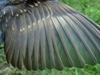
ASY Hermit Thrushes have a uniformly brown wing, without pale tips on any greater coverts. To confirm age, it can be useful to look closely at p10, which is narrow and tapered, and usually shorter than the primary coverts (ranging from 1 mm longer to 4 mm shorter).
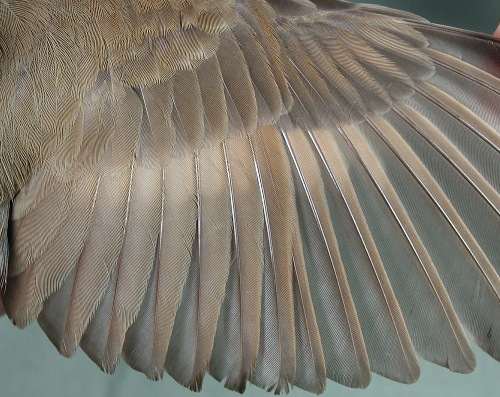
A typical ASY wing, with uniform graeter coverts, and p10 marginally appearing
to be narrow and moderately shorter than the adjacent primary coverts.
Photo by Peter Pyle, Big Sur Ornithology Lab (CA), March 2007
ASY Hermit Thrushes have relatively broad and rounded rectrices.
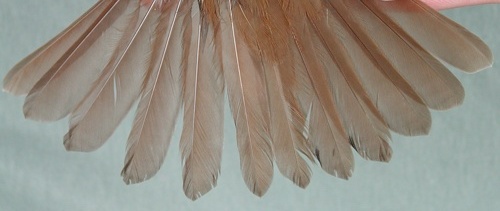
The outer rectrices show the broad and rounded shape typical of ASY Hermit Thrushes.
Photo by Peter Pyle, Big Sur Ornithology Lab (CA), March 2007
RETURN TO AGE/SEX
OVERVIEW
|
JAN - JUL: second-year
unknown |
Overall plumage is rarely helpful in ageing Swainson's Thrushes, but in some cases SY individuals have readily visible pale tips to their retained juvenile greater coverts, which are a diagnostic feature.
SY Hermit Thrushes retain most to all of their juvenile greater coverts, which usually have pale tips or shaft streaks. Also, p10 is broader and more rounded than on ASY birds, and often longer than the primary coverts (ranging from 2 mm shorter to 5 mm longer).
SY Hermit Thrushes have relatively narrow and pointed rectrices.
RETURN TO AGE/SEX
OVERVIEW
|
JUL - DEC: after-hatch-year
unknown |
Overall appearance usually cannot be used to identify AHY Hermit Thrushes, since the pale tips to the greater coverts that may be used to distinguish HY individuals are not always visible, and with the wing closed, AHY Hermit Thrushes can also appear to have some pale colouration there.
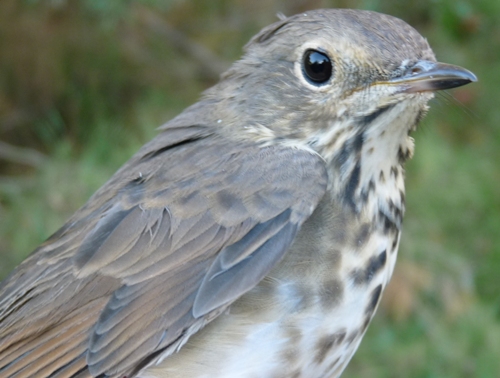
A typical AHY Hermit Thrush.
Photo by Marcel Gahbauer,
McGill Bird Observatory (QC), October 2010
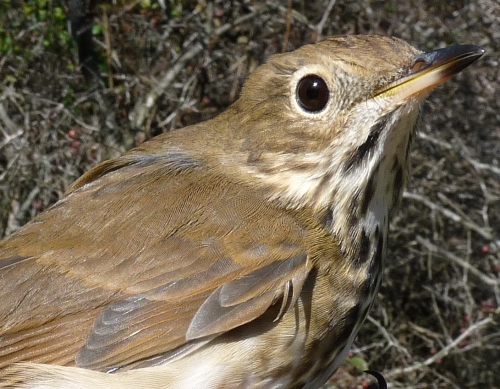
Another typical AHY Hermit Thrush, with a somewhat more rusty appearance, largely
due to the effect of sunlight on the plumage.
Photo by Marcel Gahbauer,
McGill Bird Observatory (QC), October 2010
AHY Hermit Thrushes have uniformly brown greater coverts, without distinctly pale tips or shaft streaks, though the edging may be somewhat lighter brown. Additionally, p10 is narrow, pointed, and usually shorter than the adjacent primary coverts (ranging from 1 mm longer to 4 mm shorter).
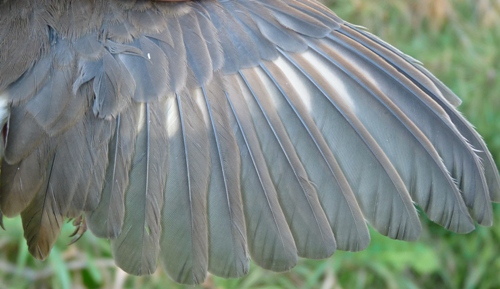
A late-molting AHY Hermit Thrush, with the last secondaries and outermost primaries
just growing in, and uniformly brown greater coverts.
Photo by Marcel Gahbauer,
McGill Bird Observatory (QC), October 2010
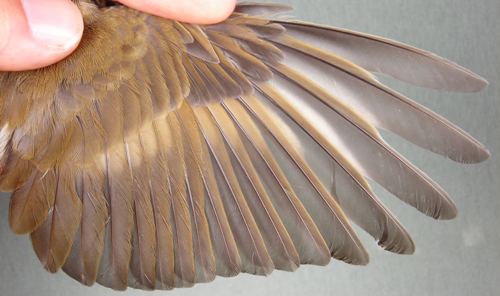
A typical AHY wing, with uniformly brown greater coverts that have just a trace of pale edging.
Photo by Peter Pyle, Big Sur Ornithology Lab (CA), October 2007
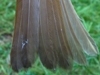
AHY Hermit Thrushes have broad rectrices with relatively blunt tips.
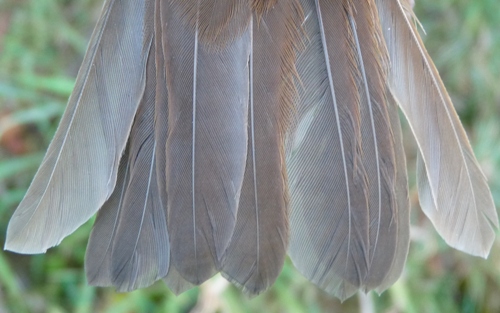
This example show that relatively broad rectrices can sometimes appear a bit pointed
at the tip, though generally less so than is seen on HY Hermit Thrushes.
Photo by Marcel Gahbauer,
McGill Bird Observatory (QC), October 2010
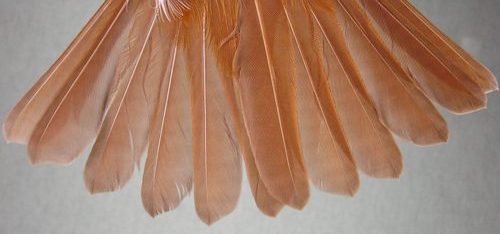
A typical AHY Hermit Thrush tail featuring broad and blunt-tipped rectrices.
Photo by Peter Pyle, Big Sur Ornithology Lab (CA), October 2007
RETURN TO AGE/SEX
OVERVIEW
|
JUL - DEC: hatch-year
unknown |
Overall plumage is rarely helpful in ageing Hermit Thrushes, but with a good view of the wing of a perched individual, it may be possible to spot the distinct pale shaft streaks on retained juvenile greater coverts, which are a diagnostic feature of HY individuals.
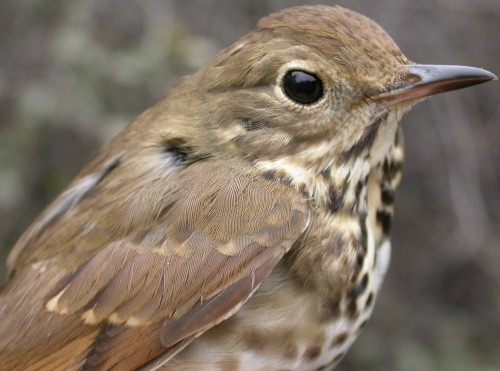
This HY Hermit Thrush shows distinct shaft streaks on not only the greater coverts,
but also
some of the median coverts.
Photo by Marcel Gahbauer,
McGill Bird Observatory (QC), October 2005
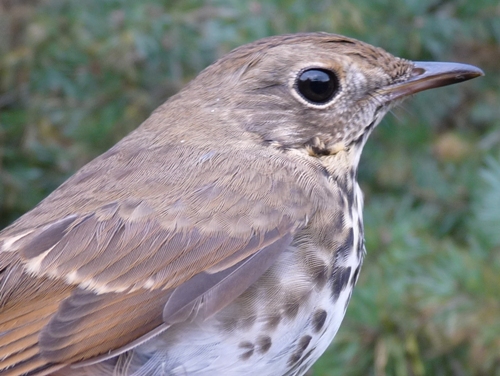
Another example of an HY Hermit Thrush readily identifiable by its juvenile greater coverts.
Photo by Marcel Gahbauer, McGill Bird Observatory (QC), October 2010
HY Hermit Thrushes usually retain most to all of their juvenile greater coverts, and these usually show either distinct pale shaft streaks, or pale tips, with the markings progressively smaller toward the outer part of the wing. Additionally, p10 is relatively broad, rounded, and usually longer than the adjacent primary coverts (ranging from 2 mm shorter to 5 mm longer).
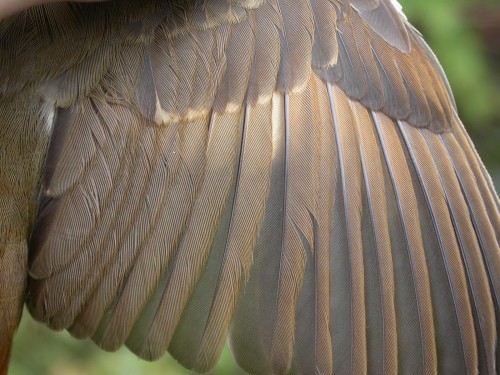
A typical HY Hermit Thrush wing, showing distinct shaft streaks on the inner greater
coverts, with the pale markings getting progressively smaller on the outer coverts.
Photo by Marcel Gahbauer,
McGill Bird Observatory (QC), October 2005
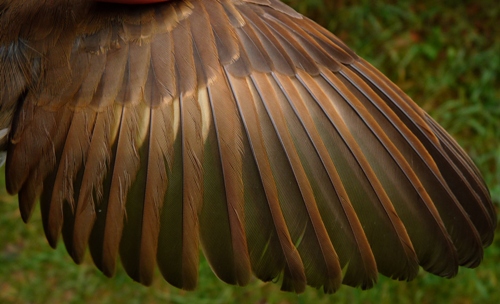
A less typical example, in which several inner greater overts appear to have been
replaced, and the outer greater coverts have only small pale tips, but note that there
are also pale tips remaining on the median coverts, only seen in HY Hermit Thrushes.
Photo by Marcel Gahbauer,
McGill Bird Observatory (QC), October 2009
HY Hermit Thrushes have narrow and relatively pointed rectrices.
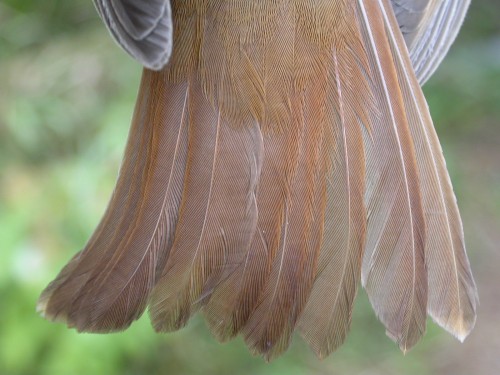
A typical HY Hermit Thrush tail, with distinctly narrow and pointed outer rectrices.
Photo by Marcel Gahbauer,
McGill Bird Observatory (QC), October 2005
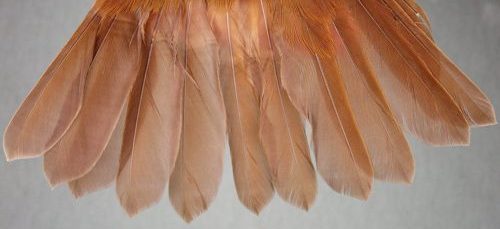
A somewhat more intermediate example, with rectrices still quite pointed, but as
wide as would be seen on some AHY Hermit Thrushes.
Photo by Peter Pyle, Big Sur Ornithology Lab (CA), October 2007
RETURN TO AGE/SEX
OVERVIEW
JUN - AUG: juvenile
unknown |
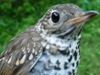
Juvenile Hermit Thrushes can be readily recognized by their more spotted plumage, especially on the back and wings, where the lesser and median coverts have large pale centres.
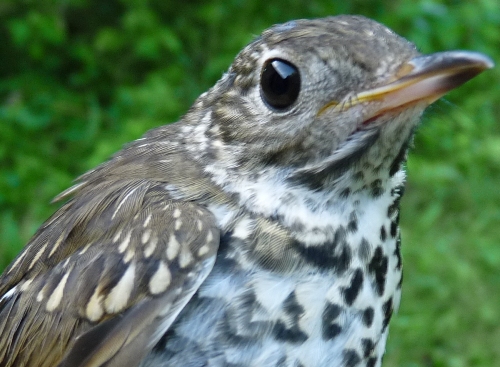
A distinctly marked juvenile, with large pale marks on the lesser and median coverts.
Photo by Marcel Gahbauer,
McGill Bird Observatory (QC), August 2009
Juvenile Hermit Thrushes show distinct white shaft streaks on the greater, median, and lesser coverts.
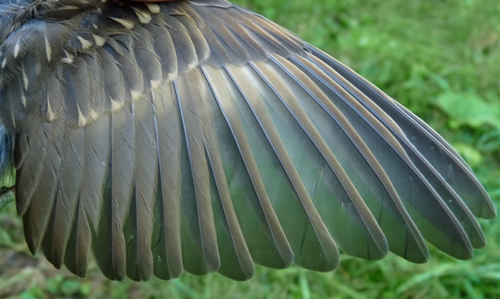
Photo by Marcel Gahbauer,
McGill Bird Observatory (QC), August 2009
Juvenile Hermit Thrushes have narrow and pointed rectrices.
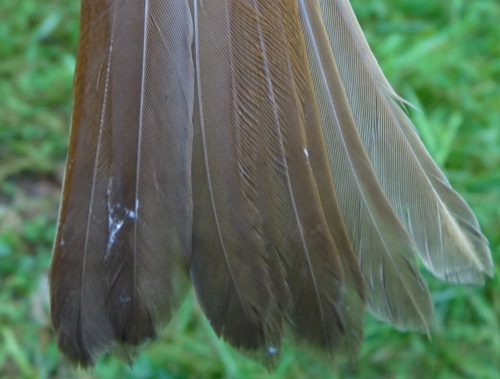
Photo by Marcel Gahbauer,
McGill Bird Observatory (QC), August 2009
RETURN TO AGE/SEX
OVERVIEW
|