|
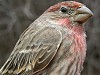
House Finch / Roselin familier (Carpodacus mexicanus) |
 |
Introductory notes:
A somewhat complex challenge for ageing and sexing, since the extent of the preformative molt is highly variable both within and among populations. All individuals showing red are males, but some males may remain entirely brown until their first prebasic molt. Molt limits on the wing, including eccentric molt among the primaries, are the best feature to check for ageing. |
QUICK TIPS:
| 1) Look
at the head and upper breast - any red plumage indicates a
male, while lack of red may be a female or a young (HY/SY)
male
2) Compare the greater coverts and primary coverts - there is usually a molt limit between darker grayish-brown greater coverts and paler brown primary coverts on HY/SY birds, while they appear uniform in colour and wear on AHY/ASY birds
3) Examine the shape of the primary coverts - they tend to be relatively narrow and pointed on HY/SY House Finches, but broad and rounded on AHY/ASY individuals.
4) Check
the rectrices - if some or all are narrow and
tapered they indicate a HY/SY bird, but if they are
all uniformly broad and rounded the bird may be
either AHY/ASY or HY/SY |
Species account updated January 2011 |
Ageing and sexing overview:
|
January - July: |
AHY - M
Red plumage on the head and upper breast; broad and
rounded rectrices and outer primary coverts. |
|
|
|
AHY - F
Lack of any red plumage; broad and rounded rectrices and
outer primary coverts. |
|
|
|
SY - M
Little to considerable red plumage; molt limits on the wing (including replaced outer primaries in some individuals); mix of old and new rectrices on some individuals. |
|
|
|
SY - F
Lack of any red plumage; molt limits on the wing (including replaced outer primaries in some individuals); mix of old and new rectrices on some individuals. |
|
|
|
|
Ageing and sexing details:
|
JAN - JUL: after-hatch-year
male |
Since HY House Finches may undergo a complete preformative molt, any individuals with red in spring that lack visible molt limits on the wing or tail should be considered AHY males.
House Finches lacking a molt limit on the wing should generally be considered AHY.
AHY House Finches have relatively broad and rounded rectrices.
RETURN TO AGE/SEX
OVERVIEW
|
JAN - JUL: after-hatch-year
female |
Like males, female House Finches should be considered AHY in spring unless there are visible molt limits on the wing or tail.
House Finches lacking a molt limit on the wing should generally be considered AHY.
AHY House Finches have relatively broad and rounded rectrices.
RETURN TO AGE/SEX
OVERVIEW
|
JAN - JUL: second-year
male |
A fair number of SY House Finches (variable by population) do not undergo a complete preformative molt, and can be aged in spring by their molt limits. By this time, most males have some red plumage (exceptions may be limited to southwestern populations).
SY House Finches often have a molt limit between the replaced greater coverts and paler brown retained primary coverts, and in some cases also show an eccentric molt among the primaries, with the outermost few feathers darker and fresher than the retained inner primaries.
Some SY House Finches can be aged by having a visibly contrasting mix of juvenile and formative rectrices.
RETURN TO AGE/SEX
OVERVIEW
|
JAN - JUL: second-year
female |
As with males, a fair number of SY House Finches (variable by population) do not undergo a complete preformative molt, and can be aged in spring by their molt limits. By this time, individuals lacking red plumage can generally be identified as females (exceptions may be limited to southwestern populations).
SY House Finches often have a molt limit between the replaced greater coverts and paler brown retained primary coverts, and in some cases also show an eccentric molt among the primaries, with the outermost few feathers darker and fresher than the retained inner primaries.
Some SY House Finches can be aged by having a visibly contrasting mix of juvenile and formative rectrices.
RETURN TO AGE/SEX
OVERVIEW
|
JUL - DEC: after-hatch-year
male |
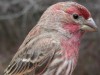
Only males have red plumage, but the extent of it can be very similar between HY and AHY males, therefore other characteristics such as molt limits on the wing, rectrix shape, or skull pneumatization need to be checked to determine age. Note that some HY House FInches may undergo a complete preformative molt, therefore by late in the year birds that appear to be AHY may better be considered unknown age, at least in areas where complete preformative molt is known to occur.
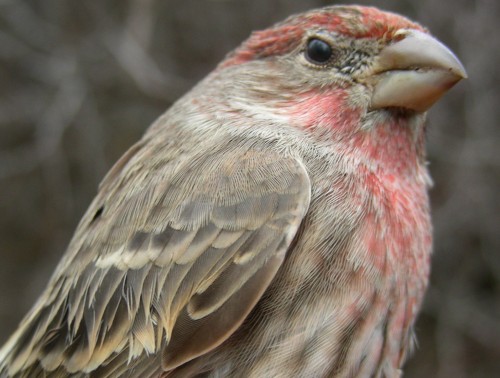
An AHY male with a relative limited amount of red on the breast and head.
Photo by Marcel Gahbauer,
McGill Bird Observatory (QC), November 2006
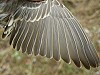
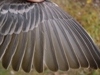
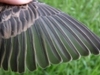
Whereas HY House Finches usually show one or more molt limits on the wing, AHY individuals have a uniformly brown wing. Their primary coverts also tend to be somewhat broader and more rounded, although appearance of shape can vary considerably depending on position of the wing.
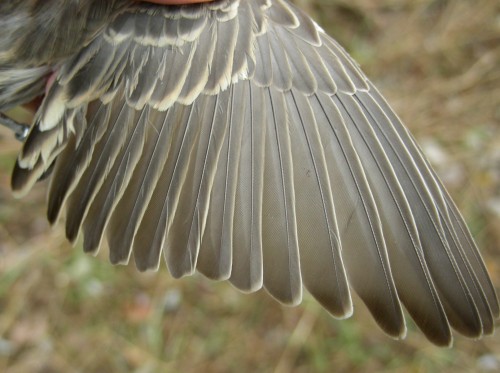
An AHY wing, lacking molt limits, and with relatively broad and rounded primary coverts.
Photo by Marcel Gahbauer,
McGill Bird Observatory (QC), November 2006
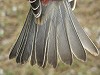
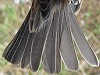
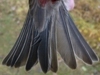
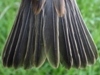
AHY House Finches have relatively broad and rounded rectrices, but note that this feature is of limited use, since many HY individuals also replace their entire tail during their preformative molt, resulting in a similar appearance.
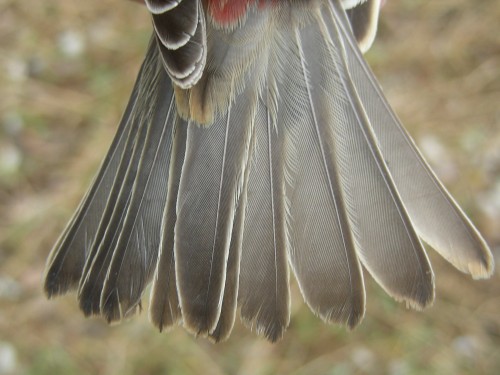
A relatively intermediate tail, with somewhat broad and rounded rectrices, but not
sufficiently distinct to provide a distinct indicator of age.
Photo by Marcel Gahbauer,
McGill Bird Observatory (QC), November 2006
RETURN TO AGE/SEX
OVERVIEW
|
JUL - DEC: after-hatch-year
female |
House Finches lacking red may either be
females of any age or hatch-year males; as noted for AHY males, wing and tail criteria (or skull) need to
be examined to classify them further. As with males, HY females may undergo a complete preformative molt, and therefore by late in the year it may be preferable to call apparent AHY birds age unknown.
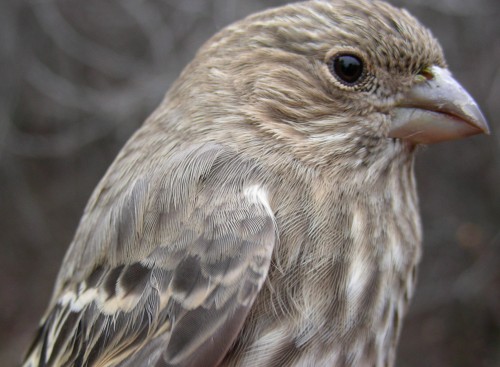
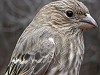
A typical AHY female, although from this view it could not be distinguished from
a HY female, or from some HY males.
Photo by Marcel Gahbauer,
McGill Bird Observatory (QC), November 2006
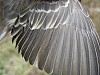
As with males, AHY females have a uniformly brown wing, lacking any molt limits, and typically with relatively broad and somewhat rounded primary coverts.
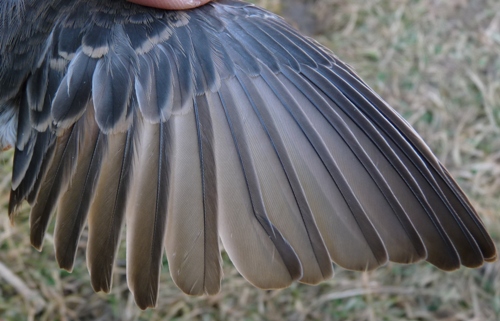
The wing of a recaptured female known to be at least three years old, just completing its
prebasic molt, with s6 still growing in. Note that while the wing is uniformly brown,
the primary coverts from this angle do not appear as broad or rounded as expected.
Photo by Marcel Gahbauer,
McGill Bird Observatory (QC), November 2009
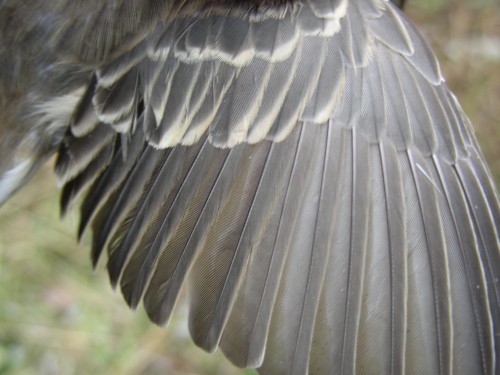
A closer view of a different AHY female's wing, this time showing the more
typical broad and rounded primary coverts, and again lacking a molt limit.
Photo by Marcel Gahbauer,
McGill Bird Observatory (QC), November 2006
AHY House Finches of both sexes have relatively broad and rounded rectrices, but this feature is of limited use, since many HY individuals also replace their entire tail during their preformative molt, resulting in a similar appearance.
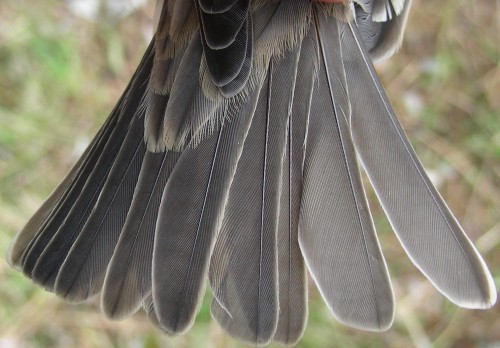
A typical AHY tail, with broad and rounded rectrices.
Photo by Marcel Gahbauer,
McGill Bird Observatory (QC), November 2006
RETURN TO AGE/SEX
OVERVIEW
|
JUL - DEC: hatch-year
male |
Hatch-year
males may vary from being entirely brown to having as much red as typical AHY males, depending on timing and the extent of their preformative molt. Although some individuals may undergo a complete preformative molt, after which they are best classified as age unknown, most show molt limits on the wing that can be used to confirm age.
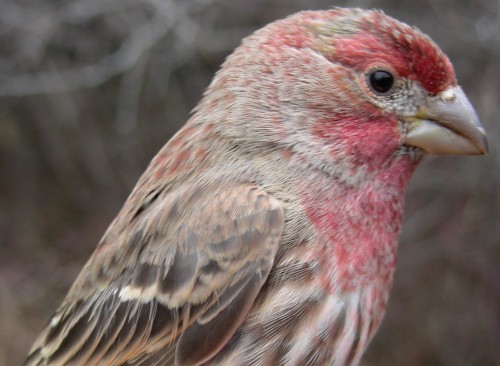
A relatively typical late fall HY male, with a fair amount of red plumage, but showing some
retained brownish patches, such as on the hind part of the crown in this bird.
Photo by Marcel Gahbauer, McGill Bird Observatory (QC), November 2006
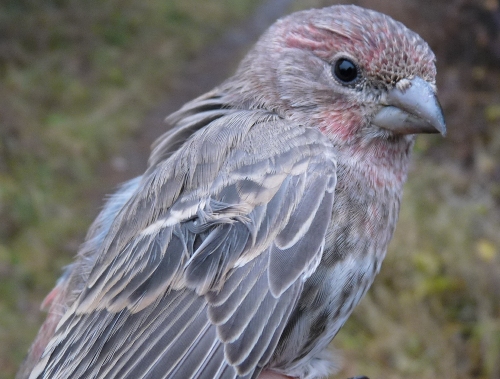
A paler HY male, with only a bit of red beginning to show up on the head and rump.
Photo by Marcel Gahbauer, McGill Bird Observatory (QC), November 2009
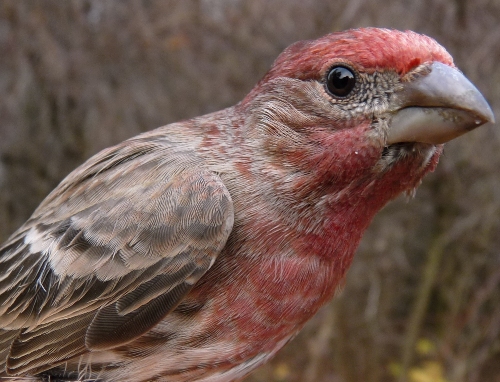
A particularly red HY male.
Photo by Marcel Gahbauer,
McGill Bird Observatory (QC), November 2009
Molt limits on the wing provide the easiest way to recognize HY House Finches. Most commonly there is a contrast between the dark formative greater coverts and the somewhat paler brown juvenile primary coverts. Quite frequently there is also an eccentric molt, with a contrast showing between the darker replaced outermost primaries, and the paler retained inner primaries (which usually match the primary coverts in colour and wear).
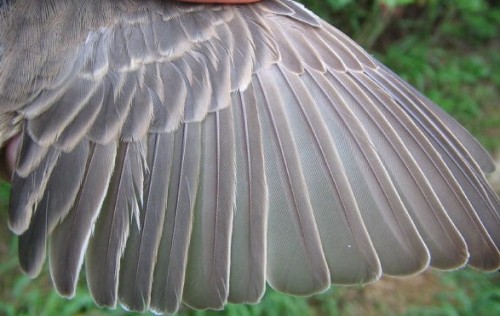
This example shows a strong contrast between the greater coverts and primary coverts,
and the alula is also contrastingly dark in comparison with the primary coverts. Also,
an eccentric molt has taken place, with the outermost three primaries replaced.
Photo by Marcel Gahbauer, McGill Bird Observatory (QC), November 2006
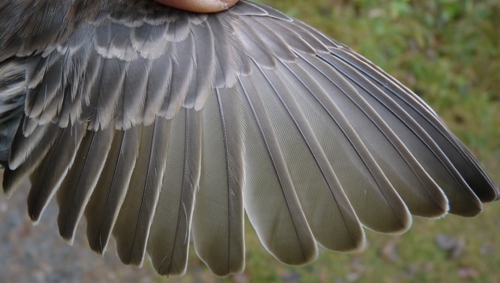
A similar pattern to the bird above, but with the contrast less obvious, since the
retained juvenile primary coverts and inner primaries are less faded.
Photo by Marcel Gahbauer,
McGill Bird Observatory (QC), November 2009
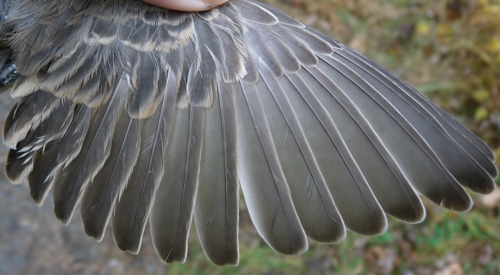
A somewhat different pattern, in which the outermost greater covert has been retained,
contrasting with the longer and darker replaced greater coverts.
Photo by Marcel Gahbauer,
McGill Bird Observatory (QC), November 2009
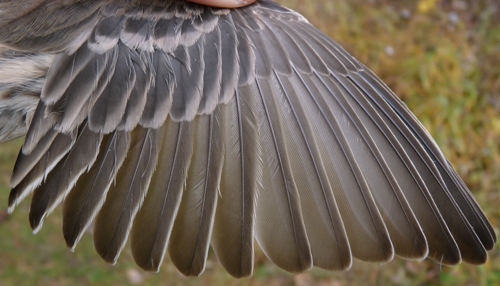
In this example, all of the greater coverts have been replaced, and contrast with the juvenile
primary coverts. It is difficult to tell whether the outermost primaries have been replaced
in an eccentric molt, or just appear darker because they are overlapping more extensively.
Photo by Marcel Gahbauer,
McGill Bird Observatory (QC), November 2009
The tail can be useful for ageing if
it includes unreplaced juvenile rectrices. However, many HY House Finches replace their entire tail as part of their preformative molt, after which it is not helpful for ageing, since it is similar to that of AHY House Finches.
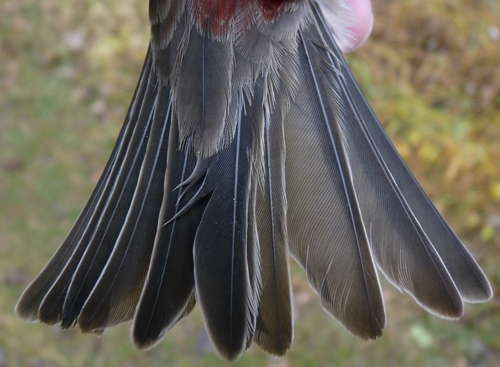
The outer rectrices are somewhat narrow and tapered, suggesting that they may be
juvenile feathers, but they are not distinct enough to be considered reliable in this case.
Photo by Marcel Gahbauer,
McGill Bird Observatory (QC), November 2009
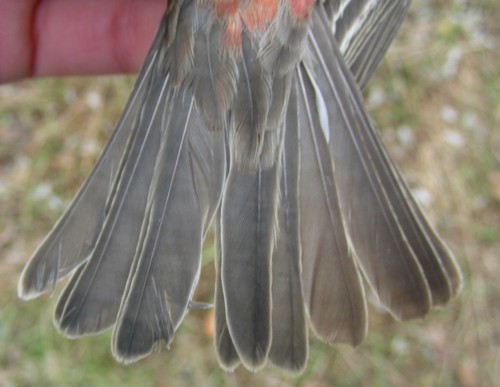
Especially on the right side of the tail, the rectrices look quite broad and rounded,
suggesting that they have been replaced.
Photo by Marcel Gahbauer,
McGill Bird Observatory (QC), November 2006
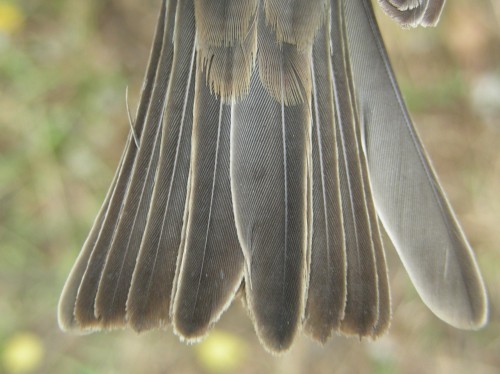
In this example, note the contrast between the broader and fresher central (r1) and
outer (r6) rectrices, compared with the other retained feathers; such a pattern or any
other mix of juvenile and formative rectrices indicates an HY House Finch.
Photo by Marcel Gahbauer,
McGill Bird Observatory (QC), November 2006
RETURN TO AGE/SEX
OVERVIEW
|
JUL - DEC: hatch-year
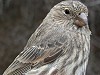
unknown (female) |
House Finches lacking red may either be
females of any age or hatch-year males; wing and tail criteria (or skull pneumatization) need to
be examined to classify them further. Since some HY males lack any red plumage, brown HY birds should by default be considered sex unknown, even though most of them are likely females.
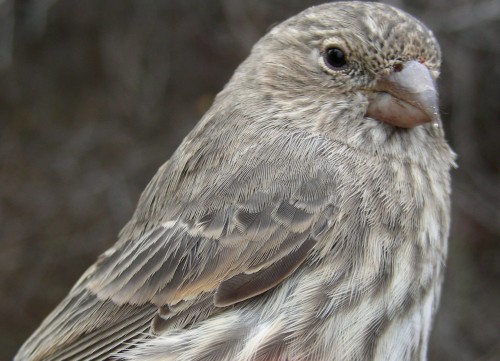
A relatively uncommon example, where a molt limit on the wing is visible on a perched
bird, allowing it to be easily recognized
as a HY bird.
Photo by Marcel Gahbauer,
McGill Bird Observatory (QC), November 2006
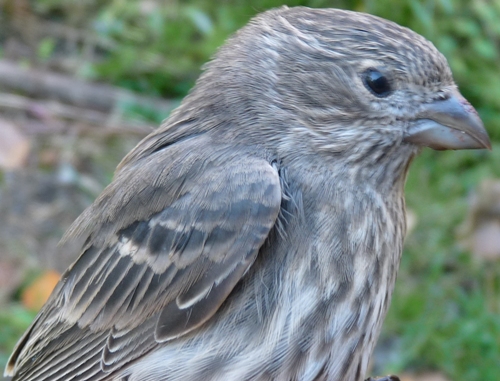
A more typical example, brownish and showing no obvious indicators of age.
Photo by Marcel Gahbauer,
McGill Bird Observatory (QC), October 2010
As with males, molt limits on the wing provide the best way to recognize the age of HY female/unknown House Finches. Most commonly there is a contrast between the dark formative greater coverts aand the somewhat paler brown juvenile primary coverts. Quite frequently there is also an eccentric molt, with a contrast showing between the darker replaced outermost primaries, and the paler retained inner primaries (which usually match the primary coverts in colour and wear).
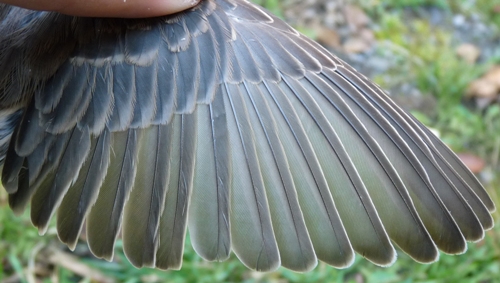
In this case, there is a molt limit between the greater coverts and primary coverts, the
most common location for it to appear on House Finches.
Photo by Marcel Gahbauer,
McGill Bird Observatory (QC), October 2010
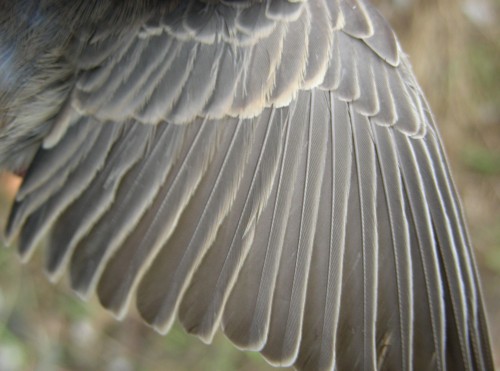
An unusually limited preformative molt, with the outermost three juvenile greater coverts
unreplaced, contrasting visibly with the inner formative greater coverts.
Photo by Marcel Gahbauer, McGill Bird Observatory (QC), November 2006
The tail can be useful for ageing House Finches if it includes unreplaced juvenile rectrices. However, many HY House Finches replace their entire tail as part of their preformative molt, after which it appears similar to that of AHY individuals. Since there is also some degree of overlap in rectrix shape across age classes, the best way to recognize HY birds is by a mix of formative and juvenile feathers.
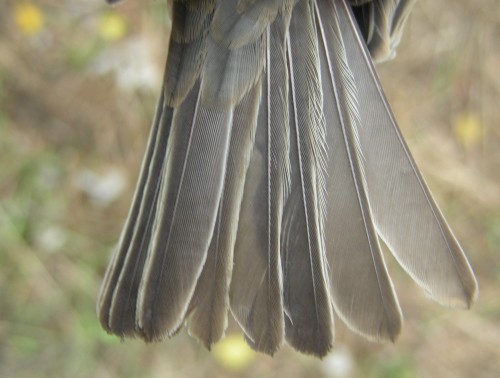
An uninformative tail, with what appears to be formative feathers.
Photo by Marcel Gahbauer,
McGill Bird Observatory (QC), November 2006
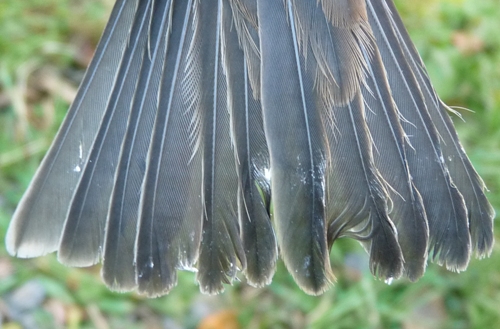
Although the wear on some feathers may be temporary and distracting, it appears that the
outermost rectrix on the left side is contrastingly broad and round, suggesting that this
is an HY bird with a mix of formative and juvenile rectrices.
Photo by Marcel Gahbauer,
McGill Bird Observatory (QC), October 2010
RETURN TO AGE/SEX
OVERVIEW
JUN - AUG: juvenile unknown |
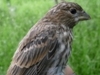
Juveniles prior to their preformative molt are brownish, without any differences between sexes.
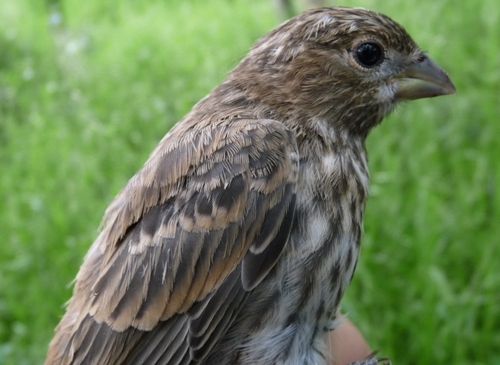
Photo by Marcel Gahbauer,
Inglewood Bird Sanctuary (AB), July 2009
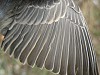
The wing of juveniles is uniformly brown, and at a glance can appear similar to that of AHY House Finches; the best way to be certain in summer is to check skull pneumatization..
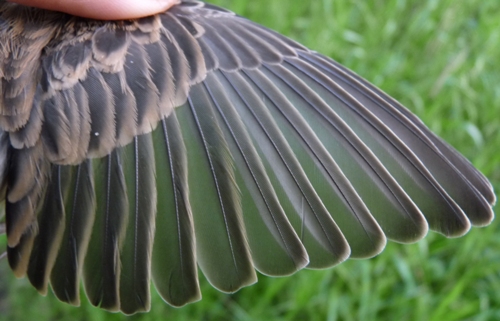
Photo by Marcel Gahbauer, Inglewood Bird Sanctuary (AB), July 2009
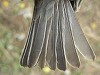
Juvenile House Finches tend to have somewhat narrower and more tapered rectrices than AHY birds, but while feathers are fresh, the distinction can be subtle, and as with the wing, it may be difficult to be confident in ageing.

Photo by Marcel Gahbauer,
Inglewood Bird Sanctuary (AB), July 2009
RETURN TO AGE/SEX
OVERVIEW
|