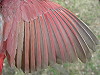
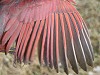
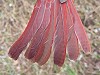
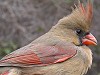
 |
Introductory notes:
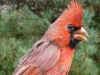
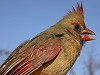
A distinctive species, in which sex can be easily recognized by plumage (except in juveniles), and with particularly noticeable molt limits that makes identification of HY/SY individuals very easy. However, since some preformative molts are complete, it is not possible to reliably call any individuals after-second-year; more study is needed on the frequency of complete molts. |
QUICK TIPS:
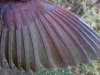
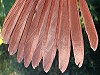
1) Examine
the wing for molt limits - on HY/SY birds there are often sharp contrasts between brown and
faded feathers and fresh red feathers (males) or brown
feathers with red edging (females) among the
primaries and secondaries, as well as the primary
coverts; note that some HY birds undergo a complete
preformative molt and will not show any molt limits
after it has been completed
2) Check
the bill colour - it is gray to blackish
on HY birds (usually through to at least September), and orange-red
on AHY birds (but by late fall, HY birds may have few or no dark patches remaining)
3) Look
at the overall plumage - on males it is mostly
red, while on females it is mostly brown,
with red on the crest, wings, and tail
Species account updated January 2011 |
|
Ageing and sexing guidelines:
Ageing and sexing details:
|
JAN - JUL: after-hatch-year
male |
AHY
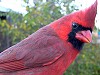
male Northern Cardinals are unmistakable. The body plumage is
entirely red aside from the black facial mask, though note that colour may appear quite
different depending on lighting. While feathers on the
back and wings may have gray edging, there are no brown juvenile feathers
visibly contrasting with the red adult feathers. Since the preformative molt may be complete in Northern Cardinals, any individuals with this appearance must be considered AHY rather than ASY.
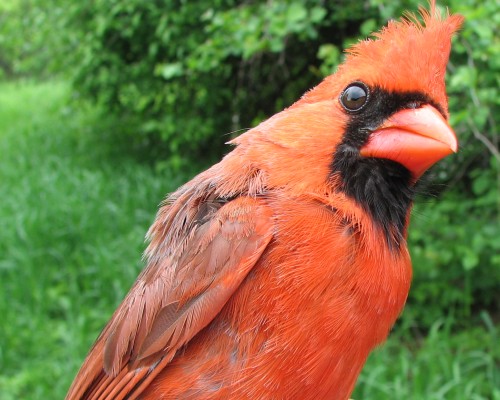
Photo by Barbara Frei,
McGill Bird
Observatory (QC), May 2006
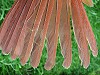
The wing is entirely red, without any molt limits.
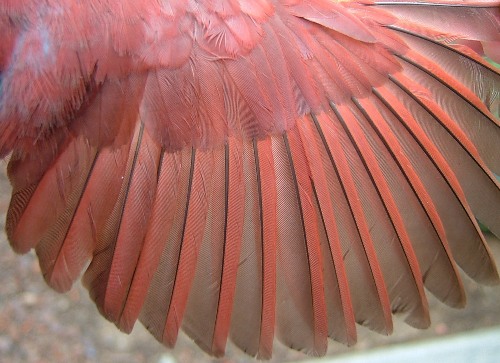
Photo by Peter Pyle, Howell Woods (NC), May 2006
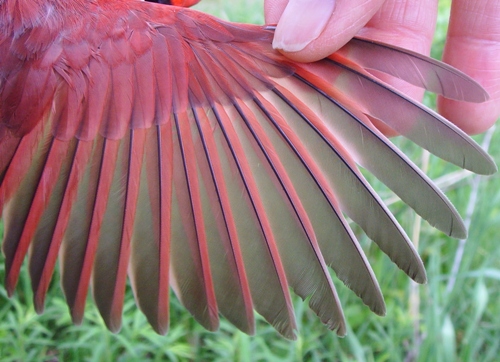
Photo by Peter Pyle, Merry Lea (IN), May 2007
The tail is uniformly brick red.
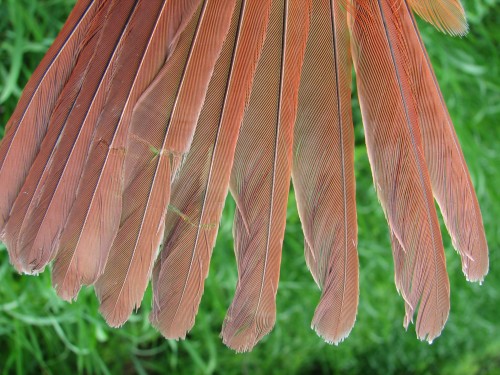
Photo by Barbara Frei, McGill Bird
Observatory (QC), May 2006
RETURN TO AGE/SEX
OVERVIEW
|
JAN - JUL: after-hatch-year
female |
AHY
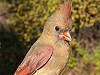
female Northern Cardinals are primarily brown, with red on the crest,
bill, and wings.
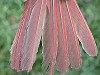
The wing is uniformly grayish-red, without any molt limits.
RETURN TO AGE/SEX
OVERVIEW
|
JAN - JUL: second-year
male |
SY males can be recognized primarily by retention of juvenile feathers on the wing; these may sometimes be visible on a perched bird, but are
more readily observed on the open wing.
The presence of one or more retained brown juvenile feathers is indicative of a second-year Northern Cardinal.
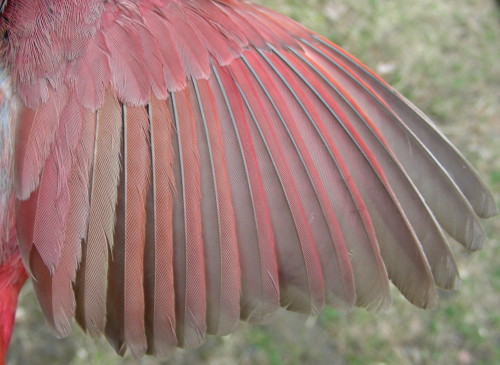
This individual had a nearly complete preformative molt, but the presence of one brown
retained juvenile secondary (s6) is sufficient to recognize this as a SY bird.
Photo by Marie-Anne Hudson, McGill Bird Observatory (QC), April 2009
RETURN TO AGE/SEX
OVERVIEW
|
JAN - JUL: second-year
female |
SY females can be recognized primarily by retention of juvenile feathers on the wing; these may sometimes be visible on a perched bird, but are
more readily observed on the open wing.
Any Northern Cardinals showing molt limits among or between feather tracts in the first half of the year can be reliably aged as second-year.
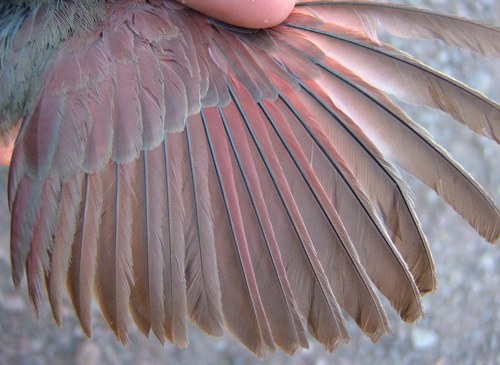
In this example, the preformative molt appears to have been limited to the primaries and
tertials, with the secondaries as a block showing as uniformly browner and more worn.
Photo by Peter Pyle, Hermosillo (MEX), July 2007
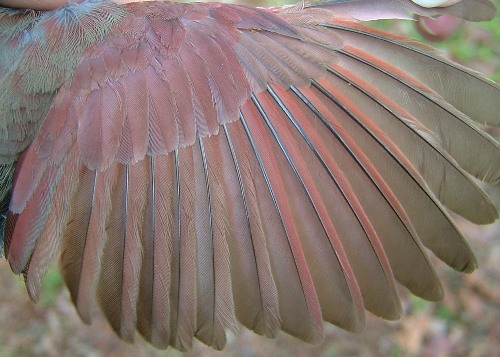
Molt limits on this wing are apparent between the replaced primaries and retained primary
coverts and secondaries, both of which are brown rather than red.
Photo by Peter Pyle, Howell Woods (NC), May 2006
RETURN TO AGE/SEX
OVERVIEW
|
JUN - DEC: unknown age
male (probable after-hatch-year) |
AHY
male Northern Cardinals are unmistakable. The body plumage is
entirely red aside from the black facial mask, though colour may appear quite
different depending on lighting. While feathers on the
back and wings may have gray edging, there are no brown juvenal feathers
visibly contrasting with the red adult feathers. Most such individuals are after-hatch-year, and in summer through early-mid fall, they are likely reliably aged as such. However, by late in the year it is possible that some hatch-year individuals will have undergone a complete preformative molt, at which point they would appear identical, so unknown age is more appropriate.
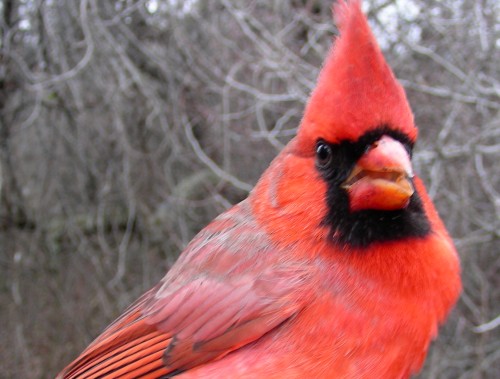
Photo by Marcel Gahbauer, McGill Bird
Observatory (QC),
November 2006
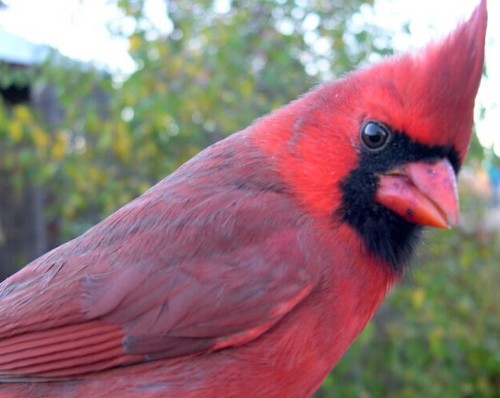
Note the more grayish tone to the back of this individual; this is not known to provide any
additional informatoin regarding age, but further study may be warranted.
Photo by Lance Laviolette, McGill Bird
Observatory (QC),
October 2004
The wing is uniformly red, with no molt limits within or among any feather tracts.
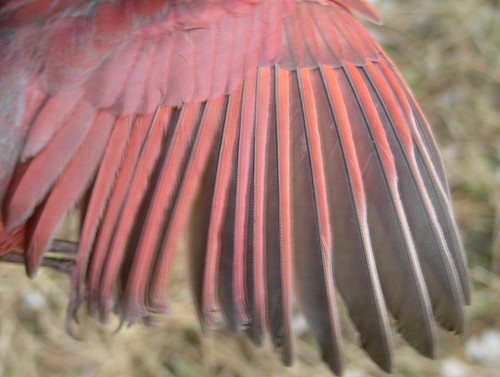
Photo by Marcel Gahbauer, McGill Bird Observatory (QC),
November 2006
The tail is uniformly brick red.
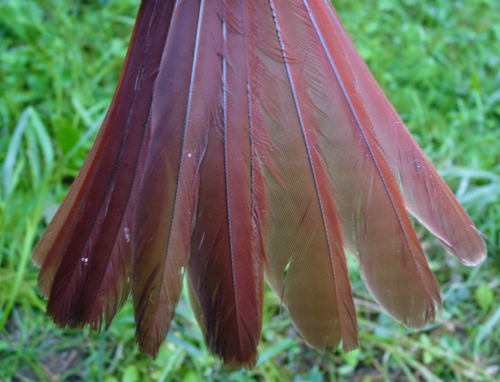
Photo by Marcel Gahbauer, McGill Bird Observatory (QC), August 2009
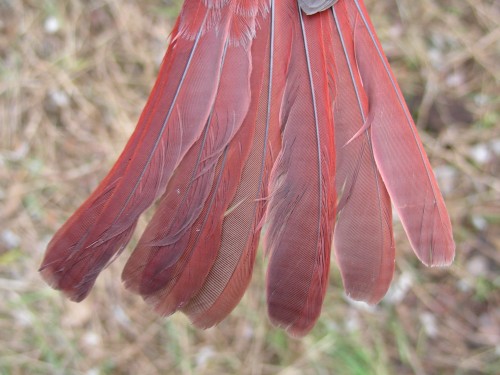
Photo by Marcel Gahbauer, McGill Bird Observatory (QC),
November 2006
RETURN TO AGE/SEX
OVERVIEW
|
JUN - DEC:
unknown age
female (probable after-hatch-year) |
AHY
female Northern Cardinals are primarily brown, with red on the crest,
bill, and wings. It is primarily the absence of a molt limit on the
wings which indicates the age of this bird as AHY. Other AHY
characteristics are the dark brown iris (gray or grayish-brown in HY) and
uniformly red bill (dark in HY birds until mid- to late fall). As with males, individuals with these characteristics are very likely after-hatch-year from summer through early-mid fall, but later in the year may be indistinguishable from hatch-year birds that have undergone a complete preformative molt.
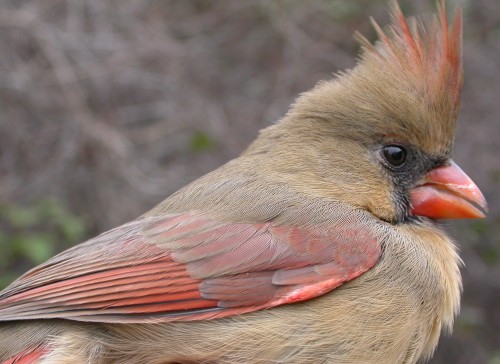
A typical after-hatch-year female.
Photo by Marcel Gahbauer, McGill Bird Observatory (QC),
November 2006
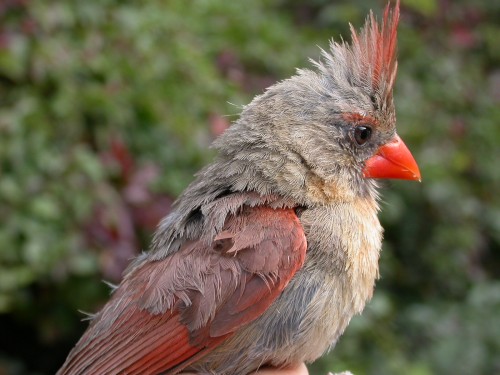
A rather worn after-hatch-year female, likely photographed shortly before its prebasic molt.
Photo by Marcel Gahbauer, McGill Bird
Observatory (QC),
August 2005
The wings of after-hatch-year female Northern Cardinals are grayish-brown with broad dull red edging, lacking in molt limits within or among feather tracts.
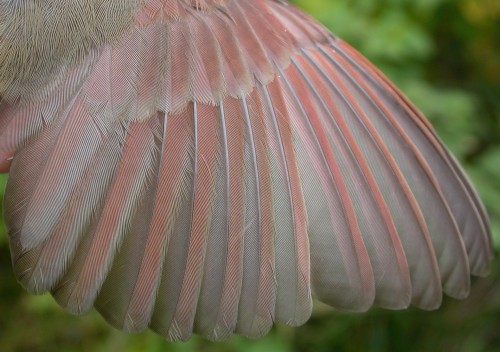
Photo by Marcel Gahbauer, McGill Bird Observatory (QC),
November 2006
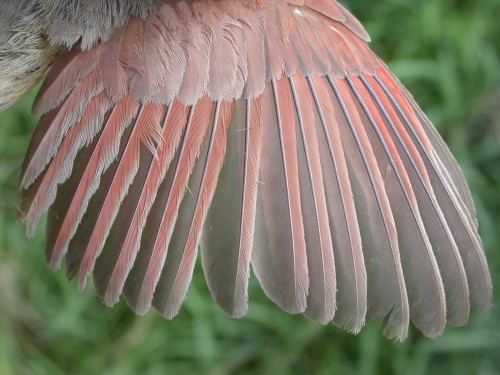
Photo by Marcel Gahbauer, McGill Bird
Observatory (QC),
August 2005
The tail of female Northern Cardinals is grayish red; note the contrast with the grayish-brown rump.
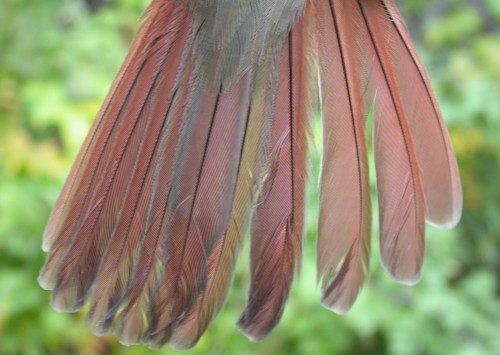
Photo by Marcel Gahbauer,
McGill Bird Observatory (QC),
November 2006
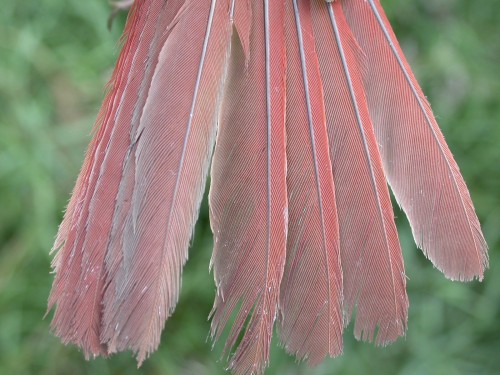
An after-hatch-year tail showing considerable wear, just prior to the prebasic molt.
Photo by Marcel Gahbauer,
McGill Bird
Observatory (QC),
August 2005
RETURN TO AGE/SEX
OVERVIEW
|
JUN - DEC: hatch-year
male |
By late in the year, HY
male Northern Cardinals are primarily red, but may have patches of retained
brown juvenal feathers if the preformative molt has not completed. These are most commonly seen on the wings,
but may also occur on the back and tail, and can generally be observed in
one or more places on a perched bird. There may also be dusky patches on the bill, and the iris tends to remain more grayish than brown until late in the year, though this may be difficult to assess reliably unless lighting is good.
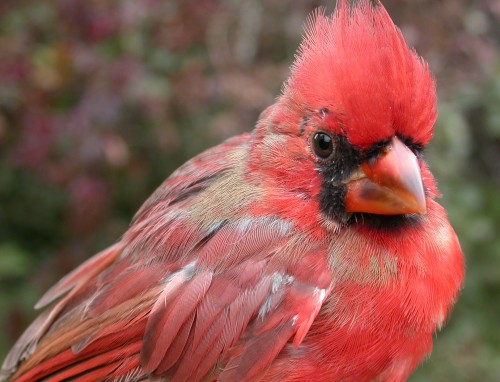
A relatively red hatch-year male, but with small patches of brown retained on the breast
and back, dusky patches on the bill, and a molt limit visible on the wing.
Photo by Marcel Gahbauer,
McGill Bird
Observatory (QC),
October 2004
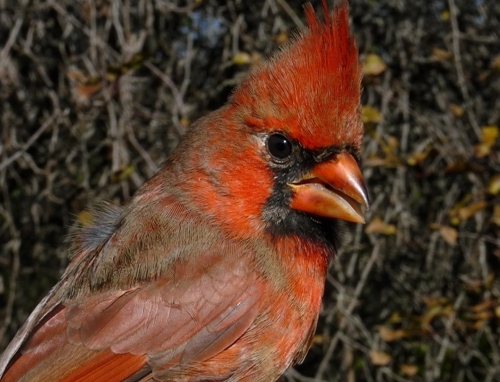
A similar pattern to the previous bird, but with the molt liming on the wing more evident.
Photo by Marcel Gahbauer, McGill Bird Observatory (QC), November 2010
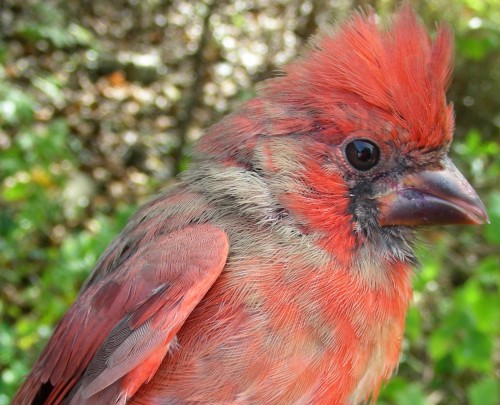
A less advanced molt, with more brown on the breast and nape, a smaller crest, and also
a much darker bill, with barely any red showing yet.
Photo by Marie-Anne Hudson, McGill Bird Observatory (QC), October 2007
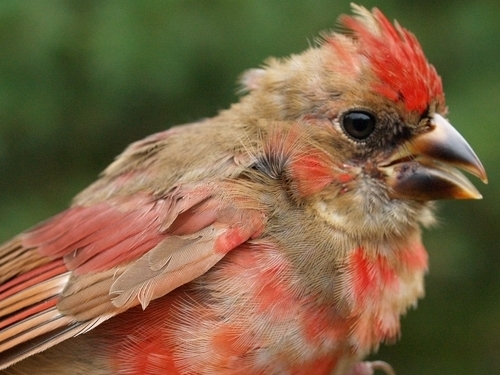
A hatch-year male in the early stages of preformative molt, with only small patches of
red having developed to date on the crest, breast, and selected feathers on the wing.
Photo by Simon Duval, McGill Bird Observatory (QC), September 2010
HY
Northern Cardinals typically show very visible molt limits on the wing, but the pattern can vary considerably among individuals.
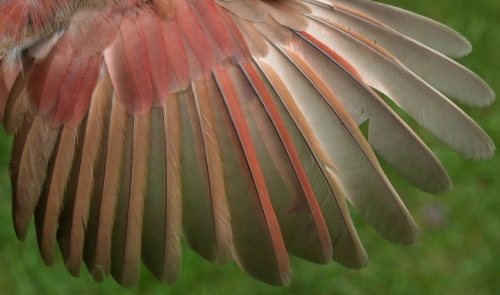
In this case all of the greater coverts have been replaced, contrasting with the unreplaced
brown primary coverts, note also the molt limit among the primaries and secondaries.
Photo by Simon Duval, McGill Bird Observatory (QC), September 2010
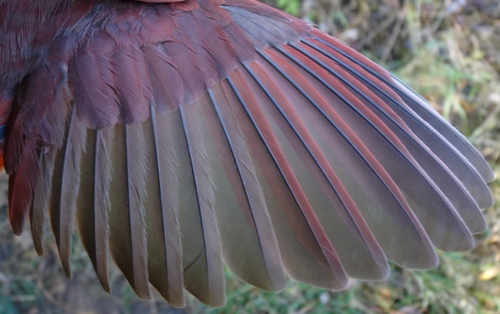
A fairly common pattern among hatch-year Northern Cardinals, with the primaries replaced,
contrasting with the retained juvenile secondaries. In this case the outermost primary coverts
have also been replaced, creating a molt limit within that tract of feathers.
Photo by Marcel Gahbauer, McGill Bird Observatory (QC), November 2010
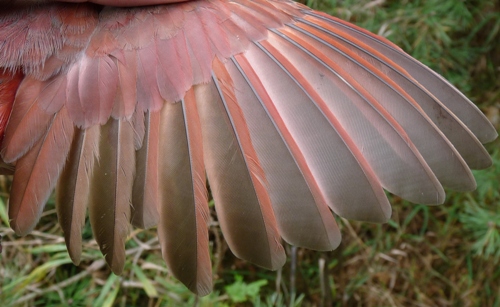
An individual nearing completion of its preformative molt, with only a couple of juvenile
secondaries remaining, to the left of where the formative feathers are growing in.
Photo by Marcel Gahbauer, McGill Bird Observatory (QC), October 2010
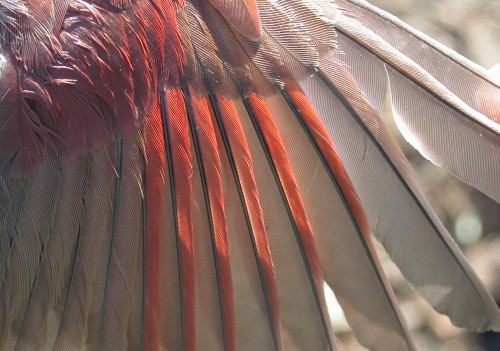
A closeup, illustrating a particularly strong contrast between the reddish formative primaries
and the retained brown juvenile feathers.
Photo by Marcel Gahbauer,
McGill Bird
Observatory (QC),
October 2004
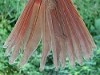
The tail is generally uniformly brownish-red to red on hatch-year Northern Cardinals.
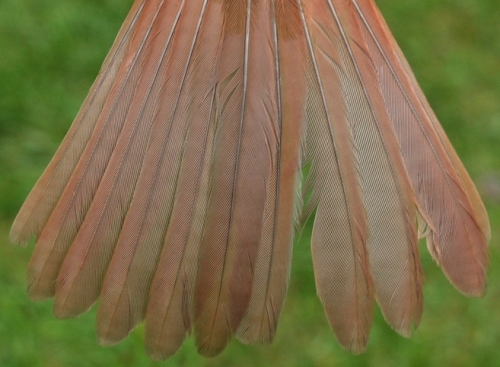
A typical hatch-year male tail.
Photo by Simon Duval, McGill Bird Observatory (QC), September 2010
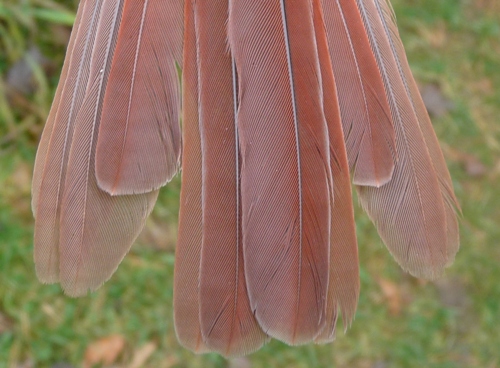
An example of an individual in the late stages of its preformative molt, showing a distinct
contrast in shape and more subtle difference in colour between the replaced central
formative rectrices and the outer retained juvenile rectrices.
Photo by Marcel Gahbauer, McGill Bird Observatory (QC), October 2010
RETURN TO AGE/SEX
OVERVIEW
|
JUN - DEC: hatch-year
female |
Like
older female Northern Cardinals, HY females are primarily brown, with red
on the crest, bill, and wings. However, there are distinct molt
limits on the wings between the retained brown juvenal feathers and the
new red adult feathers, and this is usually visible even when the bird is
perched. There are often also dusky patches on the bill, and the iris tends to be more grayish than brown until late in the year.
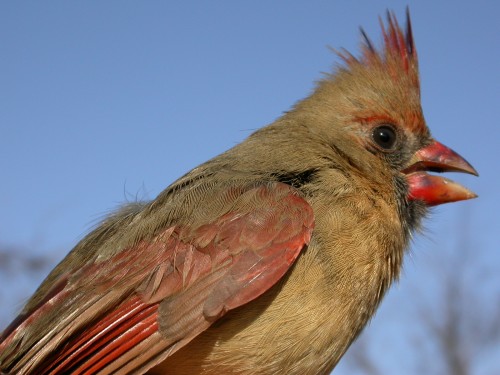
Photo by Marcel Gahbauer,
McGill Bird
Observatory (QC),
October 2004
HY
Northern Cardinals typically show very visible molt limits on the wings, but they can vary considerably in location and extent.
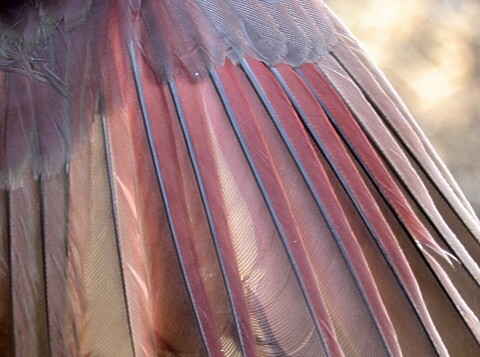
A closeup showing the contrast between the replaced inner primaries and outermost three
retained juvenile primaries, as well as between the primaries and secondaries, and
between the brownish primary coverts and replaced more reddish greater coverts.
Photo by Marcel Gahbauer,
McGill Bird
Observatory (QC),
October 2004
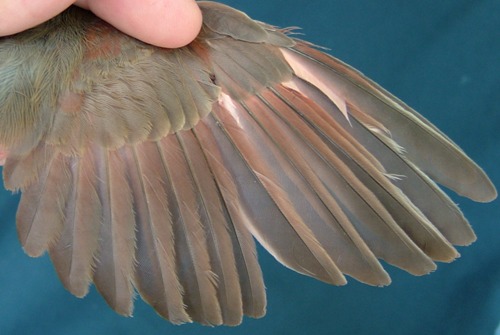
A hatch-year female with an almost entirely juvenile wing, just beginning to acquire a few
red feathers in the median coverts, and perhaps also the carpal covert.
Photo by Peter Pyle, Southeast Arizona, July 2007
The tail of female Northern Cardinals is generally a grayish-brownish red. Note in this example the growth bars across the tip of all rectrices, indicative of a hatch-year bird.
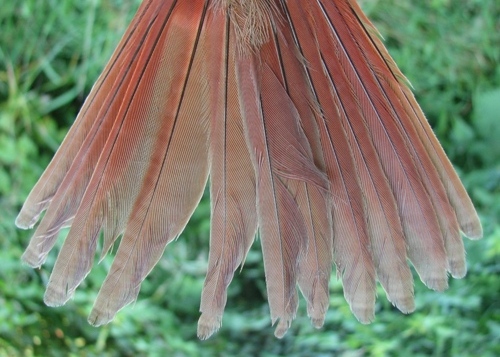
Photo by Barbara Frei,
McGill Bird
Observatory (QC), August 2007
RETURN TO AGE/SEX
OVERVIEW
|
JUN - DEC: juvenile unknown |
Juvenile Northern Cardinals
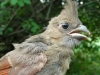
are most readily recognized by their dusky, rather than red, bills. Until they have commenced their preformative molt, sex cannot be reliably determined, although it is likely that those showing a fair amount of red on the wings are males.
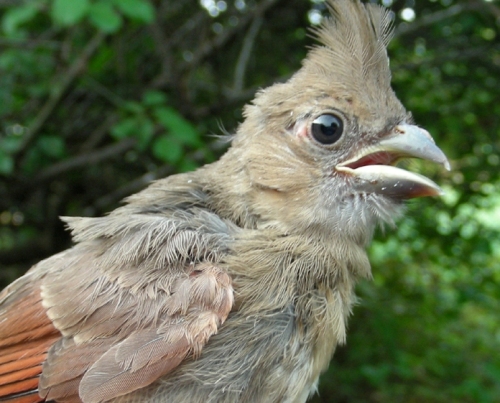
Photo by Gay Gruner, McGill Bird Observatory (QC), September 2009
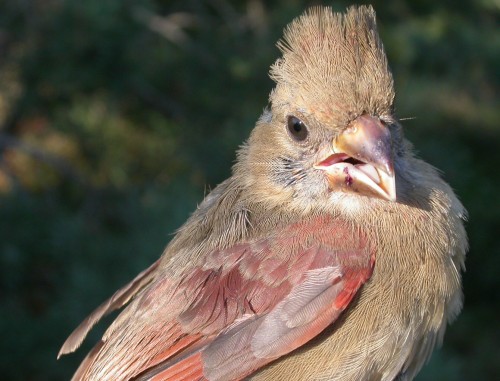
Photo by Marcel Gahbauer,
McGill Bird
Observatory (QC),
June 2005
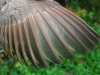
The wing of juveniles is generally uniform in appearance, mostly grayish-brown to reddish-brown.
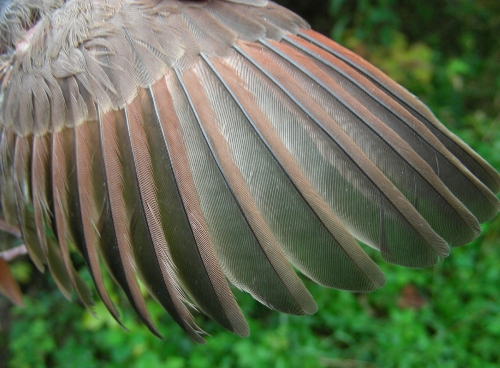
Photo by Gay Gruner, McGill Bird Observatory (QC), September 2009
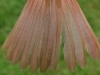
The tail is reddish even on juveniles, and is of little help with ageing.
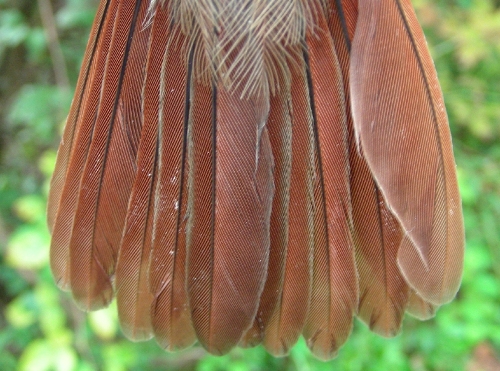
Photo by Gay Gruner, McGill Bird Observatory (QC), September 2009
RETURN TO AGE/SEX
OVERVIEW
|