|
Purple
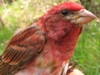
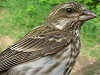
Finch / Roselin pourpré (Carpodacus purpureus) |
 |
Introductory notes:
While "purple" AHY/ASY males are easy to recognize, determining age and sex of the remaining "brown" individuals is more difficult, especially if relying just on plumage. The most reliable method for ageing in fall is to check skull development, and sex of most SY birds can only be determined in the hand by detecting a brood patch or cloacal protuberance. |
QUICK TIPS:
| 1) Look
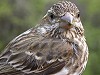
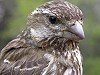
at the overall appearance - only AHY/ASY males
have extensive reddish-purple plumage, while SY
males may have a hint of red, and HY males, some SY males, and all females are entirely brown.
2) Look at
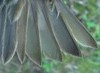
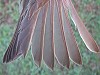
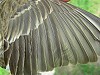
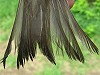
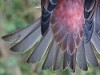
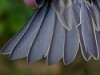
the outer rectrices - they are narrow and
relatively pointed at the tip on HY/SY birds, and broad and
relatively rounded on AHY/ASY birds
3) Examine
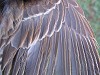
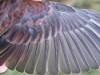
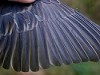
the greater coverts - on some HY/SY birds there
is a visible molt limit between paler outer
coverts and darker inner coverts that have been
replaced; on other HY/SY birds and all AHY/ASY birds
there is no moult limit among the greater coverts, but beware that at all ages the greater coverts appear somewhat darker than the rest of the wing, so if the greater coverts are uniform, the wing may be of limited reliability for determining age.
Species account updated January 2011 |
|
Ageing and sexing guidelines:
Ageing and sexing details:
|
JAN - JUL: after-second-year
male |
ASY males are easily recognizable by the
strong red/purple wash across the upper breast, head, back, and wings.
No other age or sex class has more than a trace of red. Colour may vary from deep red to purple and may be mottled with some brown.
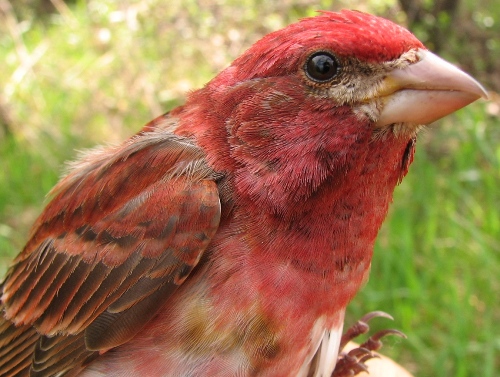
A particularly reddish ASY male, but note a few brownish and white feathers on the breast.
Photo by Barbara Frei,
McGill Bird Observatory (QC), May 2008
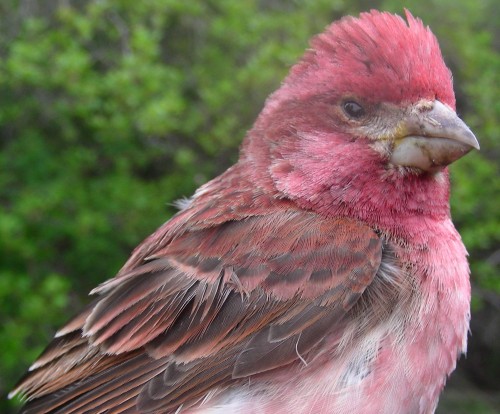
A more purplish ASY male, lacking brown patches.
Photo by Marie-Anne Hudson,
McGill Bird Observatory (QC), May 2007
Since only ASY males are red/purple, it is unnecessary to check the wing or tail. However, doing so provides good practice for detecting the patterns typical of ASY Purple Finches, which can help with separating ASY from SY females.
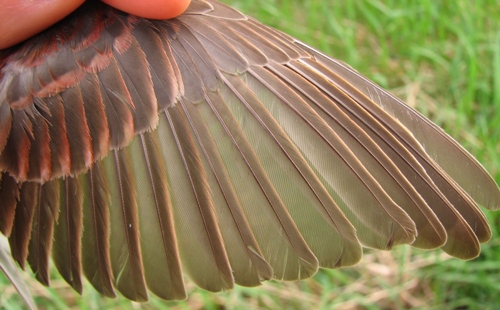
The wing corresponding to the more reddish male above.
Photo by Barbara Frei,
McGill Bird Observatory (QC), May 2008
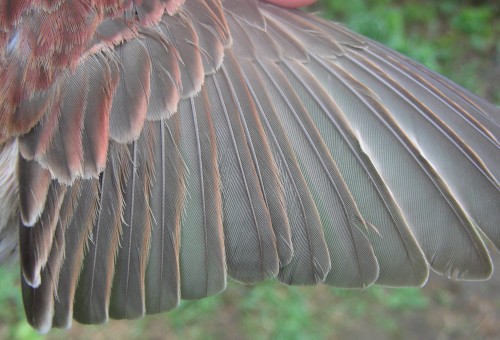
The wing corresponding to the more purplish male above.
Photo by Marie-Anne Hudson,
McGill Bird Observatory (QC), May 2007
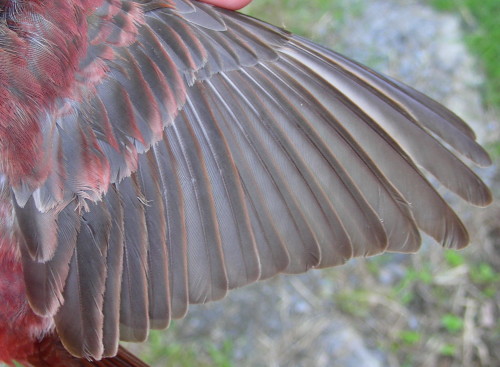
Another ASY male wing, highlighting the relatively uniform tone of the wing
(notwithstanding the pseudolimit presented by the red-edged greater coverts).
Photo by Marie-Anne Hudson, McGill Bird Observatory (QC), May 2009
Rectrices of ASY Purple Finches tend to be noticeably more broad and rounded
than those of SY birds, which are usually quite pointed.
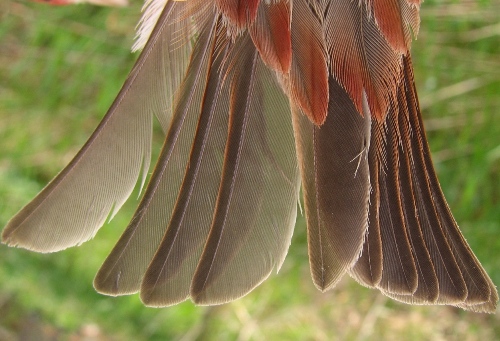
A typical ASY male tail; note also the reddish uppertail coverts.
Photo by Barbara Frei,
McGill Bird Observatory (QC), May 2008
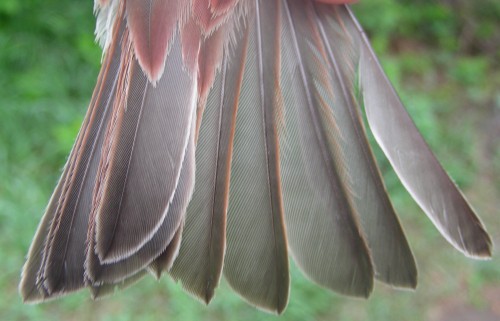
A variant with the outer rectrices slightly narrower, but still broader than on SY birds.
Photo by Marie-Anne
Hudson,
McGill Bird Observatory (QC), May 2007
RETURN TO AGE/SEX
OVERVIEW
|
JAN - JUL: after-second-year
female |
Plumage of ASY females is brown and white, generally the same as for SY Purple Finches of both sexes. The wing and tail should be checked to assess age; the presence of a brood patch during the
breeding season can be used to separate females from males.
ASY females have a relatively uniform wing, but beware that molt limits on SY Purple Finches can also be subtle, and the rectrices may provide a better indication of age (some intermediates may also be better left as simply AHY).
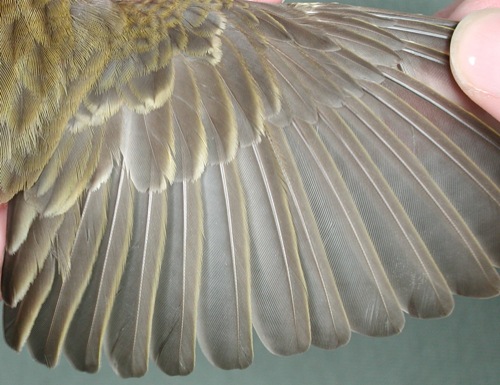
Photo by Peter Pyle,
Big Sur Ornithology Lab (CA), May 2007
Rectrices of ASY Purple Finches tend to be noticeably more broad and truncate
than those of SY birds, which are usually quite narrow and pointed.
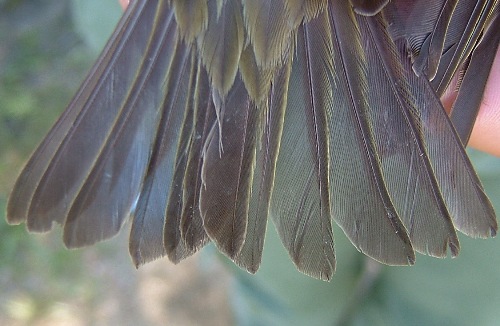
Photo by Peter Pyle,
Big Sur Ornithology Lab (CA), May 2007
RETURN TO AGE/SEX
OVERVIEW
|
JAN - JUL: second-year
male |
SY male
Purple Finches are mostly to entirely brown and white, like females, but can also show faint
traces of red, especially on the head, upper breast, and wings.
However, for males lacking any red plumage, sexing is possible only by confirmation of a cloacal protuberance during the breeding season.
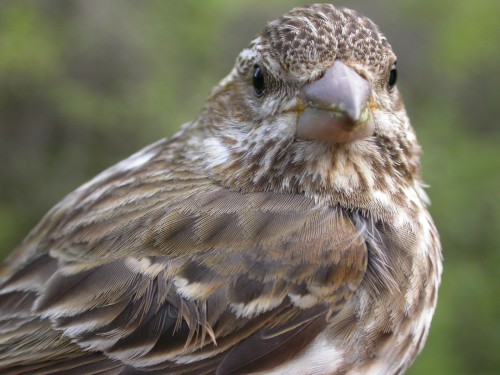
A male with a hint of red on the shoulder, but otherwise identical to females in appearance.
Photo by Marcel Gahbauer,
McGill Bird Observatory (QC), May 2006
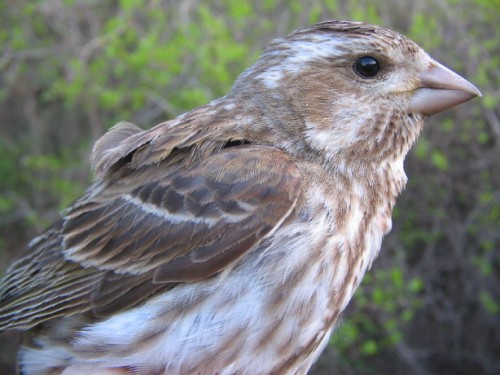
Another male with just a bit of red on the shoulder.
Photo by Marie-Anne Hudson,
McGill Bird Observatory (QC), May 2006
On some males there may be a trace of red on the wing, usually among the lesser, median, and greater coverts. A molt limit usually exists within the greater coverts or between the greater coverts and primary coverts, but can be subtle, and the tail may provide an easier indication of age. The wing (most notably the tertials) tends to show somewhat more wear than on ASY individuals, which at least in extreme cases may also help with ageing.
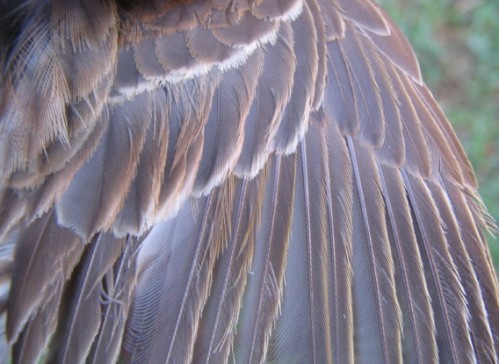
An example with a trace of red on the lesser coverts and even on the edging of the greater
coverts. While the molt limit between the greater and primary coverts is subtle, note the
relatively worn appearance of the feathers (especially tertials and primary coverts)
compared to the fresher appearance of ASY finches in spring.
Photo by Marie-Anne Hudson,
McGill Bird Observatory (QC), May 2006
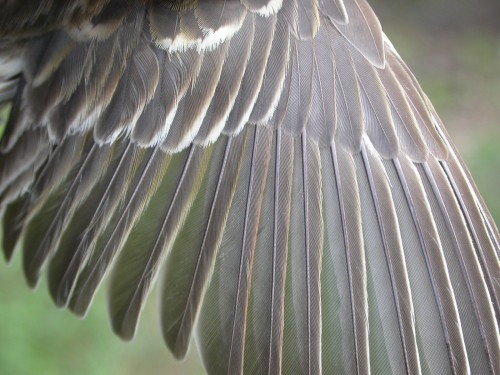
This wing shows no red and also is less worn than the previous example, but the molt limit
between the greater coverts and the rest of the wing is a bit more evident (including the
contrast between the dark alula covert and paler juvenile alula).
Photo by Marcel Gahbauer,
McGill Bird Observatory (QC), May 2006
SY Purple Finches of both sexes have relatively pointed outer rectrices; males may sometimes show a trace of red edging to the rump feathers.
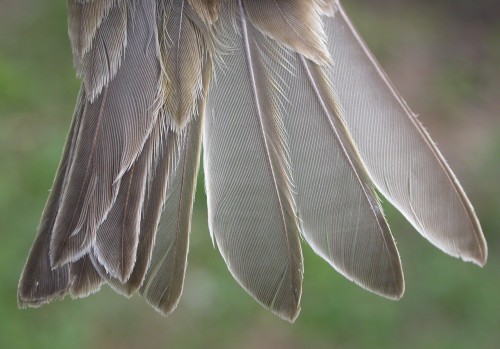
This tail is in rather good condition for an SY in spring, but note the narrower and more
pointed shape of the outermost rectrix in particular.
Photo by Marcel Gahbauer,
McGill Bird Observatory (QC), May 2006
RETURN TO AGE/SEX
OVERVIEW
|
JAN - JUL: second-year
unknown |
SY birds entirely lacking red can be sexed
only by cloacal protuberance or brood patch during the breeding season; if these features are absent or cannot be checked, such birds should be considered sex unknown.
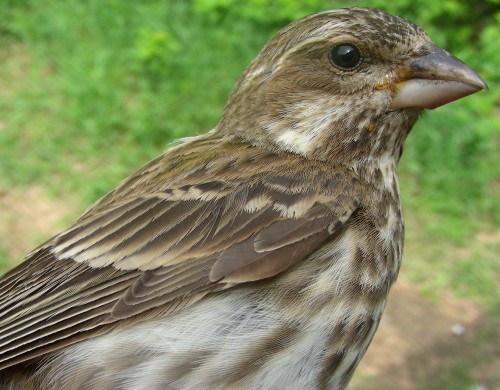
Photo by Marie-Anne Hudson, McGill Bird Observatory (QC), May 2007
As
with males, SY females/unknowns have subtle molt limits within the greater coverts or between the greater coverts and primary coverts, but the tail often is more useful for ageing.
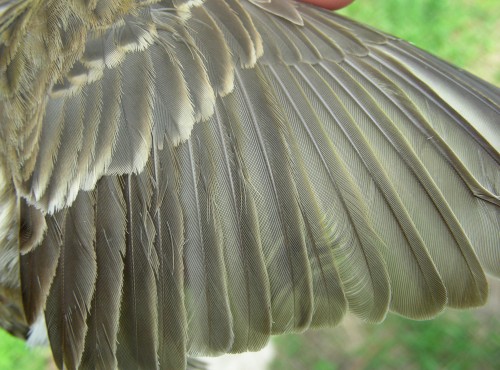
Photo by Marie-Anne Hudson, McGill Bird Observatory (QC), May 2007
SY Purple Finches are usually distinguishable by their relatively narrow and pointed outer rectrices.
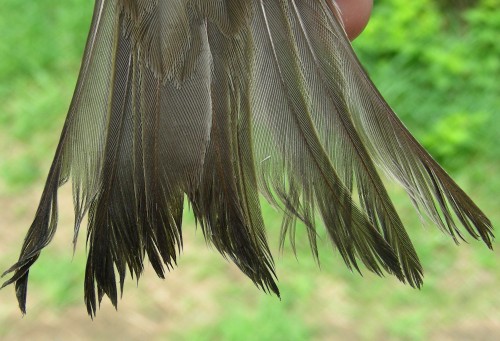
The shape of this tail is exaggerated by being wet, but even so it is possible to tell that
the outer rectrices are quite narrow, pointed, and fairly worn.
Photo by Marie-Anne Hudson, McGill Bird Observatory (QC), May 2007
RETURN TO AGE/SEX
OVERVIEW
|
JUL - DEC: after-hatch-year
male |
Only AHY males have a purple/red wash over
their upper breast, head, back, and wings.
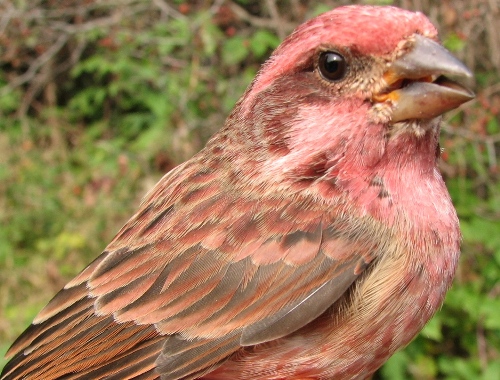
A relatively reddish AHY male with a fairly prominent dark eye line.
Photo by Barbara Frei,
McGill Bird Observatory (QC), October 2008
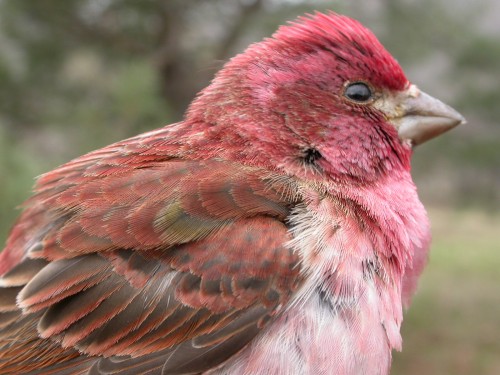
A more purplish AHY male; note the single greenish-brown back feather; it is unclear
whether this has any potential significance regarding age (likely it is just an aberrant feather).
Photo by Marcel Gahbauer,
McGill Bird Observatory (QC), October 2004
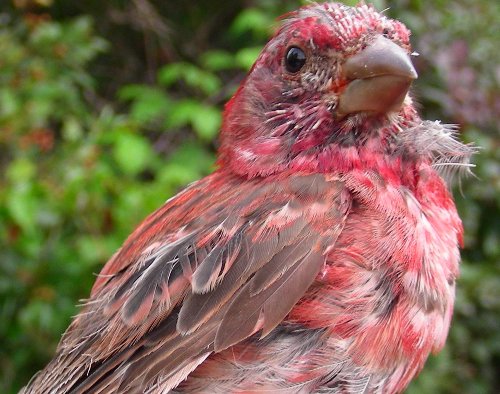
An AHY male undergoing its prebasic molt; until completion of this molt it is usually
possible to distinguish SY and ASY males.
Photo by Marcel Gahbauer,
McGill Bird Observatory (QC), August 2008
Since AHY Purple Finches can be readily identified based on their overall plumage, there is little need to examine the wing and tail, although doing so may help provide practice for separating AHY females from HY Purple Finches.
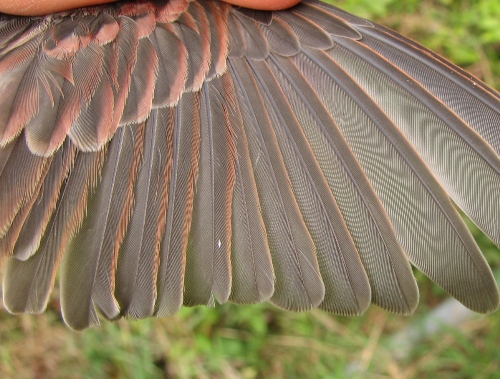
A typical AHY male wing, with uniformly dark and fresh feathers, and relatively broad
and rounded primary coverts (though the outer ones tend to be narrower and more pointed).
Photo by Barbara Frei,
McGill Bird Observatory (QC), October 2008
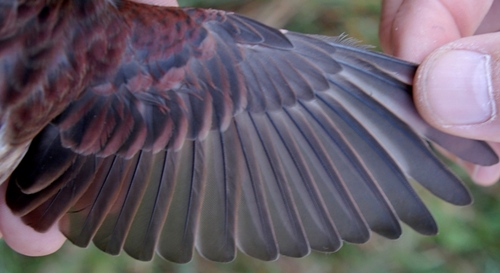
Another AHY male wing; note that there is usually a pseudolimit between the somewhat
darker and reddish-edged greater coverts and the rest of the wing.
Photo by James Junda,
McGill Bird Observatory (QC), September 2008
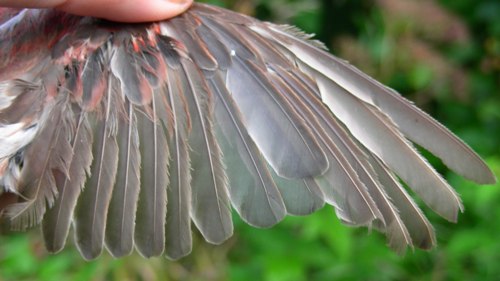
An AHY male undergoing its prebasic molt. Note that the retained secondaries appear
to have a bit of red edging, suggesting that this is an ASY male.
Photo by Marcel Gahbauer,
McGill Bird Observatory (QC), August 2008
AHY Purple Finches have broad and rounded rectrices, and males are readily recognizable by the red rump.
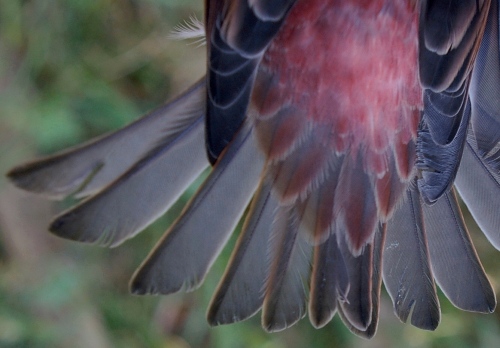
Photo by James Junda,
McGill Bird Observatory (QC), September 2008
RETURN TO AGE/SEX
OVERVIEW
|
JUL - DEC: after-hatch-year
female |
AHY females are brown and white, largely identical in overall appearance to HY
Purple Finches of both sexes. The shape of the outer rectrices are
the easiest indicator of age, and moult patterns on the wing can also be useful, though for birds in the hand, checking for skull pneumatization is the best approach until at least early November.
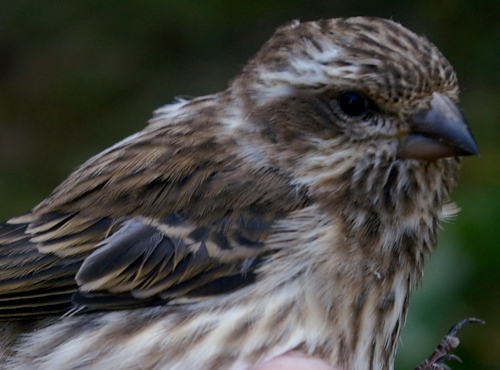
Photo by James Junda,
McGill Bird Observatory (QC), October 2008
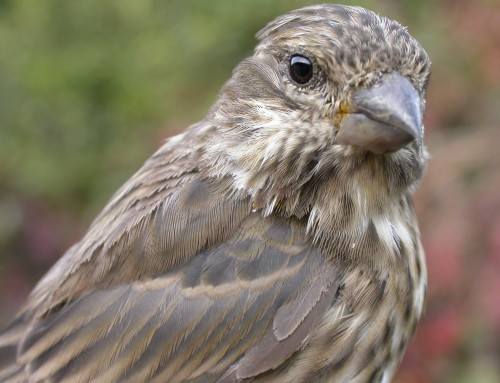
This individual was photographed during its prebasic molt; note the contrast between the
alula (and alula covert) and the greater and median coverts.
Photo by Marcel Gahbauer,
McGill Bird Observatory, August 2005
AHY females show no molt
limits on the wing, and have relatively broad and truncate outer primary
coverts.
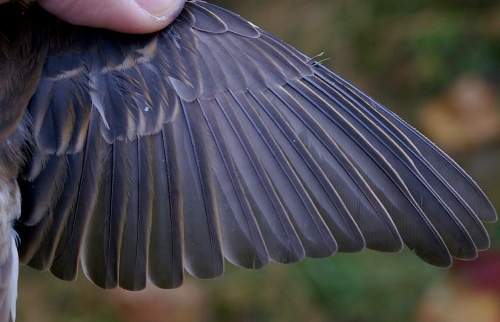
As with males, note that there is a pseudolimit between the darker greater coverts and
the rest of the wing, which can make identification of a true limit on HY birds difficult.
Photo by James Junda,
McGill Bird Observatory (QC), October 2008
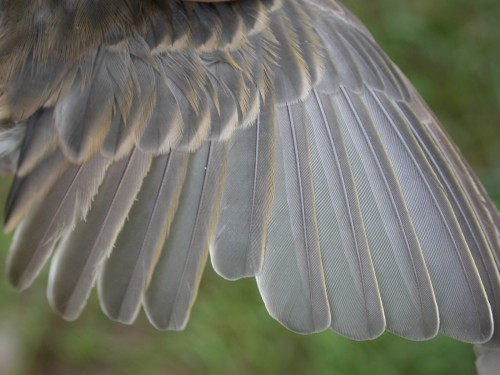
Brownish Purple FInches molting their primaries and secondaries are AHY females; if the
retained feathers are particularly faded and worn they may indicate an SY female, but
usually this is more difficult to determine for females than males since the colour
cues present on males are lacking.
Photo by Marcel Gahbauer,
McGill Bird Observatory, August 2005
The outer rectrices of AHY
Purple Finches are broad and quite rounded at the tip; on females the rump is brown rather than red.
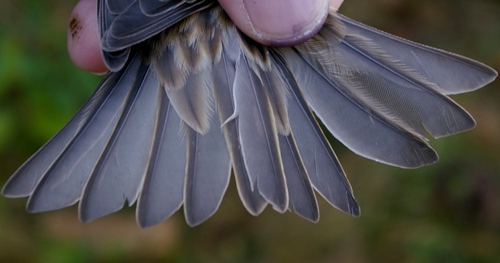
Photo by James Junda,
McGill Bird Observatory (QC), October 2008
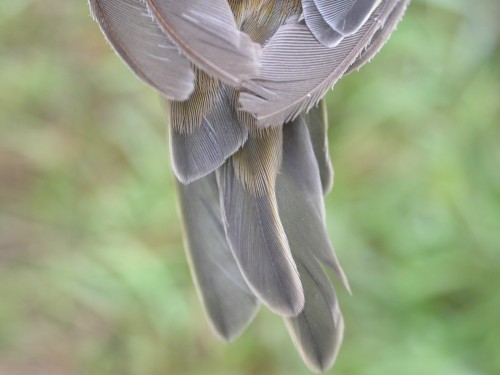
This photo corresponds to the wing above undergoing molt; all of the rectrices are growing
in and are dark and fairly broad. Note that in this view, the outermost retained primaries
appear very pale and worn, providing evidence that it likely is an SY female.
Photo by Marcel Gahbauer,
McGill Bird Observatory, August 2005
RETURN TO AGE/SEX
OVERVIEW
|
JUL - DEC: hatch-year
unknown |
HY
Purple Finches are brown and white, overall similar in appearance to AHY females. Sex can generally not be determined at this
age. HY birds are best separated from AHY females by having narrower
and more pointed primary coverts and rectrices, but if the bird is in the hand, skull pneumatization should be checked, as it does not complete in HY birds until early to mid-November.
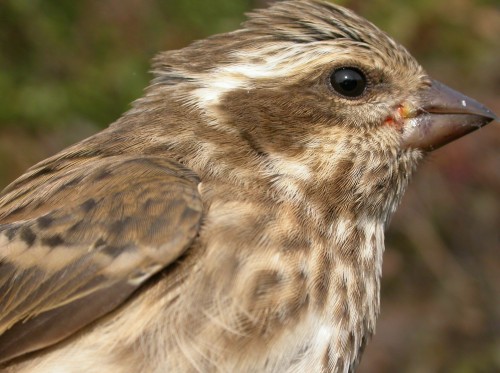
An HY Purple Finch looking nearly identical to an AHY female.
Photo by Marcel Gahbauer,
McGill Bird Observatory, October 2004
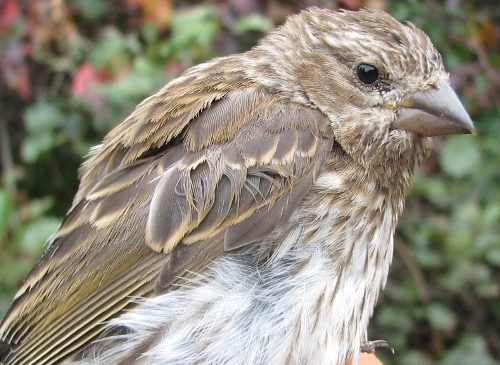
Earlier in fall, some HY Purple Finches are recognizable by having a less distinct
white supercilium.
Photo by Barbara Frei,
McGill Bird Observatory, September 2007
HY Purple Finches may show a molt limit among
the greater coverts or between the replaced greater coverts and unreplaced primary coverts. The primary coverts are relatively narrow and pointed.
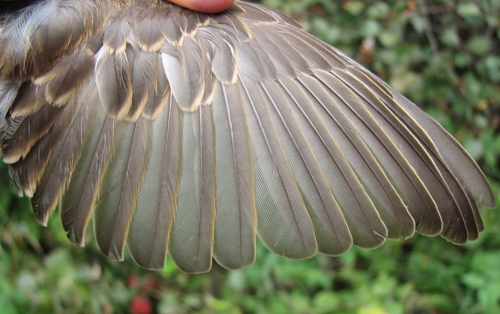
This example shows a contrast between the darker fresh formative greater coverts (and
median coverts) and the paler juvenile block of primary coverts, primaries, and secondaries.
Photo by Barbara Frei,
McGill Bird Observatory, September 2007
HY Purple Finches have
relatively narrow and pointed outer rectrices, though differences in shape (compared to AHY individuals) may be less distinct in fall when feathers are fresh than they are by spring when wear tends to accentuate the contrast.
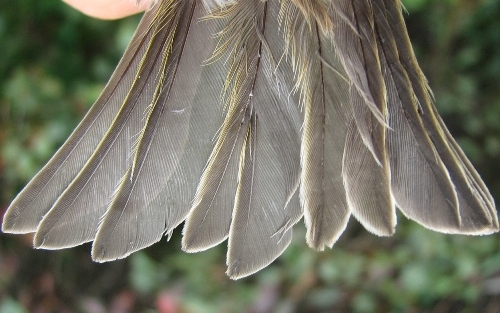
Photo by Barbara Frei,
McGill Bird Observatory, September 2007
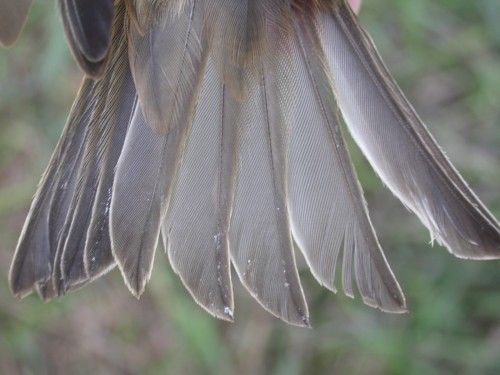
Photo by Marcel Gahbauer,
McGill Bird Observatory, October 2005
RETURN TO AGE/SEX
OVERVIEW
|