|
Rose-breasted
Grosbeak / Cardinal à poitrine rouge (Pheucticus ludovicianus) |
 |
Introductory notes:
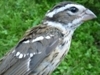
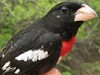
AHY/ASY and SY male Rose-breasted Grosbeaks are among the easiest of all passerines to age and sex at a glance due to their bold and distinct plumage patterns. At the other extreme, ageing of females can be quite tricky, and even with a good view of the wing and tail, some may be reliably aged only by skull in fall, and should be considered AHY in spring. |
QUICK TIPS:
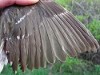
| 1) Look
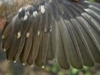
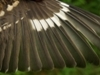
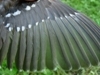
at the white marks on the primaries below the
primary coverts - on HY/SY females they are absent or
at most 2 mm long, on AHY/ASY females they are
absent or up to 4 mm long, on HY/SY males they are
4-14 mm long, and on AHY/ASY males they are
14+ mm long
2) Check
the underwing coverts - males are pinkish, while
females are yellowish
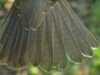
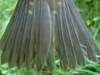
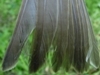
3) Examine the tail - the presence of any brown and narrow juvenile feathers indicates an HY/SY bird, but uniformly broad rectrices can occur on both HY/SY and AHY/ASY birds
4) Look
for molt limits among the greater coverts or between the median and greater coverts - HY/SY
birds often show a contrast between darker median coverts (and sometimes also inner greater coverts) and paler juvenile greater coverts, while on AHY/ASY
birds the coverts are uniform
Species account updated January 2011 |
|
Ageing and sexing guidelines:
Ageing and sexing details:
|
JAN - JUL: after-second-year
male |
ASY
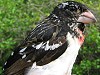
males have a solid black head and back, unlike any other age/sex of
Rose-breasted Grosbeak.
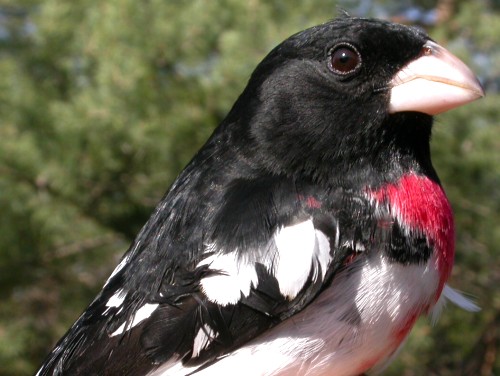
Photo by Marcel Gahbauer,
McGill Bird Observatory (QC), May 2005
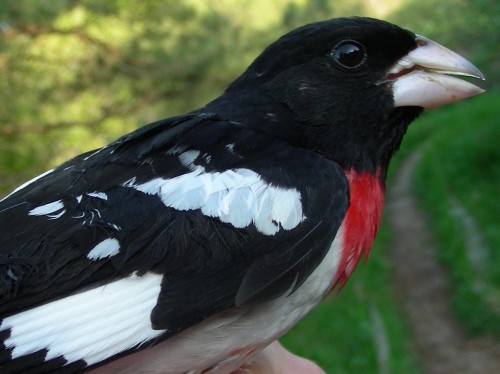
Photo by Marie-Anne Hudson,
McGill Bird Observatory (QC), May 2008
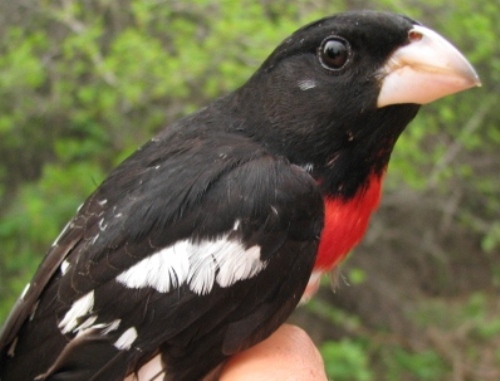
Some individuals such as this are more dark brown above than truly black, but they are
still much darker than SY males, and lack any strong molt limits.
Photo by Barbara Frei,
McGill Bird Observatory (QC), May 2007
ASY
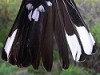
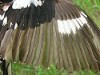
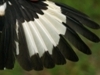
Rose-breasted Grosbeaks have distinctive wings, entirely black and white,
lacking the brown plumage present to some extent in all other ages/sexes. The large white patches on the primaries are also diagnostic, and males also have pink underwing patches.
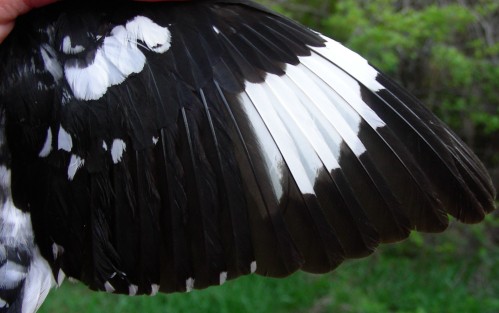
A typically black and white ASY male wing.
Photo by Marie-Anne Hudson,
McGill Bird Observatory (QC), May 2008
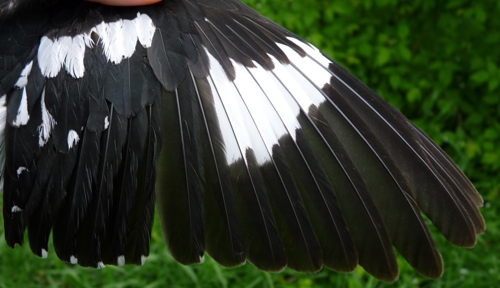
In this case the primary coverts and primaries appear slightly paler than the greater coverts
and secondaries, but this does not represent a true molt limit; compare with SY males
to see the much stronger contrast visible on them.
Photo by Marcel Gahbauer,
McGill Bird Observatory (QC), May 2010
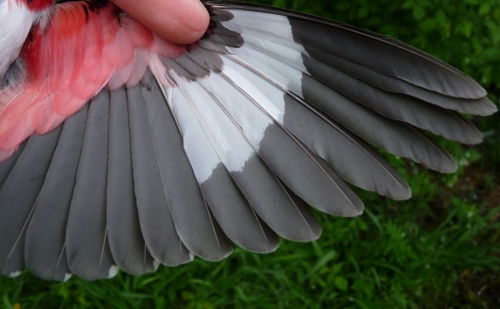
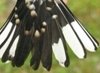
A typical ASY male underwing.
Photo by Marcel Gahbauer,
McGill Bird Observatory (QC), May 2010
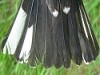
The tail of ASY male Rose-breasted Grosbeaks is mostly black, with large white spots on the outer rectrices (but note that many SY males also have such a tail as a result of replacing their entire tail as part of their preformative molt).
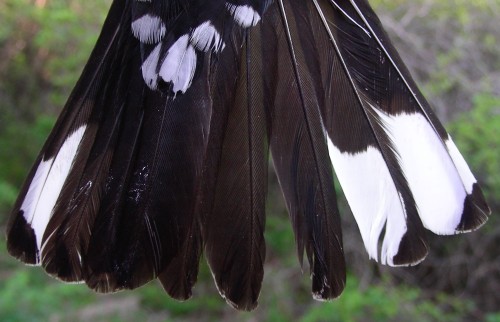
Photo by Marie-Anne Hudson,
McGill Bird Observatory (QC), May 2008
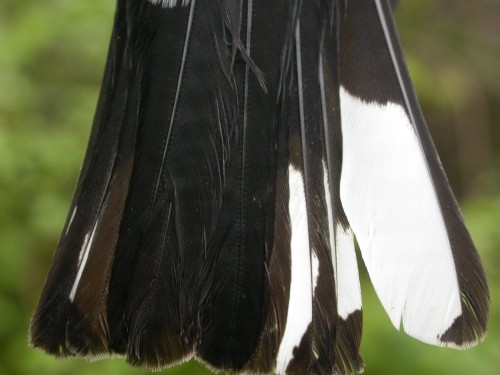
Photo by Marcel Gahbauer,
McGill Bird Observatory (QC), May 2006
RETURN TO AGE/SEX
OVERVIEW
|
JAN - JUL: after-second-year
female |
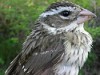
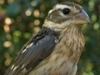
Female
Rose-breasted Grosbeaks are brown and streaked, with conspicuous pale
stripes over the eyes and on the crown. To determine age it is
necessary to look at the wings and/or tail.
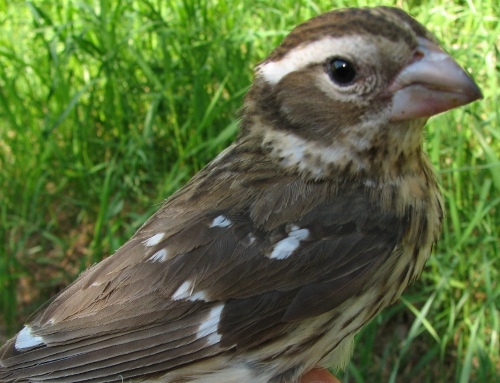
Photo by Barbara Frei,
McGill Bird Observatory (QC), May 2008
ASY females have no evident molt limits on the wing. White patches on the primaries extend up to several millimetres beyond the primary coverts. Females of all ages have yellow-orange underwing patches.
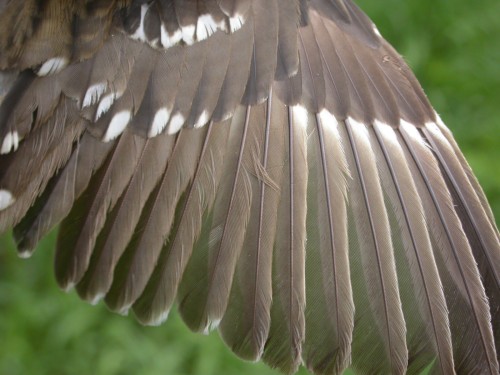
A uniformly brown ASY female wing, with fairly extensive (for a female) white patches
on the primaries.
Photo by Marcel Gahbauer,
McGill Bird Observatory (QC), May 2006
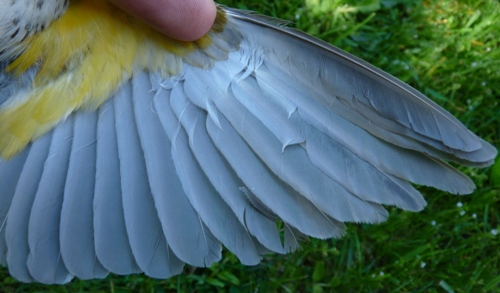
A typical female underwing.
Photo by Marcel Gahbauer,
McGill Bird Observatory (QC), May 2010
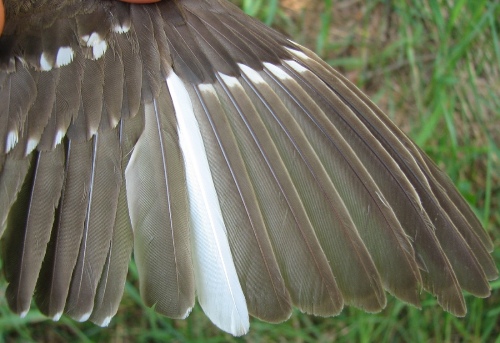
An ASY female with a single aberrantly white primary.
Photo by Barbara Frei,
McGill Bird Observatory (QC), May 2008
AHY females have a uniformly brown tail, with relatively
broad and rounded rectrices (but note that many SY females also have such a tail as a result of replacing their entire tail as part of their preformative molt).
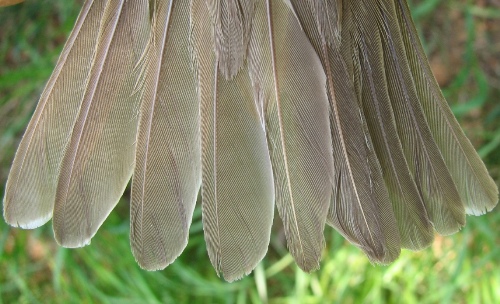
Photo by Barbara Frei,
McGill Bird Observatory (QC), May 2008
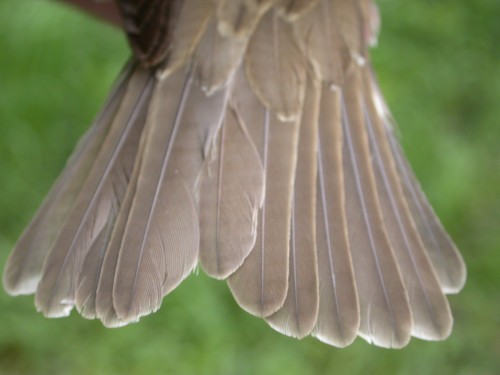
Photo by Marcel Gahbauer,
McGill Bird Observatory (QC), May 2006
RETURN TO AGE/SEX
OVERVIEW
|
JAN - JUL: second-year
male |
SY male
Rose-breasted Grosbeaks have a mottled mix of brown and black feathers
on the back and wings, and a rose-coloured triangle of variable size on the upper breast.
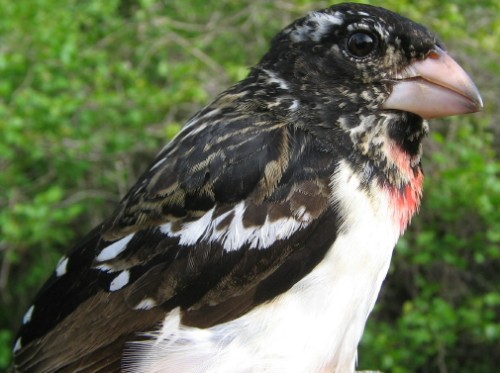
A particularly mottled SY male, with a distinct molt limit visible on the wing,
a mix of
brown and black on the back and head,
and very limited red on the breast.
Photo by Marie-Anne Hudson,
McGill Bird Observatory (QC), May 2006
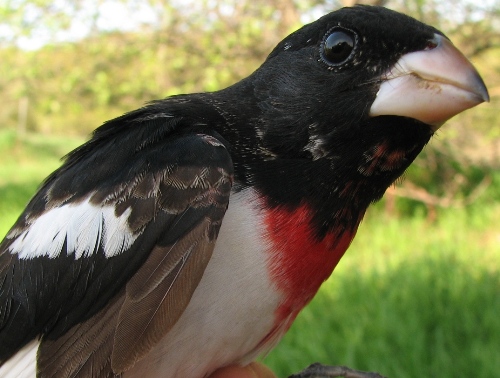
A more typical SY male, almost fully black on the back and head and with a fairly extensive
red patch on the breast, but with distinctly brown juvenile feathers on the wing.
Photo by Barbara Frei,
McGill Bird Observatory (QC), May 2008
SY males are easily recognized by the distinct contrast on the wing between retained brown juvenile feathers (generally the primary coverts, primaries, secondaries) and the replaced black alternate feathers (usually the greater coverts and often also the tertials).
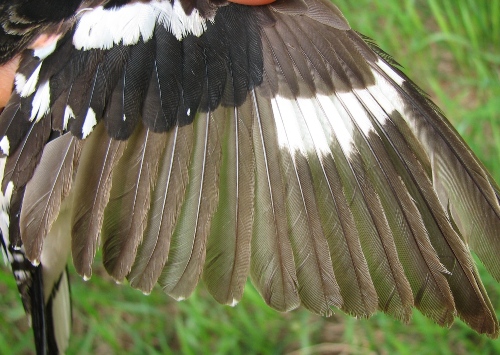
A typical SY male, showing a very obvious molt limit between the retained brown juvenile
feathers and the fresher black alternate feathers.
Photo by Barbara Frei,
McGill Bird Observatory (QC), May 2008
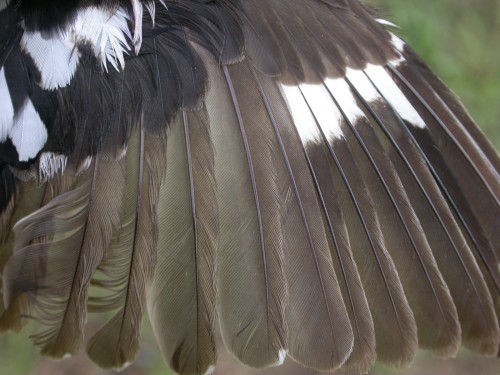
A closer view of an SY male, including a somewhat unusual shape to the white
patch on the primaries.
Photo by Marcel Gahbauer,
McGill Bird Observatory (QC), May 2005
A fair number of HY/SY Rose-breasted Grosbeaks replace their entire tail during their first winter, therefore by spring the tail of some SY males looks the same as on ASY males. More rarely, SY males retain all of their brown juvenile rectrices, while many others show a mix of brown juvenile and black formative feathers.
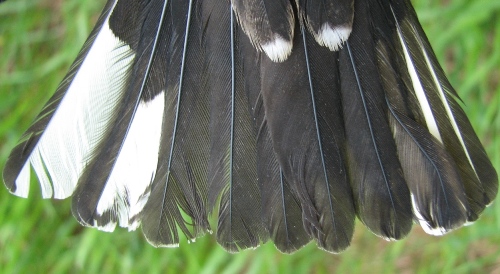
An SY male with a completely replaced tail, of no help in determining age.
Photo by Barbara Frei,
McGill Bird Observatory (QC), May 2008
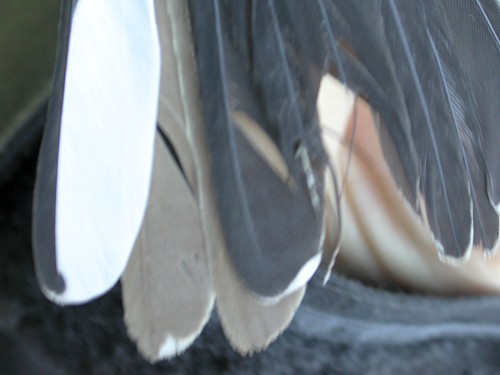
An example with r4 and r5 as retained brown and worn juvenile feathers, contrasting
with the replaced black and white feathers.
Photo by Marcel Gahbauer,
McGill Bird Observatory (QC), May 2005
RETURN TO AGE/SEX
OVERVIEW
|
JAN - JUL: second-year
female |
Female Rose-breasted Grosbeaks are brown and streaked, with conspicuous pale stripes over the eyes and on the crown. To determine age it is necessary to look at the wings and/or tail. Differences between ASY and SY females can be quite subtle, and some individuals may have to be classified as AHY.
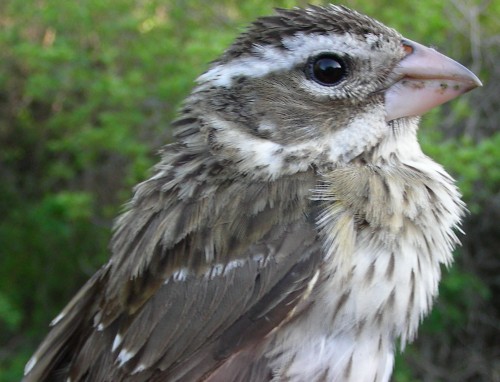
Some SY females show more worn and frayed feathers than ASY females, but
this is difficult to assess, and both wing and tail need to be checked to confirm age.
Photo by Marie-Anne Hudson,
McGill Bird Observatory (QC), May 2008
Second-year females often show a moult limit among the greater coverts,
and the underwing patch is uniformly yellow as on females of all ages. White patches on the primaries are minimal to absent.
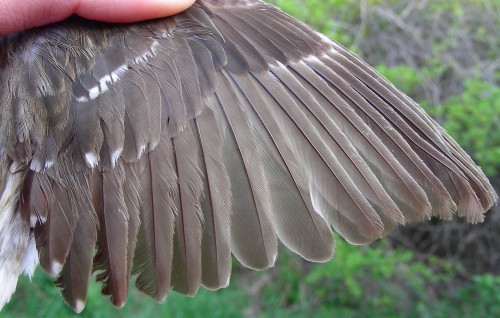
Note the near absence of white patches on the primaries, and subtle molt limits within
the greater and median coverts, as well as the frayed tips of the primaries. Overall though,
the wing is only slightly different from that of ASY females.
Photo by Marie-Anne Hudson,
McGill Bird Observatory (QC), May 2008
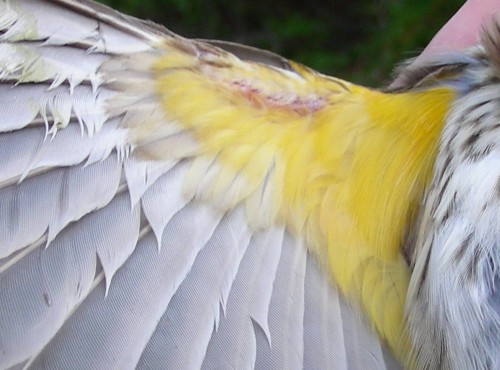
A typical female underwing.
Photo by Marie-Anne Hudson,
McGill Bird Observatory (QC), May 2008
Like males, SY females may have broad, rounded, and relatively fresh rectrices if they have replaced their entire tail during their first winter; in such cases the tail provides no reliable indication of age, and given the subtleties of wing patterns on females, many with entirely formative or basic tails should be considered AHY. However, other SY females retain some to all of their juvenile rectrices, which by spring are narrow, pointed, and quite worn, and the presence of such feathers is usually the best indicator of age for such birds.
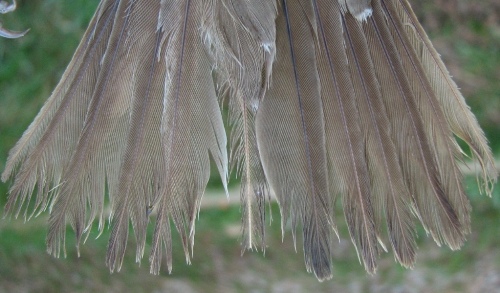
An example of a tail that appears to be comprised almost entirely of retained juvenile
feathers, with r1 on the left side showing an extreme amount of wear and contrasting
noticeably with the lone replaced feather, r1 on the right side, which stands out by
virtue of its width and darker shaft.
Photo by Barbara Frei,
McGill Bird Observatory (QC), May 2008
RETURN TO AGE/SEX
OVERVIEW
|
JUL - DEC: after-hatch-year
male |
AHY males have a fairly variable appearance, but can always be recognized by the presence of black on the wings; most also have at least bit of red on the breast.
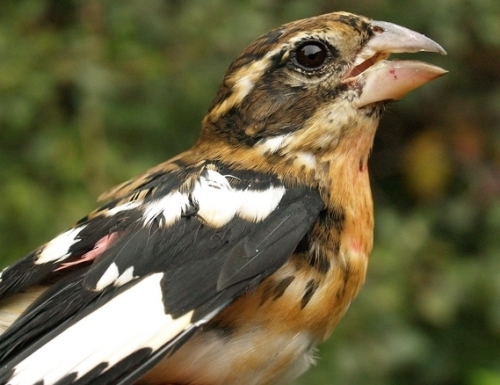
A particularly dark AHY male.
Photo by Simon Duval, McGill Bird Observatory (QC), August 2010
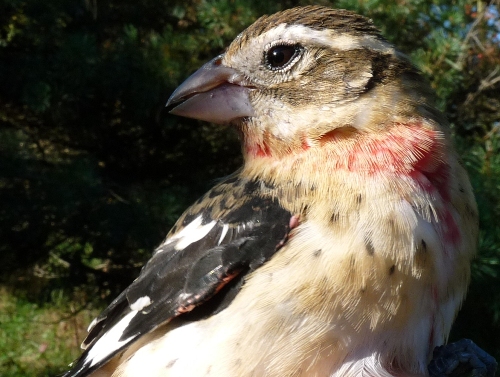
A somewhat paler AHY male, with no black on the head, but with more red on the breast.
Photo by Marcel Gahbauer,
McGill Bird Observatory (QC), September 2009
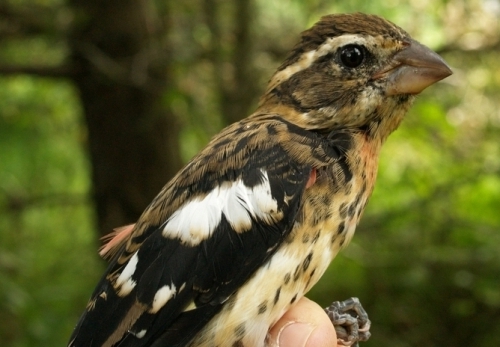
In this case, at least one contastingly pale brown retained juvenile feather on the wing is
visible, enabling this to be identified as an SY male just from this angle alone.
Photo by Simon Duval,
McGill Bird Observatory (QC), August 2010
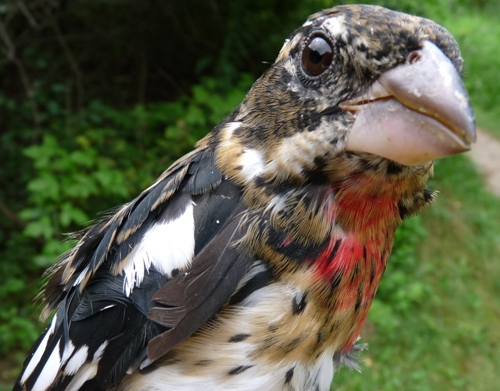
Another AHY male that can be readily recognized as an SY due to the retained juvenile
alula; again there is some black on the head and red on the breast, but the extent of
such plumage appears to vary more with timing of molt than by age (SY vs. ASY).
Photo by Marcel Gahbauer,
McGill Bird Observatory (QC), August 2009
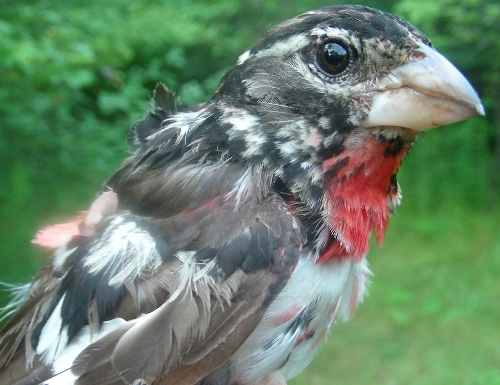
A particularly obvious SY male, with extensive brown on the back, but also with a fairly
extensive red throat patch, likely due to the earlier date of this photo compared to others.
Photo by Gay Gruner,
McGill Bird Observatory (QC), July 2009
AHY males are the only age/sex class to have black on the wing in fall; until the prebasic molt is completed (commonly August, sometimes into September), it should be possible to separate SY and ASY individuals by determining whether the unreplaced feathers are brown (SY) or black (ASY).
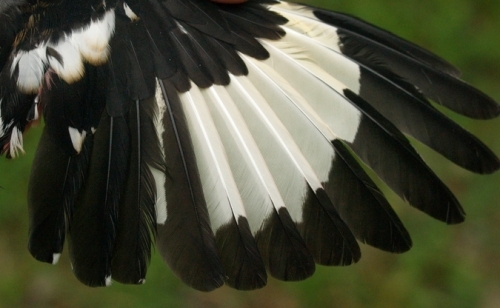
An AHY wing with exceptionally large white patches on the primaries.
Photo by Simon Duval,
McGill Bird Observatory (QC), August 2010
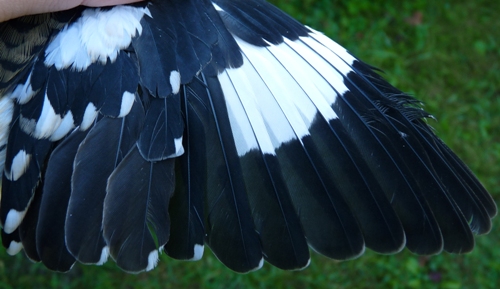
A more typical AHY wing; based on the nearly black colour of the unreplaced
secondaries, this individual can be identified as ASY.
Photo by Marcel Gahbauer,
McGill Bird Observatory (QC), September 2009
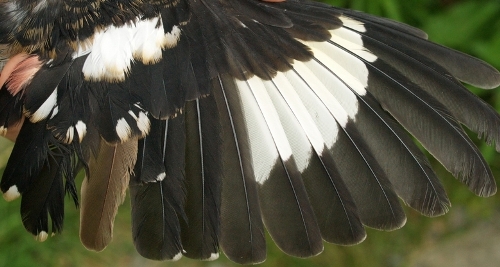
An AHY male nearing the end of its prebasic molt; thanks to the retention of a single
juvenile secondary, it can safely be recognized as an SY male.
Photo by Simon Duval,
McGill Bird Observatory (QC), August 2010
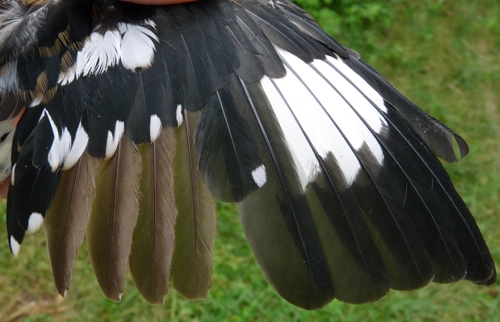
An SY male somewhat earlier in its prebasic molt.
Photo by Marcel Gahbauer,
McGill Bird Observatory (QC), August 2009
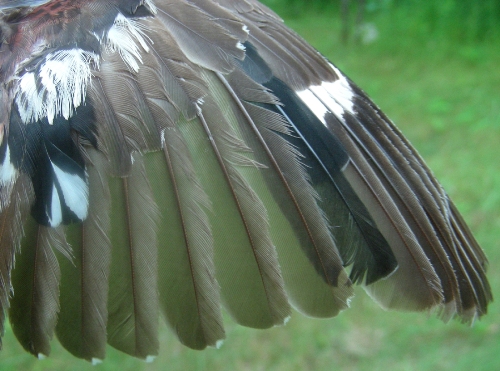
An unusually brown SY male. Not only has the prebasic molt just begun with only two
primaries replaced so far, but the preformative/prealternate molts appear to have been
very limited, given that most of the greater coverts are still retained juvenile feathers.
Photo by Gay Gruner,
McGill Bird Observatory (QC), July 2009
AHY males have black and white tails, whereas all other age/sex classes in fall are brown.
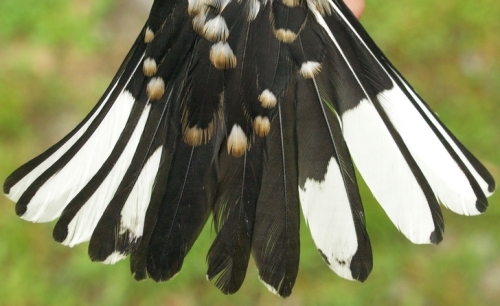
An AHY male tail with an unusually large amount of white, corresponding to the first wing above.
Photo by Simon Duval,
McGill Bird Observatory (QC), August 2010
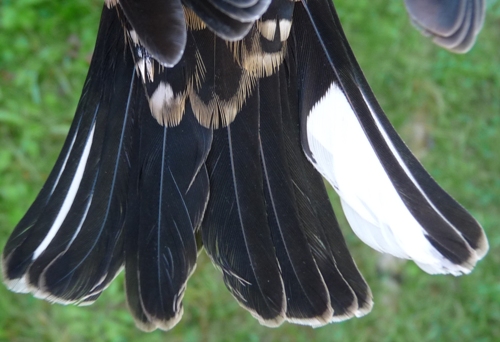
A more typical AHY male tail, corresponding to the ASY wing above.
Photo by Marcel Gahbauer,
McGill Bird Observatory (QC), September 2009
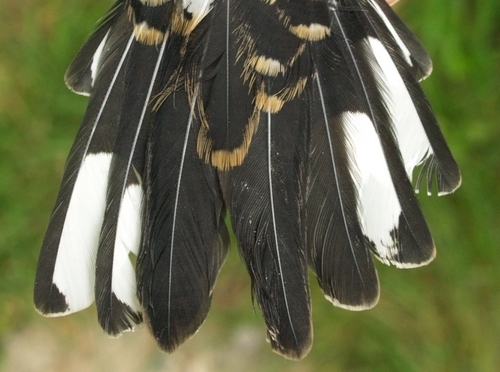
An AHY tail nearing completion of molt, and corresponding to the first of three SY male
wings above; note that this tail does not help distinguish SY from ASY.
Photo by Simon Duval,
McGill Bird Observatory (QC), August 2010
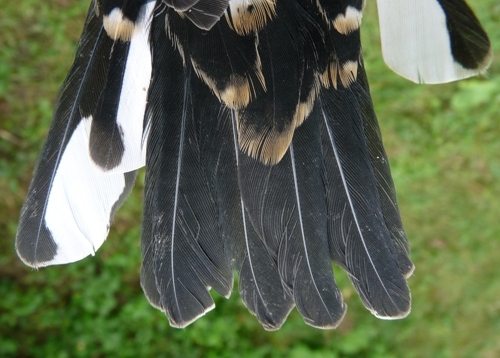
Another SY tail undergoing molt but providing no indication of age beyond AHY.
Photo by Marcel Gahbauer,
McGill Bird Observatory (QC), August 2009
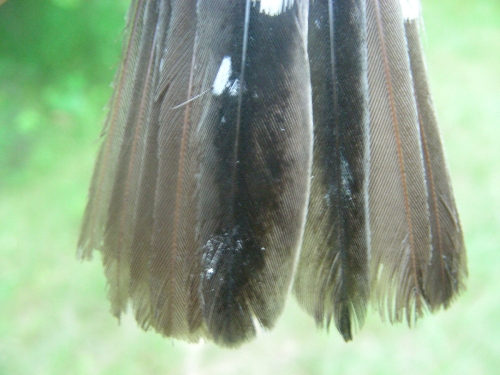
This tail corresponds to the SY male shown in previous sections with an unusually limited
molt; it appears the prebasic molt of the tail has not yet begun, and that only the central
rectrices were replaced during the preformative/prealternate molt.
Photo by Gay Gruner,
McGill Bird Observatory (QC), July 2009
RETURN TO AGE/SEX
OVERVIEW
|
JUL - DEC:
after-hatch-year
female |
In fall, female Rose-breasted Grosbeaks as well as hatch-year males are brown and streaked, with conspicuous pale stripes over the eyes and on the crown. Sex can be determined by the colour of the underwing coverts, while to determine age it is necessary to look at the wings and/or tail.
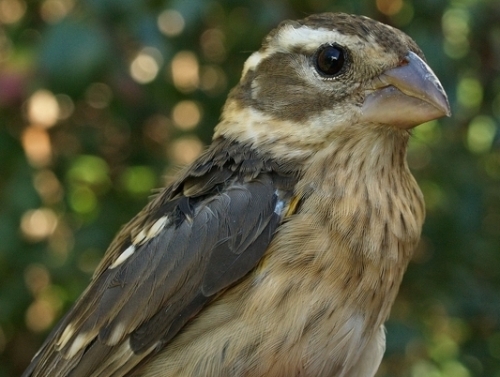
A typical AHY female, indistinguishable from HY males and females at this angle.
Photo by Simon Duval,
McGill Bird Observatory (QC), September 2010
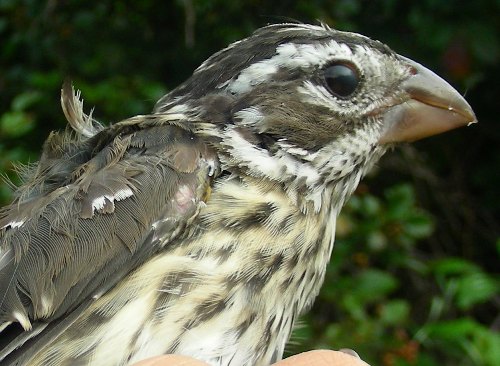
An AHY female earlier in fall, looking somewhat frayed as it undergoes its prebasic molt.
Photo by Marie-Anne Hudson,
McGill Bird Observatory (QC), August 2007
Molt limits on the wings of SY Rose-breasted Grosbeaks can be subtle, and therefore if none are evident, the tail and/or skull should be checked to confirm age. However, if primaries or secondaries are in active molt, a female can be recognized as AHY, since HY birds do not replace these feathers in their preformative molt. AHY females typically have small white patches on the primaries just below the primary coverts, but these may not always be visible, especially if the primaries have not yet finished growing.
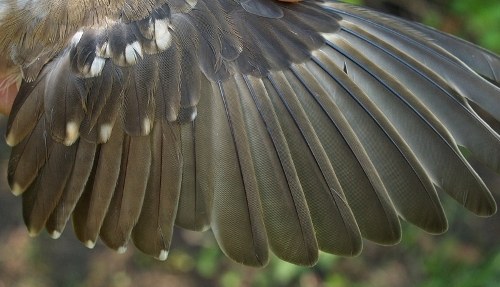
An AHY female undergoing prebasic molt; given the subtle contrast in colour and condition
between the retained secondaries and fresh feathers, this is likely an ASY female.
Photo by Simon Duval,
McGill Bird Observatory (QC), September 2010
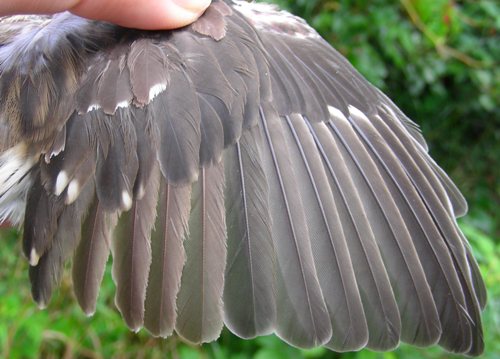
Another AHY female undergoing prebasic molt; in this case the retained secondaries
are somewhat paler and more frayed, suggesting this may be an SY female.
Photo by Marie-Anne Hudson,
McGill Bird Observatory (QC), August 2007
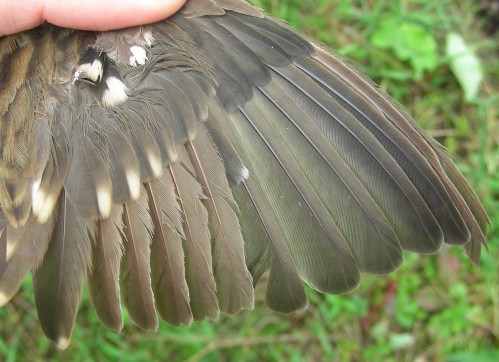
This AHY female was photographed somewhat earlier in its molt; the contrast with the
retained secondaries and in this case also primaries is particularly strong, and this
individual is very likely
an SY female. Of interest are the two almost
blackish median
coverts that seem unusually
dark for a female.
Photo by Marie-Anne Hudson,
McGill Bird Observatory (QC), August 2007
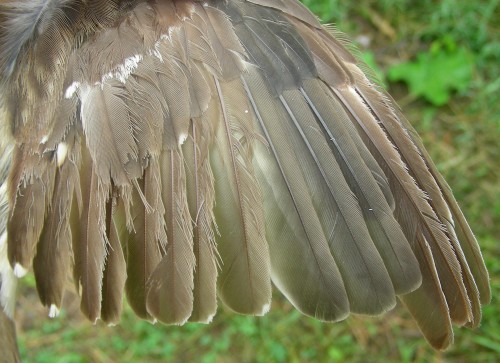
Another AHY female, this one certainly an SY based on how pale and worn the retained feathers appear.
Photo by Marie-Anne Hudson,
McGill Bird Observatory (QC), August 2007
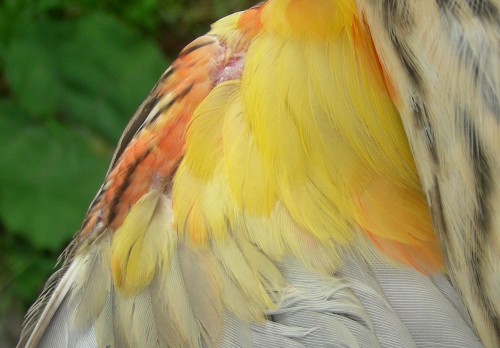
An underwing with an unusual amount of orange, possibly related to diet during molt.
Photo by Marie-Anne Hudson,
McGill Bird Observatory (QC), August 2007
AHY females have brown rectrices similar in colour to those of HY males and females, but generally more broad and rounded.
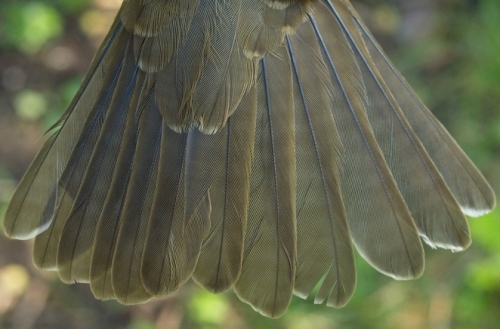
A typical AHY female tail.
Photo by Simon Duval,
McGill Bird Observatory (QC), September 2010
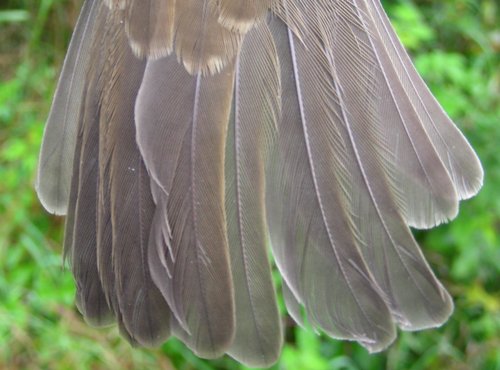
Another AHY female tail, this one with the outermost rectrices still growing in.
Photo by Marie-Anne Hudson,
McGill Bird Observatory (QC), August 2008
RETURN TO AGE/SEX
OVERVIEW
|
JUL - DEC:
hatch-year
male |
HY birds
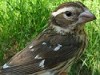
of both sexes are streaked brown and white, and are quite similar in overall appearance to AHY females. If visible, the pink underwing of males is the most reliable way to identify them, but in some cases HY males may also have a few rose-tinged feathers on the
upper breast. The white patch on the primaries is larger than on females of any age, and is also quite often visible on perched birds.
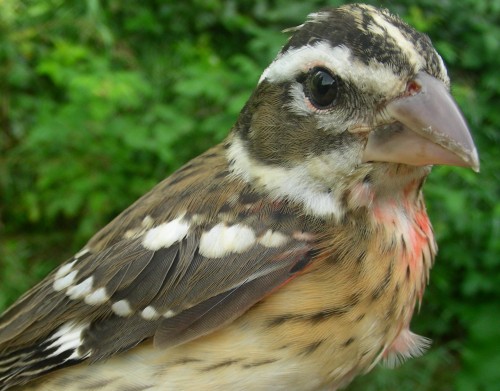
An HY male easily recognizable by its handful of red feathers on the upper breast.
Photo by Marie-Anne Hudson,
McGill Bird Observatory (QC), August 2007
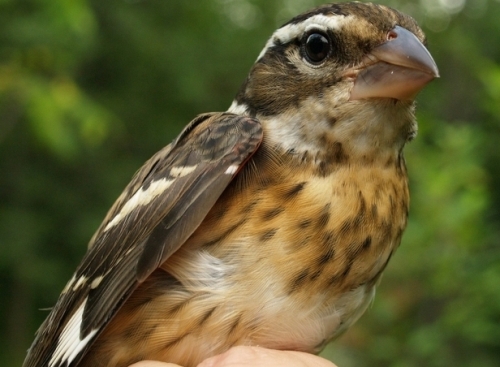
A more typical HY male body pattern; note also that the extensive white patch on the
primaries is sufficient to recognize this as a male.
Photo by Simon Duval,
McGill Bird Observatory (QC), July 2010
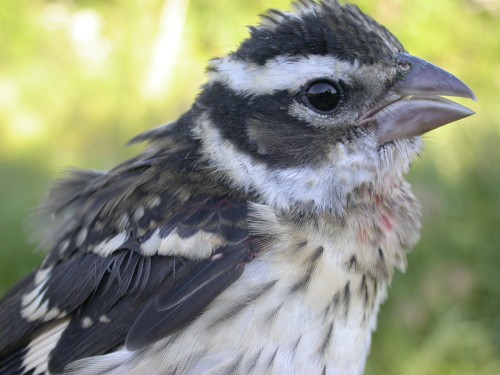
An individual with a much whiter breast, but with just a few red feathers in the throat.
Photo by Marcel Gahbauer,
McGill Bird Observatory (QC), August 2005
The wing provides the most reliable clues for identifying HY males. On the upper surface, the white patch on the primaries is longer than on females of any age, usually at least 4 mm beyond the end of the primary coverts, and often much longer. The pink patch on the underwing is an even more obvious indicator of males, but is usually difficult to see except when in the hand.
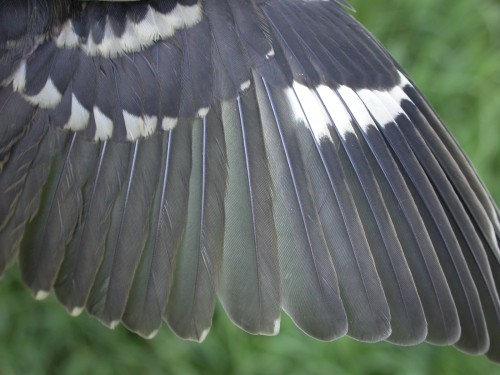
A typical HY male wing, with a fairly distinct patch of white on the primaries, and a bit of
a contrast between the replaced median coverts and unreplaced juvenile greater coverts.
Photo by Marcel Gahbauer,
McGill Bird Observatory (QC), August 2005
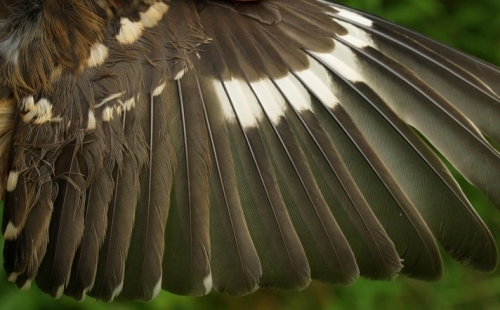
A somewhat browner wing, but showing the same pattern as above.
Photo by Simon Duval,
McGill Bird Observatory (QC), July 2010
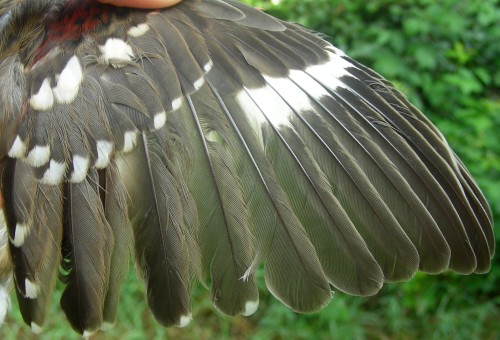
A variant with some red in the lesser coverts.
Photo by Marie-Anne Hudson,
McGill Bird Observatory (QC), August 2007
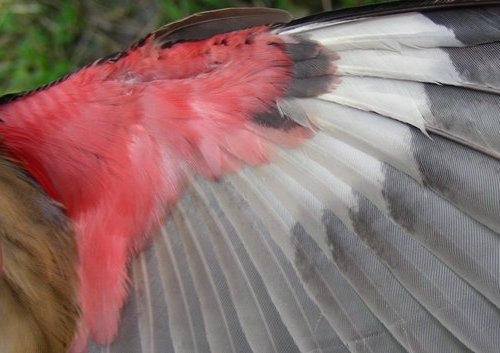
A typical male underwing pattern.
Photo by Marcel Gahbauer,
McGill Bird Observatory (QC), August 2008
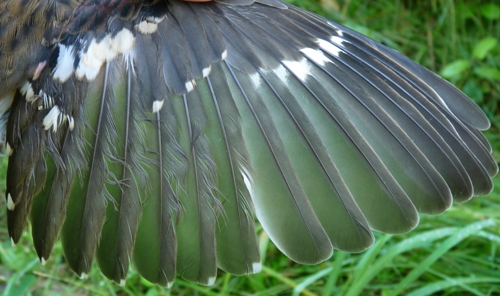
An HY male with a relatively small extent of white on the primaries, and with the median
and some greater coverts undergoing preformative molt.
Photo by Marcel Gahbauer,
McGill Bird Observatory (QC), August 2009
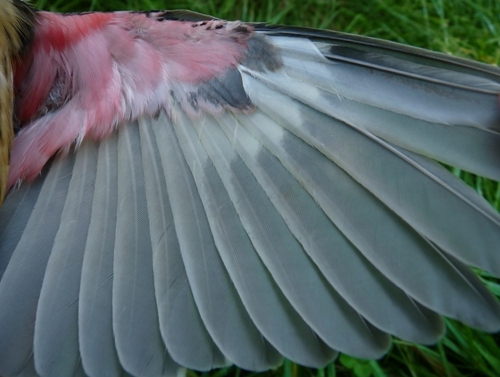
The underwing of the bird shown above, with a somewhat paler pink patch.
Photo by Marcel Gahbauer,
McGill Bird Observatory (QC), August 2009
HY grosbeaks have narrow and
tapered rectrices, with a variable amount of white near the tip of the outer rectrices.
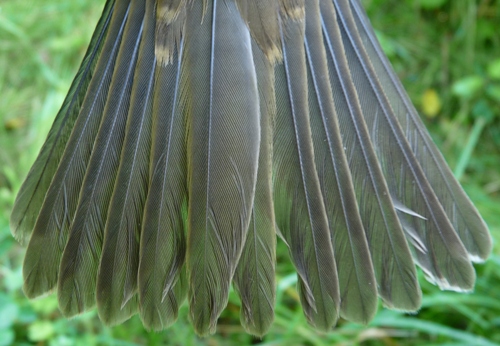
A typical HY male tail, with noticeably narrower rectrices than AHY grosbeaks.
Photo by Marcel Gahbauer,
McGill Bird Observatory (QC), August 2009
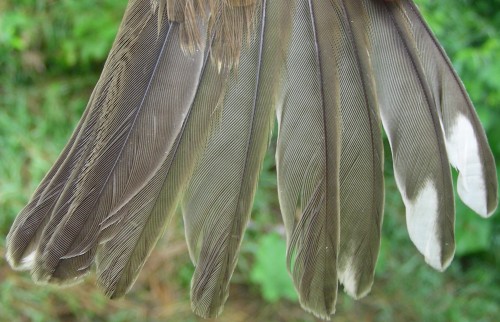
A variant with a fair amount of white on the outermost rectrices.
Photo by Marie-Anne Hudson,
McGill Bird Observatory (QC), August 2007
RETURN TO AGE/SEX
OVERVIEW
|
JUL - DEC: hatch-year
female |
HY birds
of both sexes are streaked brown and white; the colour of the underwing patches can be used to determine sex, while both the wing and tail are helpful in determining
age. Females lack any red on the breast, and HY females have little if any white showing on the primaries.
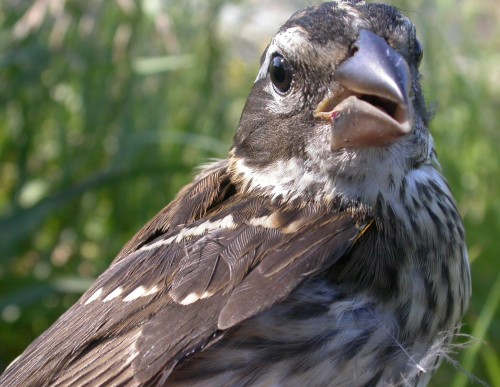
Photo by Marcel Gahbauer,
McGill Bird Observatory (QC), August 2005
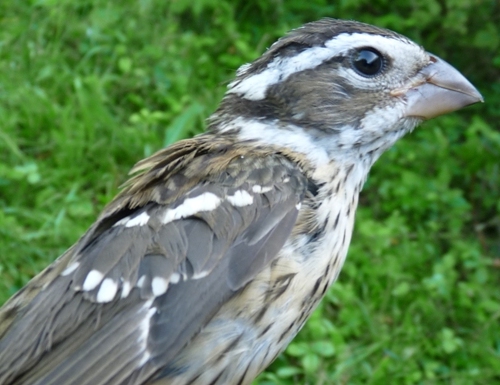
Photo by Marcel Gahbauer,
McGill Bird Observatory (QC), August 2009
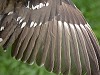
HY females have a dull brown wing, with little if any white showing on the primaries below the primary coverts. There is often a molt limit between the replaced median coverts and the somewhat paler retained juvenile greater coverts. The underwing has a yellow patch similar to that of AHY females.
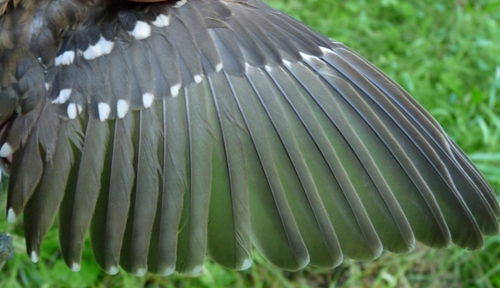
A typical HY female wing, with a contrast showing between the median and greater
coverts, and only a few small patches of white showing on the primaries.
Photo by Marcel Gahbauer,
McGill Bird Observatory (QC), August 2009
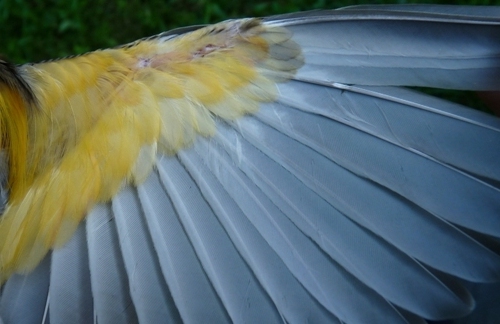
The corresponding underwing, showing the yellow patch typical of females.
Photo by Marcel Gahbauer,
McGill Bird Observatory (QC), August 2009
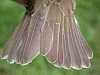
Like males, HY females have narrow and relatively tapered rectrices, usually distinctly different from those of AHY grosbeaks.
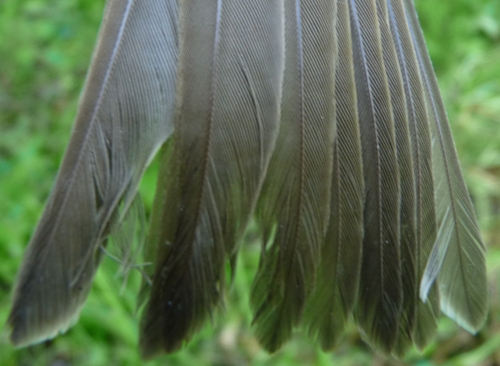
A typical HY female tail.
Photo by Marcel Gahbauer,
McGill Bird Observatory (QC), August 2009
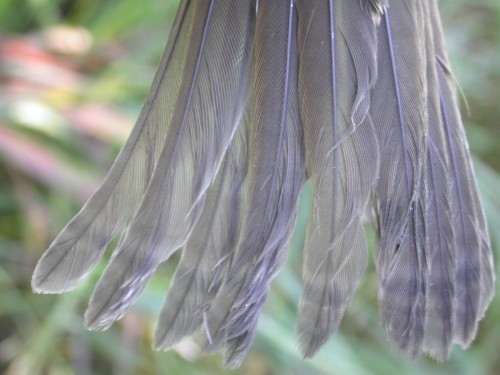
An unusually pale, narrow, and worn tail, with strong growth bars near the tip of all feathers.
Photo by Marcel Gahbauer,
McGill Bird Observatory (QC), August 2005
RETURN TO AGE/SEX
OVERVIEW
|