Ageing and sexing details:
|
JAN - JUL: after-second-year
male |
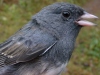
ASY males are uniformly dark gray above, with few if any brown body
feathers.
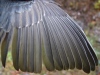
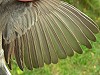
The wing of ASY male juncos is uniformly dark gray, with no contrast in colour or
condition between any feather tracts.
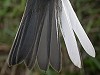
ASY males have broad and rounded tails. The amount of white on the
outer three rectrices tends to be most extensive on ASY males, but there
is considerable variation among and between races, and this feature
cannot be used alone to age or sex individuals.
RETURN TO AGE/SEX
OVERVIEW
|
JAN - JUL: after-second-year
female |
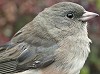
There is some overlap between SY males and
ASY females in overall appearance, but ASY females tend to be somewhat
paler gray, and with more brown on the back. Note that appearance may vary among individuals and can also be affected by lighting. Age can usually be
easily determined by looking at the wing and/or tail, and sex can be determined more reliably once age is known.
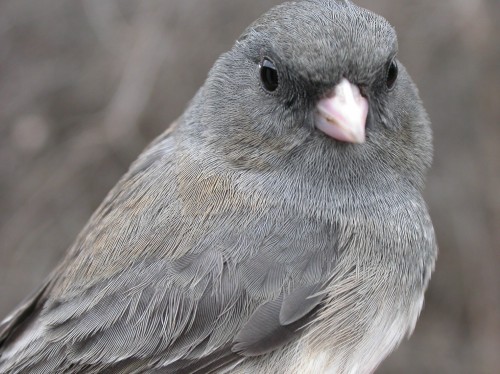
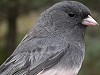
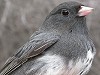
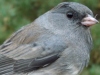
A fairly typical ASY female, with moderately dark gray on the head and some brown on the back.
Photo by Marcel Gahbauer, McGill Bird Obseravtory (QC),
April 2006
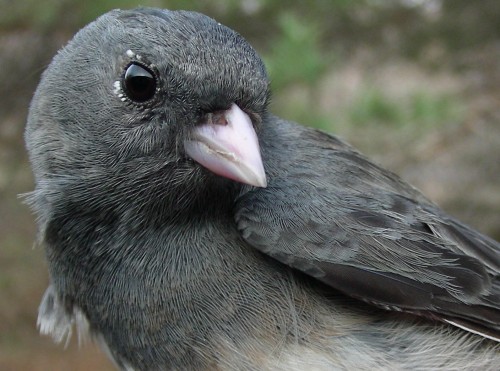
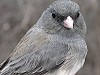
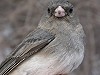
A somewhat darker individual on the head, with less brown on the back, but some on the
breast (and also a short wing chord, as measured while in the hand).
Photo by Marie-Anne Hudson,
McGill Bird Observatory (QC), April 2008
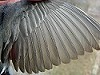
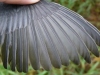
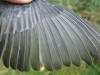
ASY juncos have a uniformly gray wing, with no contrast in colour or
condition between feather tracts.
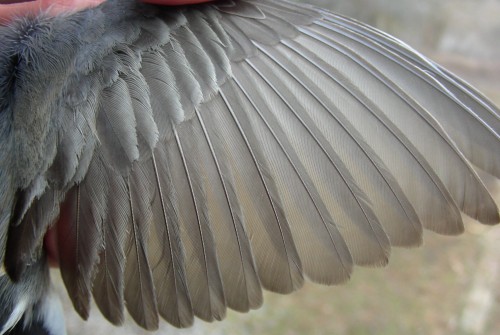
Photo by Marie-Anne Hudson,
McGill Bird Observatory (QC), April 2008
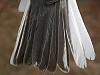
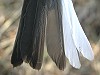
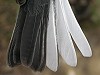
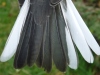
Rectrices are broad and rounded, usually showing relatively little wear
even by spring.
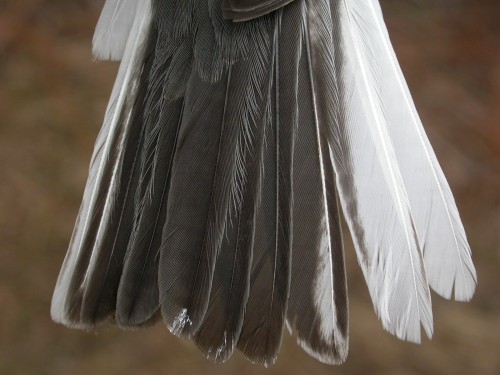
Photo by Marcel Gahbauer,
McGill Bird Observatory (QC), April 2006
RETURN TO AGE/SEX
OVERVIEW
|
JAN - JUL: second-year
male |
There is some overlap between SY males and
ASY females in overall appearance, but SY males tend to be somewhat
darker gray, and with less brown on the back. Age can usually be
easily determined by looking at the wing and/or tail, and should be done before considering sex.
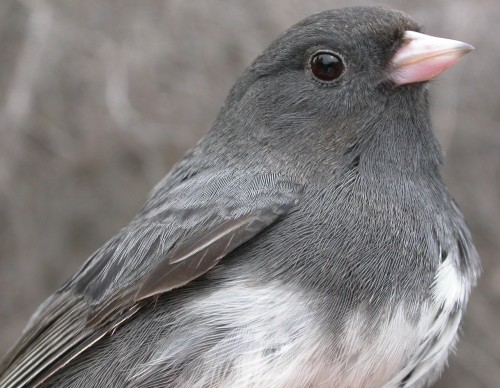
A typical SY male Slate-colored Junco; note that in some cases like this one, the molt limit
between the brownish juvenile alula and primary coverts
vs. the grayish formative greater
and median coverts.
Photo by Marcel Gahbauer,
McGill Bird Observatory (QC), January 2006
SY Slate-colored Juncos typically have a rather obvious molt limit within the greater coverts or between the greater coverts and primary coverts.
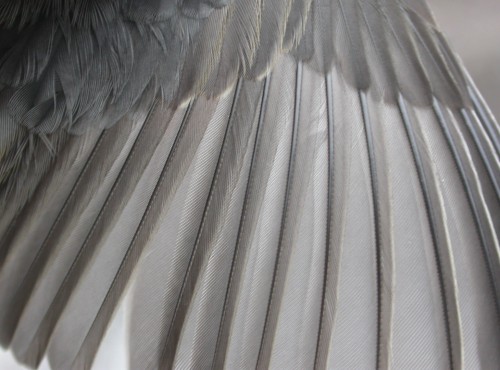
In this example, the molt limit is in the middle of the greater coverts, with the outer greater coverts
and primary coverts distinctly brownish, contrasting with the replaced inner greater
coverts.
Photo by Marcel Gahbauer,
McGill Bird Observatory (QC), January 2006
Although the wing is the most reliable for ageing juncos, SY birds typically also have somewhat more narrow and tapered outer rectrices. The extent of white on the outer rectrices appears to vary geographically as well as by age and sex, and is therefore of limited use for ageing or sexing.
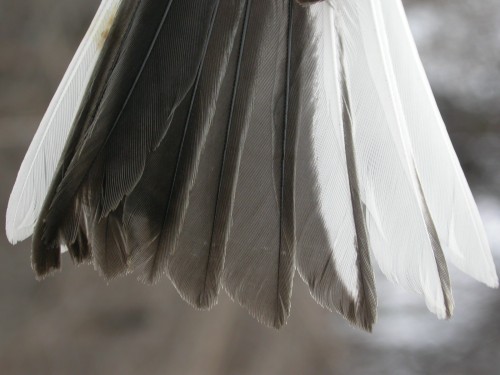
Photo by Marcel Gahbauer,
McGill Bird Observatory (QC), January 2006
RETURN TO AGE/SEX
OVERVIEW
|
JAN - JUL: second-year
female |
SY
females are usually distinctly paler than any other juncos. They are
usually medium gray on the upper breast and back, mixed with some pale
brown, sometimes leading to a bit of a pinkish tone.
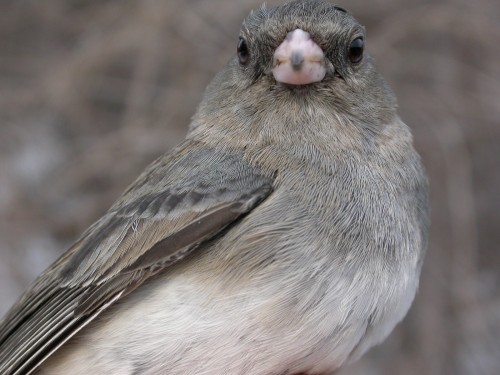
Photo by Marcel Gahbauer,
McGill Bird Observatory (QC), April 2006
SY
juncos typically have a rather obvious molt limit among the greater coverts or between the greater coverts and primary coverts.
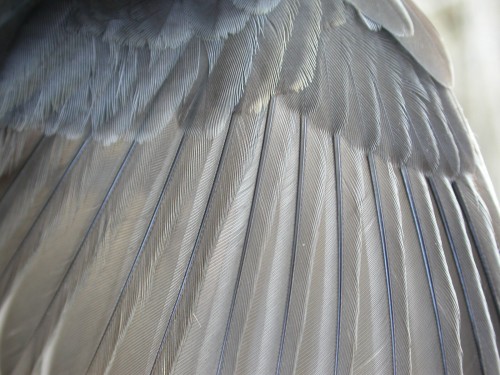
In this example, the outer two brownish greater coverts are retained juvenile feathers,
contrasting with the replaced formative inner greater coverts.
Photo by Marcel Gahbauer,
McGill Bird Observatory (QC), April 2006
Although the wing is the most reliable feature for ageing juncos, the outer rectrices of SY individuals are usually somewhat more narrow and tapered than on ASY birds. SY females typically have the least amount of white on the outermost three rectrices, but this is quite variable and not a reliable feature for ageing and sexing.
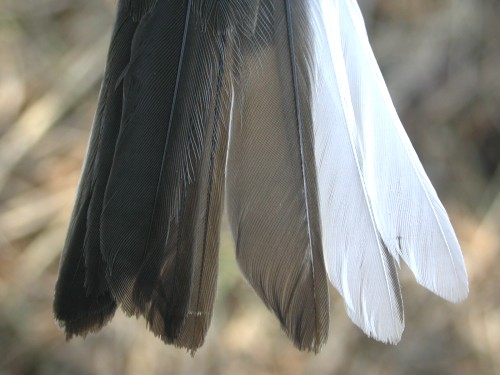
Photo by Marcel Gahbauer,
McGill Bird Observatory (QC), April 2006
RETURN TO AGE/SEX
OVERVIEW
|
JUL - DEC: after-hatch-year
male |
ASY males
are uniformly dark gray above, usually with only a bit of brown on the
back.
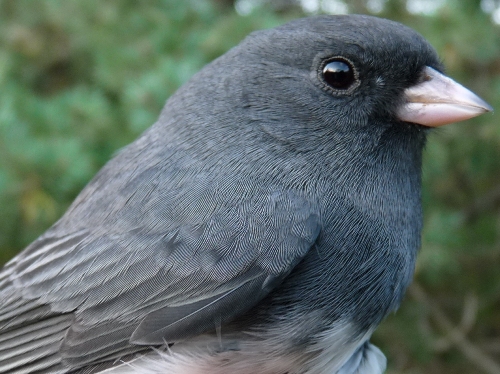
A typical AHY male, with a dark face and only a hint of brown on the back.
Photo by Marcel Gahbauer,
McGill Bird Observatory (QC), October 2009
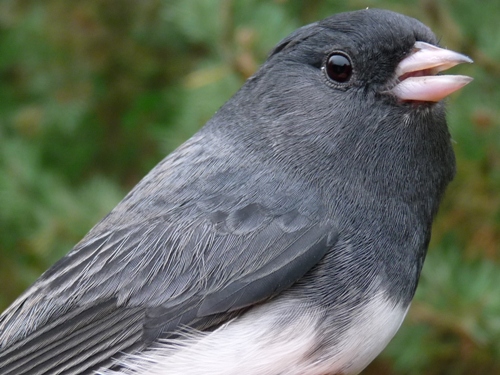
Another typical AHY male, illustrating that due to feather edging, the wings and back
may appear contrastingly pale, but note the head is again uniformly dark.
Photo by Marcel Gahbauer,
McGill Bird Observatory (QC), October 2010
The wing of AHY males is uniformly gray, with no contrast in colour or
condition between any feather tracts.
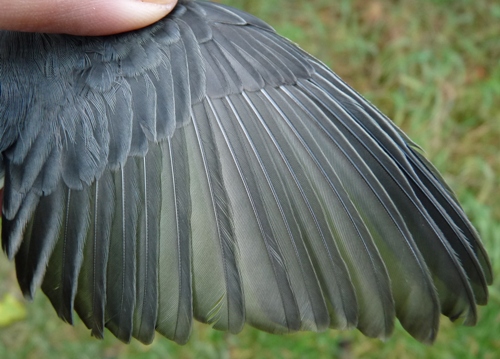
A typical AHY male wing, dark gray throughout and with broad silvery edging on the
greater coverts and tertials.
Photo by Marcel Gahbauer,
McGill Bird Observatory (QC), October 2009
AHY males have broad and rounded tails. The amount of white on the outer
three rectrices tends to be most extensive on AHY males, but there is
considerable variation among and between races, and this feature should not
be considered reliable for ageing or sexing individuals.
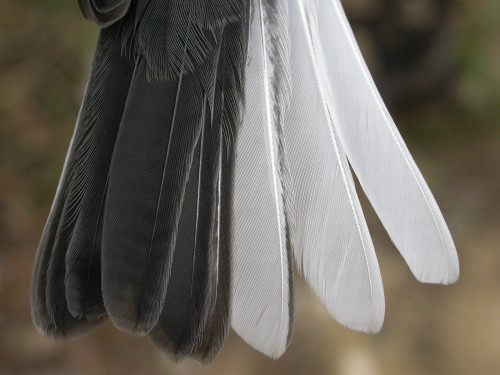
A typical AHY male tail, showing broad and rounded rectrices, and almost no dark patches
on the outermost three feathers.
Photo by Marcel Gahbauer,
McGill Bird Observatory (QC), October 2005
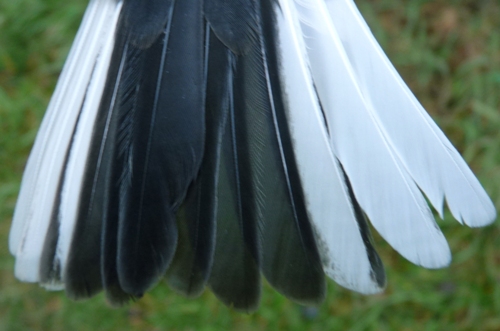
Another example showing similar feather shape, but with a bit more dark on r4.
Photo by Marcel Gahbauer,
McGill Bird Observatory (QC), October 2009
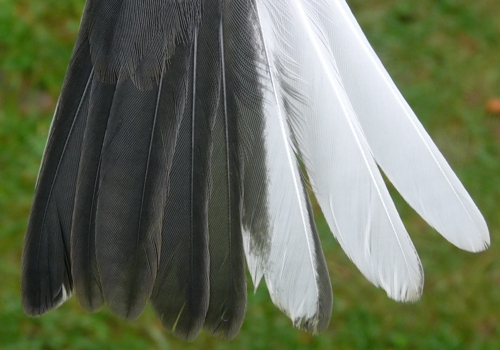
Again, similar rectric shape, but even more extensive dark patches on r4.
Photo by Marcel Gahbauer,
McGill Bird Observatory (QC), October 2010
RETURN TO AGE/SEX
OVERVIEW
|
JUL - DEC: after-hatch-year
female |
There is some overlap between HY males and
AHY females in overall appearance, but AHY females tend to be somewhat
paler gray, and with more brown on the back and upper breast. It is usually better to first determine age by looking at the wing and/or tail, then consider sex.
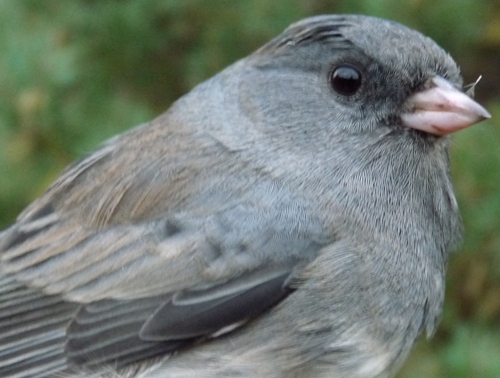
A typical AHY female, medium gray in colour with a bit of a darker face and a distinct brown
patch on the back. Note that although the primary coverts and greater coverts contrast in
colour, this is due to the brown edging on the greater coverts, but the primary coverts are
in fact dark and gray-edged, suggesting they are basic rather than juvenile feathers.
Photo by Marcel Gahbauer,
McGill Bird Observatory (QC), October 2010
AHY females have uniformly
gray primary and greater coverts, though there may be some brownish
edging on inner greater coverts.
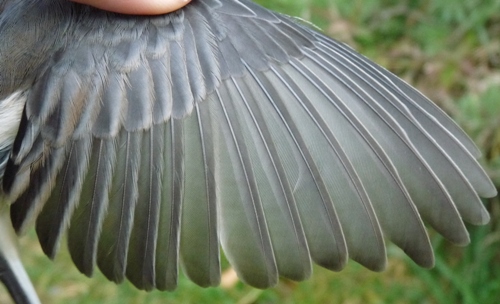
A typical AHY female wing, relatively uniformly gray, but a bit paler than that of a typical
AHY male. Note that some greater coverts and tertials may have brownish edging.
Photo by Marcel Gahbauer,
McGill Bird Observatory (QC), October 2010
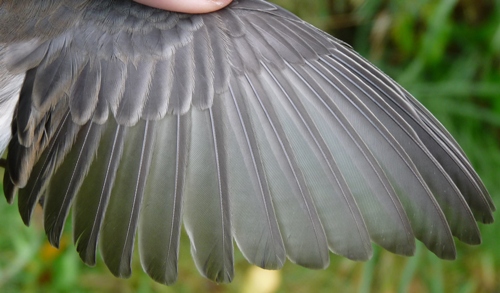
Another example, somewhat duller overall, but again uniform in tone across the wing.
Photo by Marcel Gahbauer,
McGill Bird Observatory (QC), October 2010
AHY juncos have broad and
rounded tails. The amount of white averages greater on AHY birds
than on HY individuals, but not reliably so.
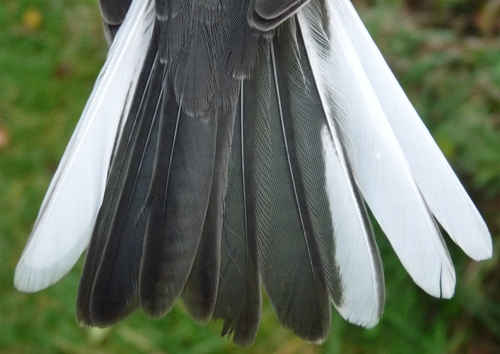
A typical AHY female wing, with broad and rounded rectrices, and a moderate amount of
dark on r4.
Photo by Marcel Gahbauer,
McGill Bird Observatory (QC), October 2010
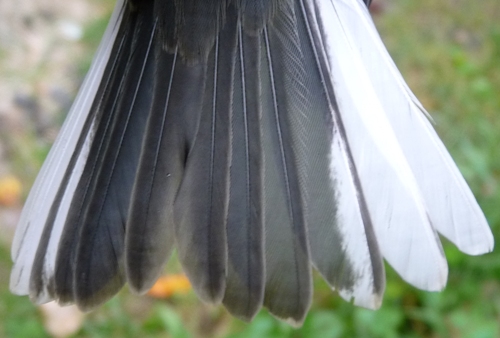
An AHY female with an unusually limited amount of white on r4.
Photo by Marcel Gahbauer,
McGill Bird Observatory (QC), October 2010
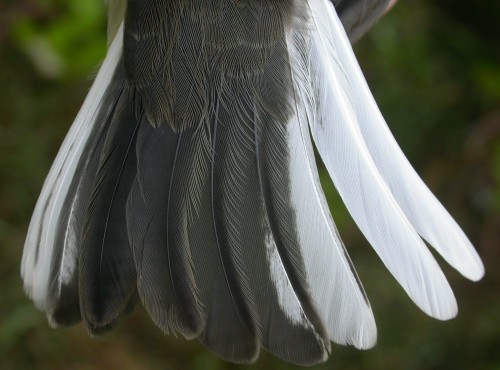
An unusual case with white extending as far as r3.
Photo by Marcel Gahbauer,
McGill Bird Observatory (QC), October 2005
RETURN TO AGE/SEX
OVERVIEW
|
JUL - DEC: hatch-year
male |
There is some overlap between HY males and
AHY females in overall appearance, but HY males tend to be somewhat
darker gray, especially in the face, and with less brown on the back and
upper breast. Age can usually be easily determined by looking at
the wing and/or tail.
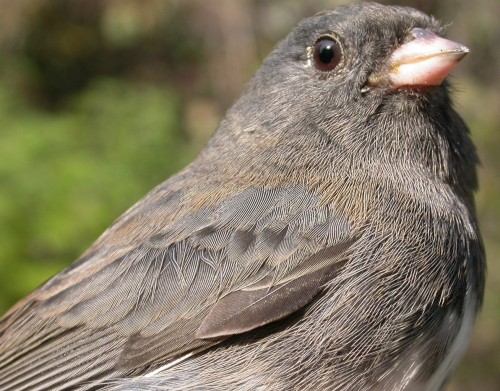
A typical HY male, darker on the head and upper breast than an average AHY female,
but also with a fair amount of brown on the back.
Photo by Marcel Gahbauer,
McGill Bird Observatory (QC), October 2005
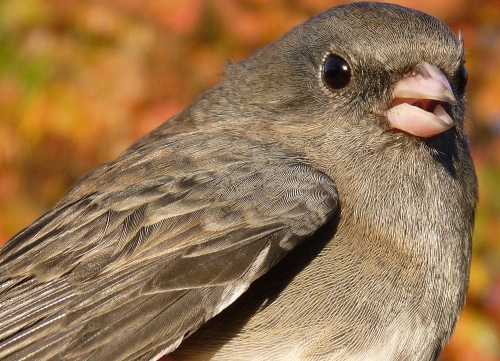
An example of how a HY male may appear somewhat paler in bright sunlight, highlighting
the care required with regarding subjective assessment of plumage.
Photo by Marcel Gahbauer,
McGill Bird Observatory (QC), October 2010
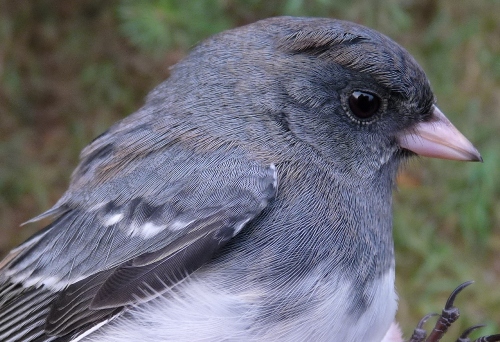
A typical gray/brown pattern for a HY male, but with distinct white tips to the median
and greater coverts.
Photo by Marcel Gahbauer,
McGill Bird Observatory (QC), October 2009
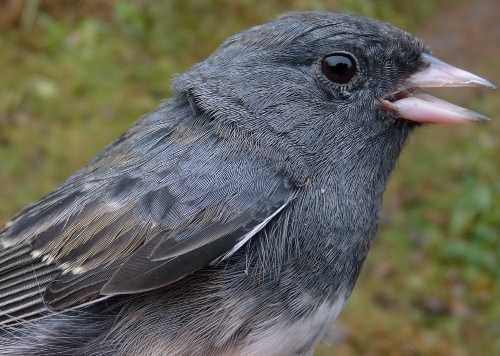
An example illustrating that sometimes the molt limits on the wing are prominently visible
even on perched birds, in this case the brown-edged juvenile outer greater coverts
contrasting witht he longer, darker, gray-edged inner greater coverts.
Photo by Marcel Gahbauer,
McGill Bird Observatory (QC), November 2009
HY juncos can usually be aged easily by spotting distinct molt limits either among the greater coverts or between the greater coverts and primary coverts.
The primary coverts are usually brownish or brownish-gray, with minimal edging; retained juvenile greater coverts are also brownish and often have distinct pale tips.
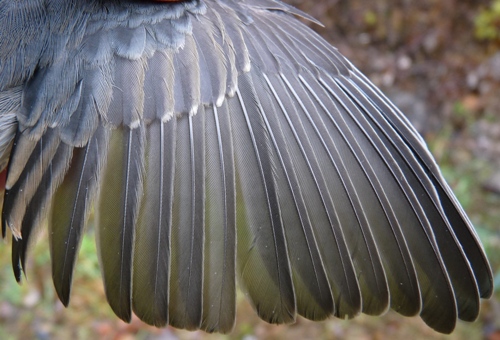
A particularly distinct HY wing, with a sharp molt limit between the grayish replaced inner
greater coverts and the brown, white-tipped juvenile
outer greater coverts. More generally,
the gray median coverts and inner greater coverts contrast with the generally brownish
tone of the rest of the wing.
Photo by Marcel Gahbauer, McGill Bird Observatory (QC), November 2009
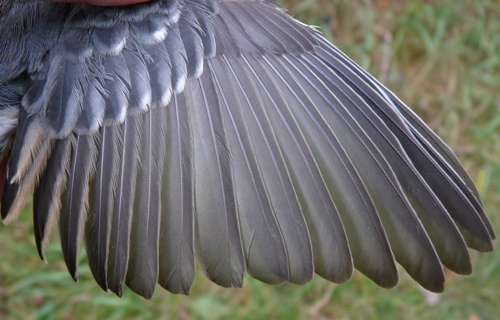
Fairly often, HY juncos have replaced all their greater coverts. Although the molt limit isn't
quite as obvious as in the first example, there is nonetheless a distinct contrast between
the gray greater coverts
and the block of more brownish retained feathers including
the primary coverts, primaries, and secondaries.
Photo by Marcel Gahbauer, McGill Bird Observatory (QC), October 2009
Although the wing provides the easiest and most reliable clues for ageing, the tail on HY juncos is usually also narrow and tapered, in contrast to the broader and more rounded shape typical of AHY juncos. HY males typically have an intermediate amount of white on the outer rectrices, usually including at least some white on r4, but this is highly variable and not reliable for ageing and sexing.
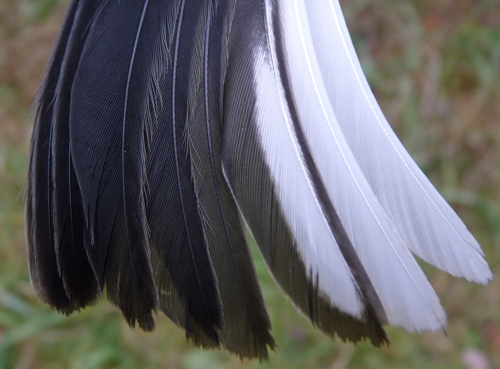
A typical HY male tail, showing relatively narrow and tapered rectrices, already with a bit
of wear at the tips, and a moderate amount of white on r4.
Photo by Marcel Gahbauer, McGill Bird Observatory (QC), October 2009
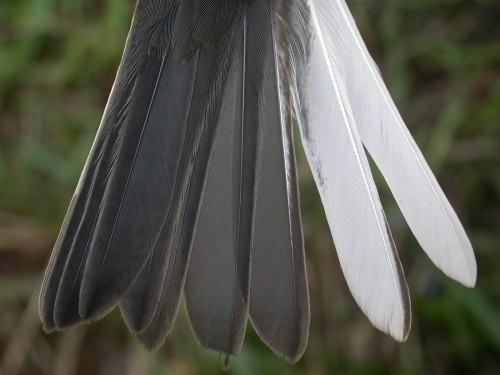
A much fresher-loooking tail except for the tip of r3 on the right side, but note that again
the outer rectrices are quite narrow. In this case there is only a trace of white along
the shaft of r4, and even r5 is not entirely white.
Photo by Marcel Gahbauer,
McGill Bird Observatory (QC), October 2005
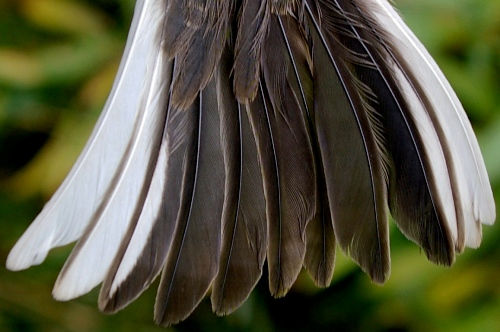
Another example highlighting the typical shape of the outer rectrices, and again a moderate
amount of white on r4, but in this case also a dark outer edge to r5.
Photo by James Junda, McGill Bird Observatory (QC), September 2008
RETURN TO AGE/SEX
OVERVIEW
|
JUL - DEC: hatch-year
female |
Most HY
females are distinctly paler than all other age/sex combinations in fall. They are
typically more brown than gray on the back, with a pale upper breast
that is a mixture of light gray and brown and may even appear pinkish; colouration also varies
by subspecies as in other age/sex combinations.
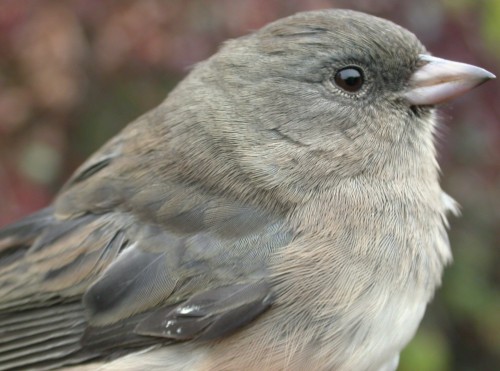
A typical HY female, pale on the upper breast and head, and with a bit of a pinkish-brown tone.
Photo by Marcel Gahbauer,
McGill Bird Observatory (QC), October 2005
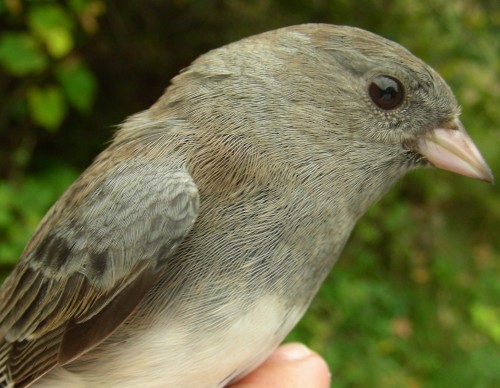
This individual is more grayish, but still distinctly pale. Note that the molt limit among the
greater coverts is visible even from this angle.
Photo by Marie-Anne Hudson,
McGill Bird Observatory (QC), October 2007
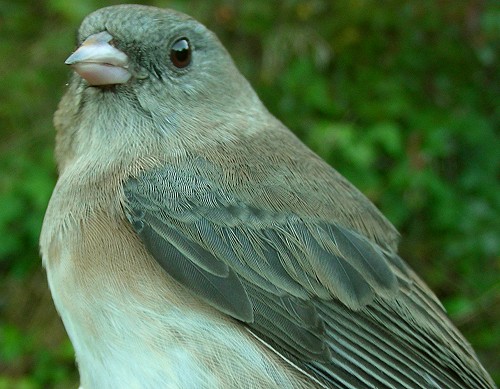
A particularly brownish/pinkish example, with the breast almost suggestive of the
cismontanus subspecies, but difficult to be certain of since HY females of the eastern
subspecies hyemalis can also have a pinkish tone sometimes.
Photo by Marie-Anne Hudson,
McGill Bird Observatory (QC),
October 2007
HY juncos can easily be aged by the presence of usually distinct molt limits within the greater coverts or between the greater coverts and primary coverts.
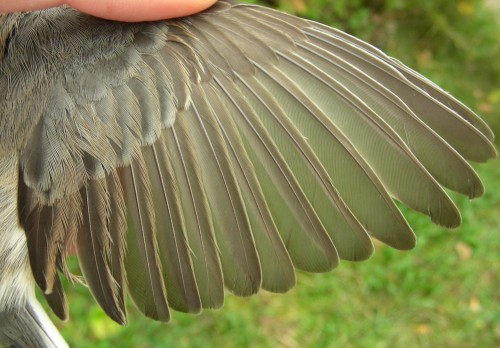
A typical HY female wing, largely brownish, with contrasting pale gray in the median and
greater coverts. Note the distinct molt limit between the replaced gray formative inner
greater coverts and the retained outermost two brownish ones. Also, the primary coverts
are distinctly brownish and lacking edging.
Photo by Marie-Anne Hudson,
McGill Bird Observatory (QC),
October 2007
Although the wing is best for ageing juncos, the tail is usually reliable too, with HY individuals having outer rectrices that are relatively narrow and tapered. Females tend to average somewhat browner than males, and with a lesser amount of white on r4 and r5, but there is too much overlap for this to be reliable for sexing.
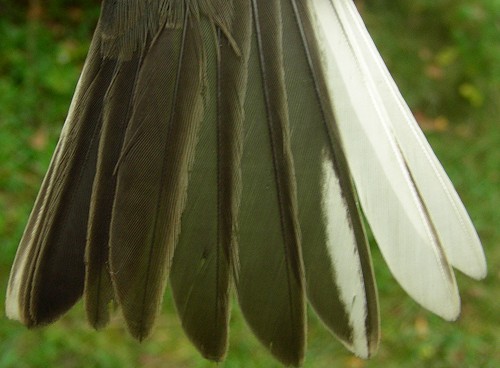
A fairly typical HY female tail, with narrow and tapered outer rectrices, and a general
brownish (rather than grayish) tone to the central rectrices.
Photo by Marie-Anne Hudson,
McGill Bird Observatory (QC),
October 2007
RETURN TO AGE/SEX
OVERVIEW