|
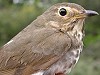
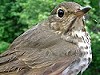
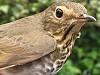
Swainson's Thrush / Grive à dos olive (Catharus ustulatus) |
 |
Introductory notes:
Swainson's Thrush is readily distinguished from the other Catharus species by its buffy eye ring and cheek and uniformly brown back and tail. The pale shaft streaks or tips to the greater coverts are the easiest way to recognize HY/SY Swainson's Thrushes, but beware that these tend to be less distinct than on most other Catharus species. |
QUICK TIPS:
| 1) Look
at the greater coverts - the presence of buffy-white
tips or shaft streaks indicates a HY/SY bird, however the
absence of buffy-white markings is NOT an
entirely reliable indicator of AHY/ASY, as some HY/SY
birds may lack these markings
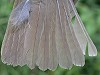
2) Consider the shape of the rectrices - they are tapered and relatively abraded on HY/SY birds, but rounded and relatively fresh on AHY/ASY birds
3) Examine
the outermost primary (p10) - on HY/SY birds it
is broad, rounded and 1 mm longer to 6 mm shorter than the
primary coverts, while on AHY/ASY birds it is
narrow, pointed, and 4-9 mm shorter than the primary
coverts
Species account updated February 2011 |
|
Ageing and sexing overview:
Ageing and sexing details:
|
JAN - JUL: after-second-year
unknown |
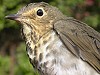
Swainson's Thrushes vary little by age, and sex can be determined only by checking for a brood patch or cloacal protuberance.
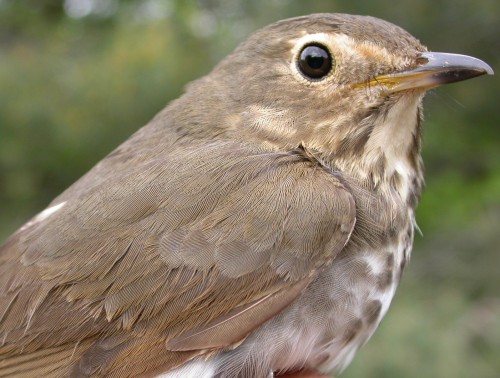
Photo by Marcel Gahbauer,
McGill Bird Observatory (QC), May 2005
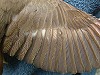
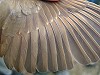
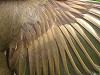
ASY Swainson's Thrushes have a uniformly brown wing, without pale tips on any greater coverts. To confirm age, it can be useful to look closely at p10, which is narrow and tapered and 4-9 mm shorter than the primary coverts.
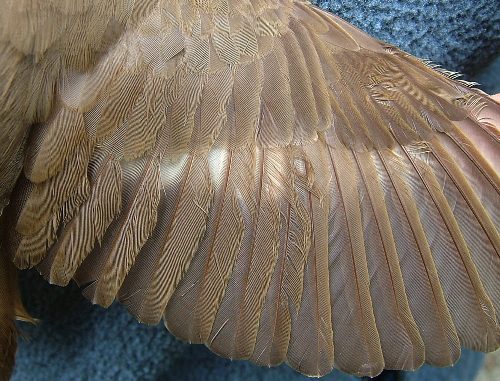
A uniform ASY wing.
Photo by Peter Pyle, Howell Woods (NC),
May 2006
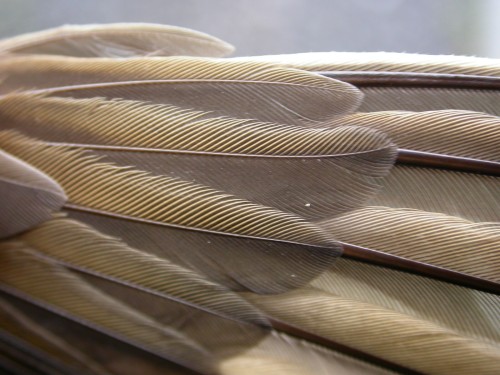
A closeup showing the short, narrow, and pointed p10.
Photo by Marcel Gahbauer,
McGill Bird Observatory (QC), May 2006
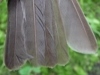
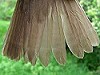
ASY Swainson's Thrushes have relatively broad and rounded rectrices.
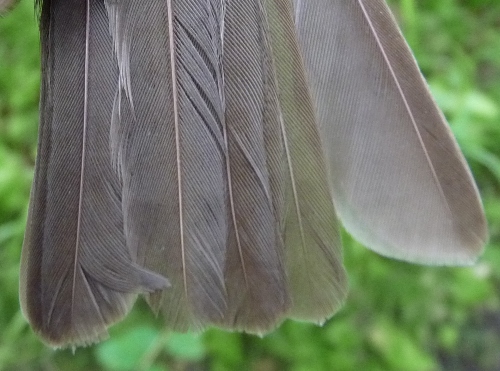
A particularly extreme example in terms of the width of the outer rectrices.
Photo by Marcel Gahbauer,
Inglewood Bird Sanctuary (AB), July 2009
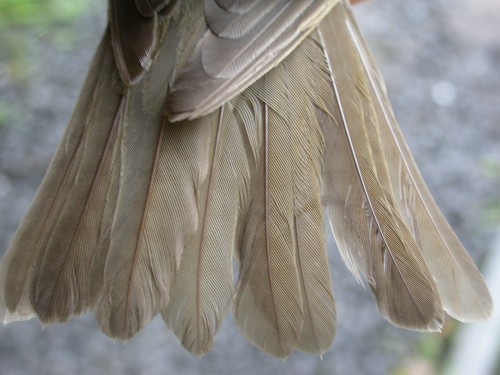
A somewhat intermediate example, with only moderately wide rectrices.
Photo by Marcel Gahbauer,
McGill Bird Observatory (QC), May 2006
RETURN TO AGE/SEX
OVERVIEW
|
JAN - JUL: second-year
unknown |
Overall plumage is rarely helpful in ageing Swainson's Thrushes, but in some cases SY individuals have readily visible pale tips to their retained juvenile greater coverts, which are a diagnostic feature.
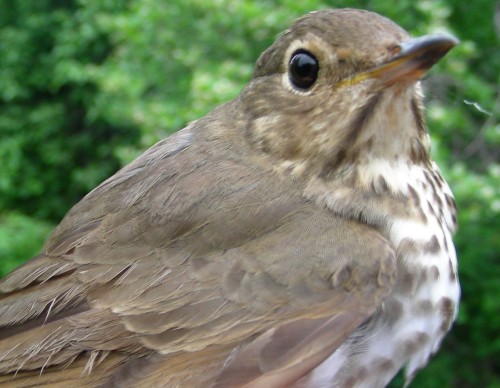
Pale tips to the outer greater coverts are visible in this photo but subtle, and a good look
at the open wing provides a better assessment of this feature for most Swainson's Thrushes.
Photo by Marie-Anne Hudson, McGill Bird Observatory (QC),
May 2008
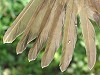
SY Swainson's Thrushes retain at least half of their juvenile greater coverts, which usually have a pale tip or shaft streak. Also, p10 is broader and more rounded than on ASY birds, although still usually relatively short (between 1 mm longer and 6 mm shorter than the primary coverts).
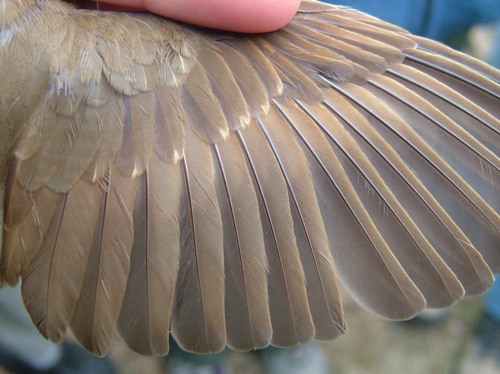
A typical SY wing, with the innermost two greater coverts replaced and somewhat longer
than the retained juvenile greater coverts, which also have distinct pale shaft streaks.
Photo by Peter Pyle, Big Sur Ornithology Lab (CA),
May 2007
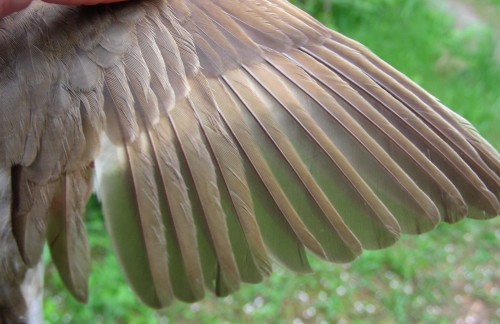
A more subtle example, in which there are small pale tips to the retained juvenile greater
coverts, but no shaft streaks, and a less obvious contrast with the replaced inner coverts.
Photo by Marie-Anne Hudson, McGill Bird Observatory (QC),
May 2008
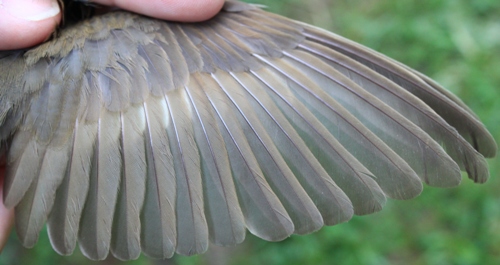
A particularly unmarked SY wing, but note that there is still a contrast in length between
the innermost two greater coverts and the remainder, representing the molt limit.
Photo by Peter Pyle, Braddock Bay Bird Observatory (NY), May 2010
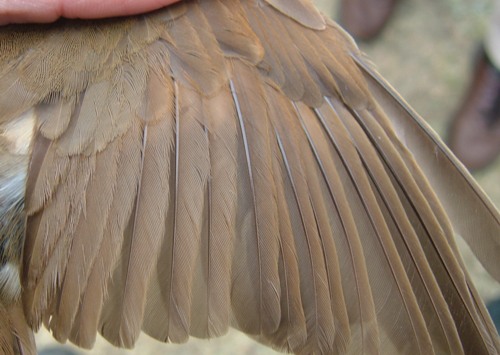
Another subtle example; in this case there is a colour difference between the darker brown
replaced inner greater coverts and the more rusty retained juvenile greater coverts.
Photo by Peter Pyle, Big Sur Ornithology Lab (CA),
May 2007
SY Swainson's Thrushes have relatively narrow and pointed rectrices.
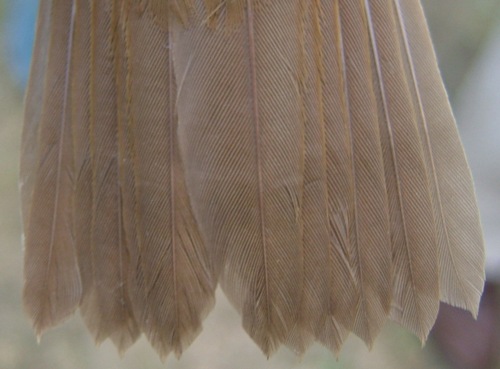
An extreme example, with distinctly narrow and pointed rectrices across the entire tail.
Photo by Peter Pyle, Big Sur Ornithology Lab (CA),
May 2007
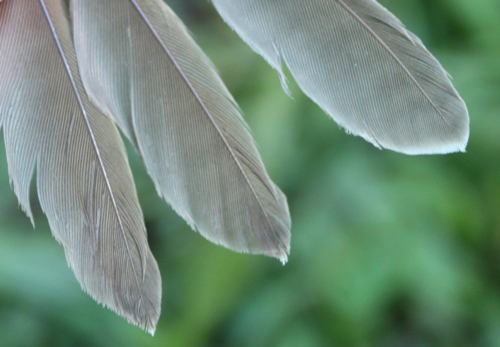
A somewhat more intermediate case, especially on the outermost (right) feather.
Photo by Peter Pyle, Braddock Bay Bird Observatory (NY), May 2010
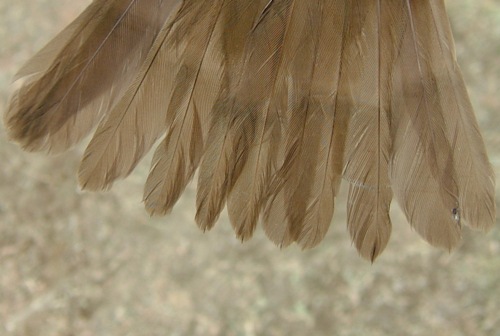
An example with relatively narrow but somewhat less pointed rectrices; note also in this
case a uniform growth bar across the tail, relatively common among SY thrushes.
Photo by Peter Pyle, Big Sur Ornithology Lab (CA),
May 2007
RETURN TO AGE/SEX
OVERVIEW
|
JUL - DEC: after-hatch-year
unknown |
Overall appearance usually cannot be used to identify AHY Swainson's Thrushes, since the pale tips to the greater coverts that may be used to distinguish HY individuals are not always readily visible.
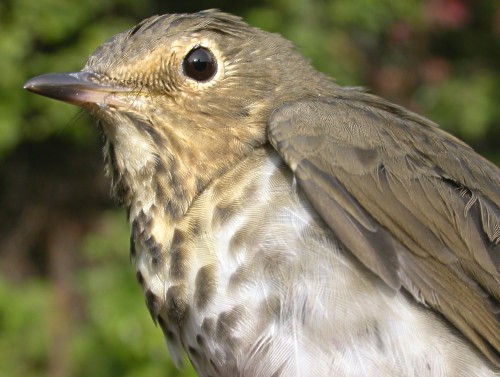
Photo by Marcel Gahbauer,
McGill Bird Observatory (QC), August 2005
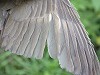
AHY Swainson's Thrushes have uniformly brown wings, without pale tips or shaft streaks on any of the greater coverts. Additionally, p10 is narrow, pointed, and substantially (4-9 mm) shorter than the adjacent primary coverts.
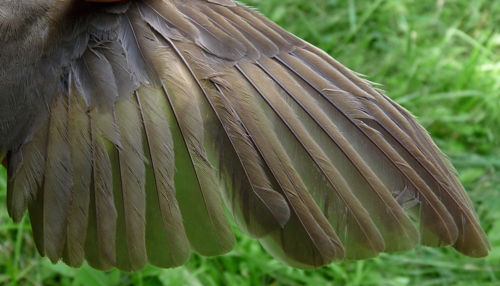
Photo by Marcel Gahbauer,
McGill Bird Observatory (QC), August 2009
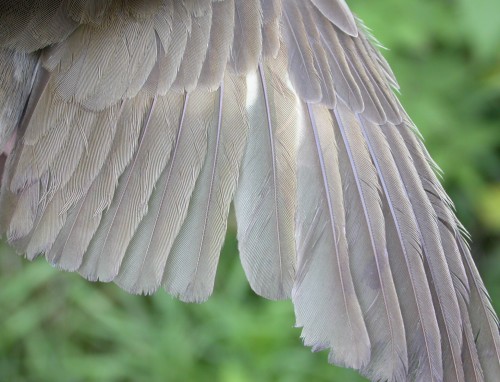
Photo by Marcel Gahbauer,
McGill Bird Observatory (QC), August 2005
AHY Swainson's Thrushes have broad rectrices with relatively rounded tips.
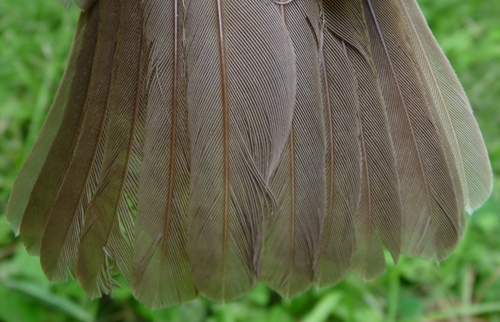
Photo by Marcel Gahbauer,
McGill Bird Observatory (QC), August 2009
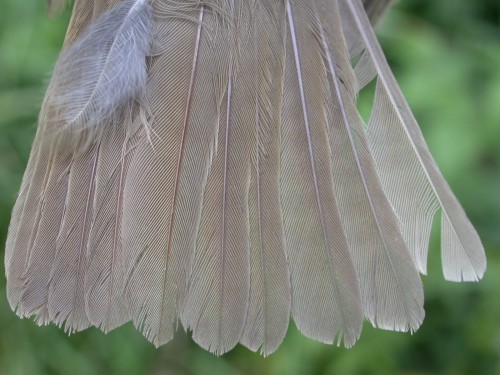
Photo by Marcel Gahbauer,
McGill Bird Observatory (QC), August 2005
RETURN TO AGE/SEX
OVERVIEW
|
JUL - DEC: hatch-year
unknown |
Overall plumage is rarely helpful in ageing Swainson's Thrushes, but with a good view of the wing of a perched individual, it may be possible to spot the pale tips to their retained juvenile greater coverts, which are a diagnostic feature.
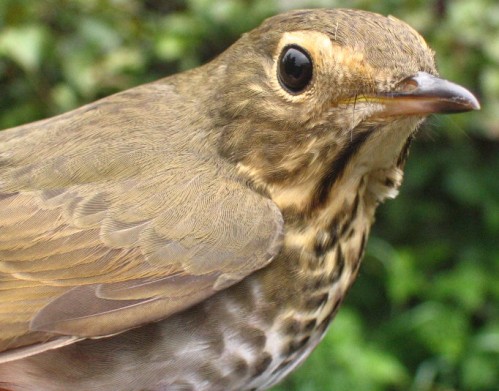
In this pose, the pale tips to the greater coverts are only subtly apparent.
Photo by Seabrooke Leckie,
McGill Bird Observatory (QC), September 2006
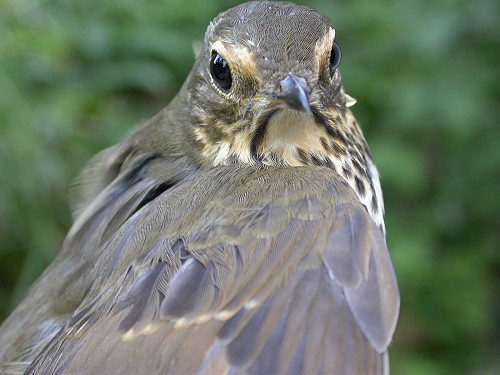
This individual, holding its wing partially open, makes it easier to see the pale markings
on the greater coverts that identify it as an HY Swainson's Thrush.
Photo by Marcel Gahbauer,
McGill Bird Observatory (QC), August 2005
HY Swainson's Thrushes usually have a molt limit among the greater coverts, with up to several inner coverts (most commonly two) replaced that are slightly darker and lack any pale markings, contrasting with the retained outer greater coverts that have pale tips or shaft streaks. Additionally, p10 is relatively broad, rounded, and somewhat longer than on AHY individuals (ranging from 1 mm longer than the primary coverts to 6 mm shorter).
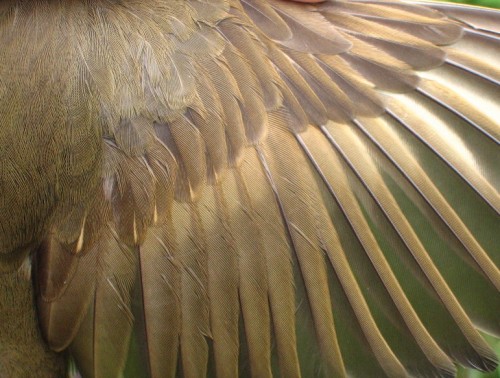
An individual showing distinct shaft streaks on some greater coverts, but lacking a molt
limit as it appears not to have replaced any of the inner greater coverts (a rare case).
Photo by Seabrooke Leckie,
McGill Bird Observatory (QC), September 2006
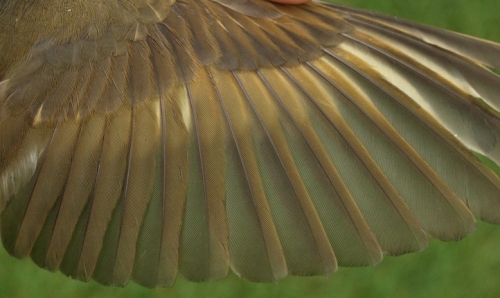
Another unusual case with shaft streaks only apparent on some of the inner greater
coverts (but also still present on some median coverts, confirming this as an HY bird).
Photo by Simon Duval,
McGill Bird Observatory (QC), September 2010
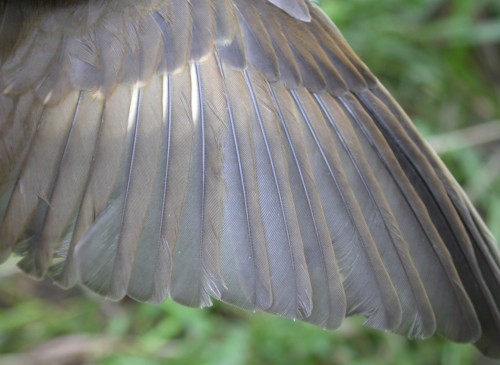
A somewhat more typical case with pale markings across all of the outer greater coverts,
but note that they progressively get smaller toward the outside of the wing, and by
spring many of the tips may be worn off, leaving the coverts looking entirely brown.
Photo by Marcel Gahbauer,
McGill Bird Observatory (QC), August 2005
HY Swainson's Thrushes have narrow and relatively pointed rectrices.
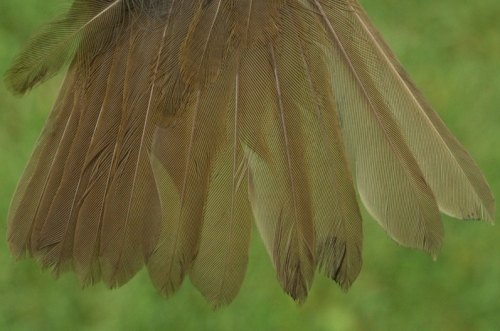
A somewhat intermediate tail, but relatively pointed compared to most AHY individuals.
Photo by Simon Duval,
McGill Bird Observatory (QC), September 2010
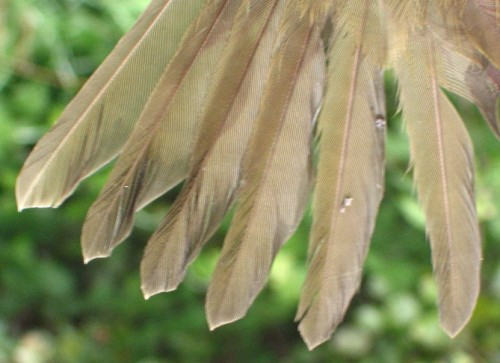
A more distinctly HY tail, with all rectrices narrow and quite pointed.
Photo by Seabrooke Leckie, McGill Bird Observatory (QC), September 2006
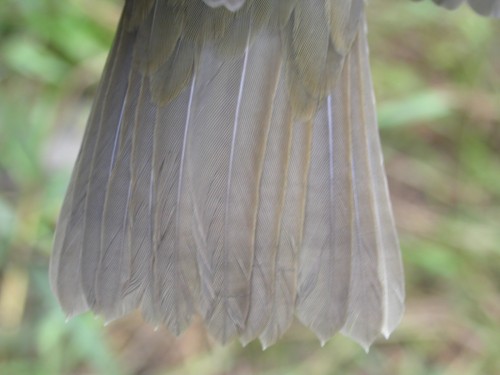
Another example showing distinctly narrow and pointed rectrices. Note also the relatively
faint growth bars going across the tail.
Photo by Marcel Gahbauer,
McGill Bird Observatory (QC), August 2005
RETURN TO AGE/SEX
OVERVIEW
|