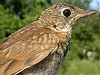
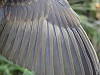
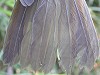
|
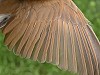
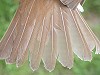
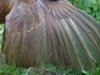
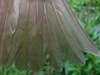
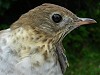
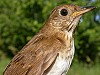
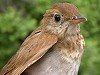
Veery / Grive fauve (Catharus fuscescens) |
 |
Introductory notes:
The Veery is rather variable in appearance across its range, with plumage differences by subspecies greater than among age/sex classes. HY/SY individuals are often easy to recognize if their retained juvenile feathers have distinct pale tips, but since these can fade over time, it can require greater effort to confirm an AHY/ASY bird, especially in spring. |
QUICK TIPS:
| 1) Look
at the greater coverts - the presence of buffy-white
shaft streaks indicates a HY/SY bird, however the
absence of buffy-white shaft streaks is NOT an
entirely reliable indicator of AHY/ASY, as some HY/SY
birds may lack these markings
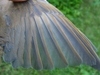
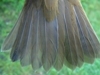
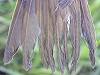
2) Consider the shape of the rectrices - they are narrow and relatively pointed on HY/SY birds, but broad and relatively rounded on AHY/ASY birds
3) Examine
the outermost primary (p10) - on HY/SY birds it
is rounded similar in length to the primary coverts (2 mm longer to 5 mm shorter),
while on AHY/ASY birds it is narrow, pointed, and 4-9
mm shorter than the primary coverts
Species account updated February 2011 |
|
Ageing and sexing overview:
Ageing and sexing details:
|
JAN - JUL: after-second-year
unknown |
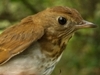
Veery appearance varies little by age, and sexes are identical, separable only during the breeding season by checking for a brood patch or cloacal protuberance. There is some geographical variation, with eastern birds tending to have a more rusty tone compared to western birds that are usually a duller shade of brown.
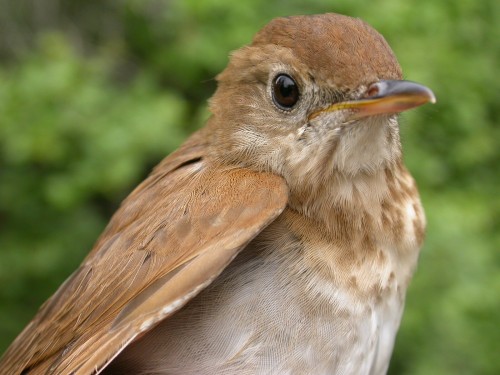
A typical eastern Veery.
Photo by Marcel Gahbauer,
McGill Bird Observatory (QC), May 2006
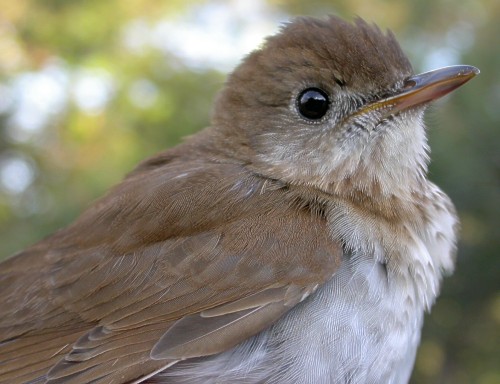
A somewhat duller eastern Veery.
Photo by Marcel Gahbauer,
McGill Bird Observatory (QC), May 2005
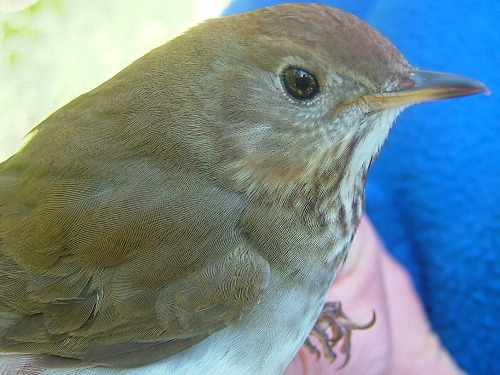
A browner, more olive-tinged western Veery.
Photo by Peter Pyle,
Spokane (WA), May 2005
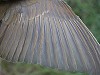
ASY wings are generally uniform in appearance, lacking any molt limits. If visible, the outermost primary (p10) is substantially (4+ mm) shorter than the primary coverts.
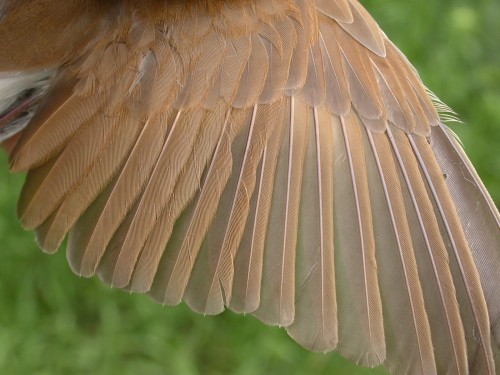
A typical ASY Veery wing, showing a uniform rusty tone throughout.
Photo by Marcel Gahbauer,
McGill Bird Observatory (QC), May 2006
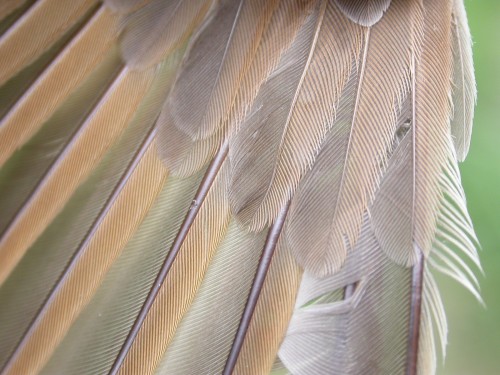
A closeup of the same bird, showing how short p10 is relative to the primary coverts.
Photo by Marcel Gahbauer,
McGill Bird Observatory (QC), May 2006
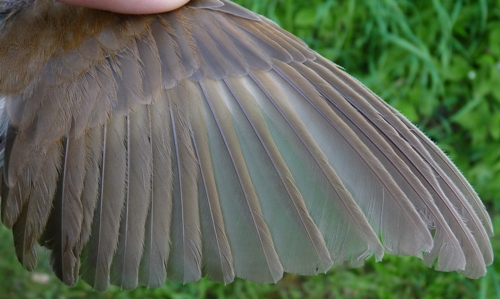
An ASY Veery with a more uniformly brown appearance.
Photo by Marcel Gahbauer,
McGill Bird Observatory (QC), May 2010
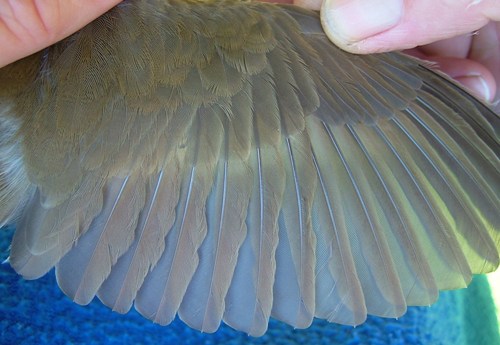
The wing of a western Veery, more dull brown, but uniform in appearance.
Photo by Peter Pyle, Spokane (WA), May 2005
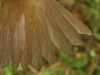
The typical ASY Veery tail has broad rectrices, but note that individual rectrices may often have a fine point at the tip.
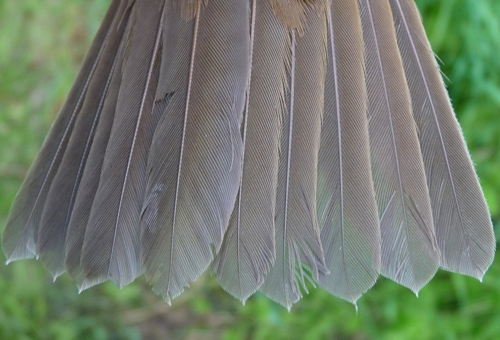
The tail of a relatively dull Veery.
Photo by Marcel Gahbauer,
McGill Bird Observatory (QC), May 2010
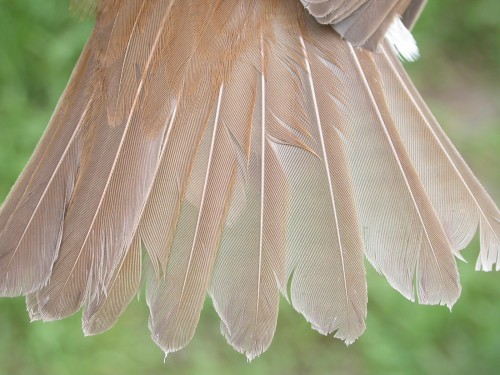
The tail of a more reddish Veery, corresponding to photos in previous sections.
Photo by Marcel Gahbauer,
McGill Bird Observatory (QC), May 2006
RETURN TO AGE/SEX
OVERVIEW
|
JAN - JUL: second-year
unknown |
As noted for ASY individuals, there are usually on easily recognizable plumage traits that allow for ageing or sexing of Veery. However, in some cases retained juvenile greater coverts may be visible on a perched bird.
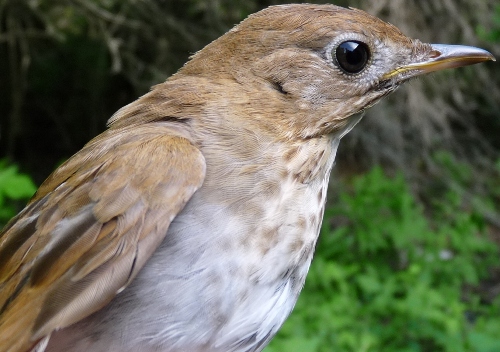
An SY Veery, with no clues to age visible from this angle.
Photo by Marcel Gahbauer,
McGill Bird Observatory (QC), May 2010
SY individuals have a molt limit within the greater coverts, but by spring it can be subtle. Look for the replaced inner greater coverts to be slightly darker and sometimes longer, while the retained outer juvenile greater coverts may have pale tips. Additionally, p10 tends not to be as short as on ASY individuals, ranging from 2 mm longer than the primary coverts to 5 mm shorter than them..
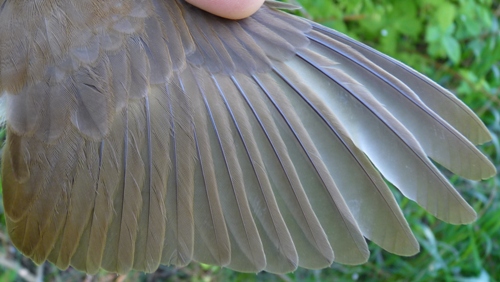
An example of an SY Veery with a subtle molt limit, with the inner three greater coverts
only slightly darker than the others, but also a bit longer; the retained juvenile greater
coverts are also recognizable by having faint pale tips. Also, p10 is visible, and appears
to be only a few mm shorter than the primary coverts.
Photo by Marcel Gahbauer,
McGill Bird Observatory (QC), May 2010
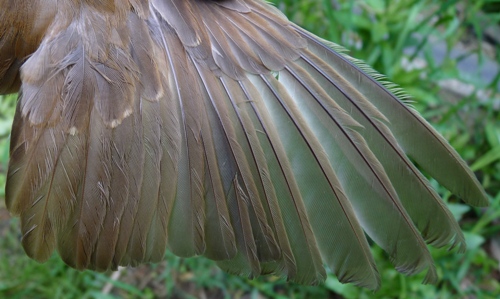
A somewhat rougher wing, making it more difficult to see the individual greater coverts,
but note the distinct pale tip to several of them, which indicates that they are retained
juvenile feathers and that this is an SY Veery.
Photo by Marcel Gahbauer,
McGill Bird Observatory (QC), May 2010
Rectrices of SY individuals tend to be somewhat narrower and more worn; some may also show growth bars across the tail.
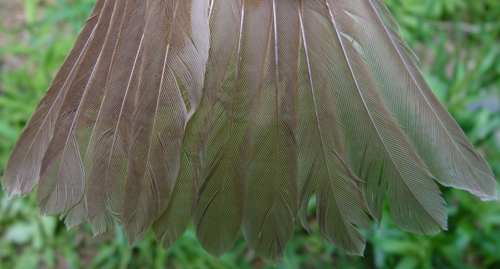
A typical SY Veery tail, with rectrices somewhat narrower than would be typical for an ASY
individual, and showing a bit more wear along the edges and at the tips.
Photo by Marcel Gahbauer,
McGill Bird Observatory (QC), May 2010
RETURN TO AGE/SEX
OVERVIEW
|
JUL - DEC: after-hatch-year
unknown |
In summer and early fall, overall body plumage may be used to separate recently fledged juveniles from older birds, but in general HY and AHY appearance differs little.
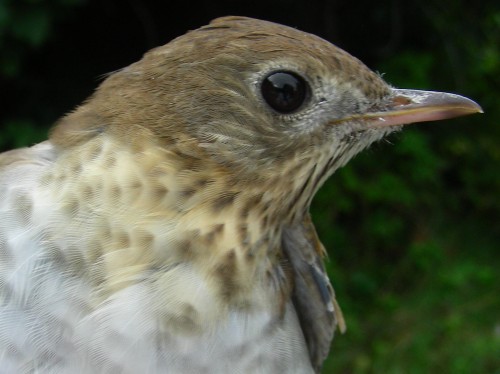
Photo by Marie-Anne Hudson,
McGill Bird Observatory (QC), August 2007
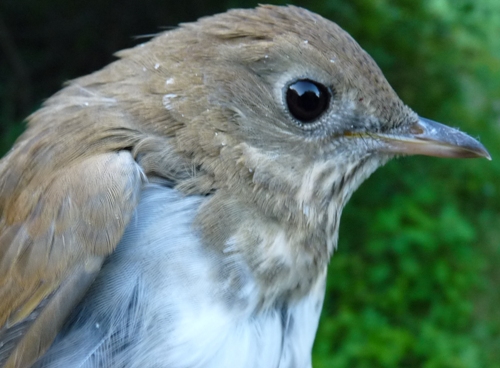
Photo by Marcel Gahbauer,
McGill Bird Observatory (QC), August 2009
Ageing a Veery is usually done most readily by looking at the wing. On AHY individuals there is no molt limit among the greater coverts and there are no feathers with pale tips. Also, the outermost primary (p10) tends to be narrow and pointed, and is at least 4 mm shorter than the adjacent primary coverts.
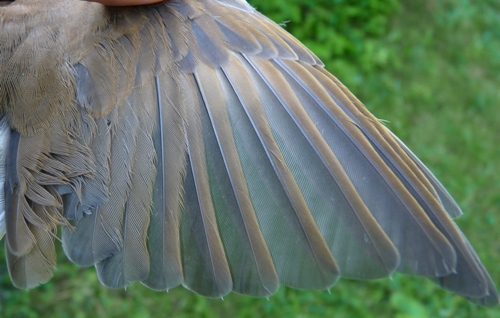
Since the preformative molt of the Veery does not include any flight feathers, and individual
replacing its primaries and secondaries, as in this photo, can be recognized as AHY.
Photo by Marcel Gahbauer,
McGill Bird Observatory (QC), August 2009
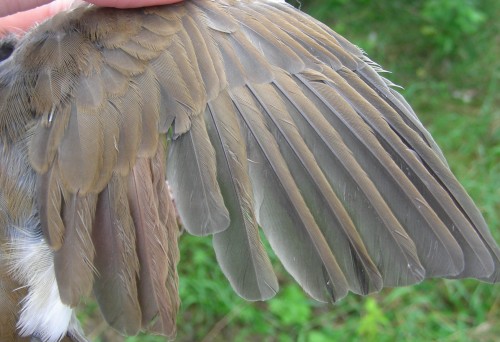
This AHY Veery was also photographed during its prebasic molt; it appears that most depart
immediately after completing their molt or perhaps even before they are done, as it is rare
that
any are
observed at McGill Bird Observatory once all feathers have been replaced.
Note also the uniformity of the wing (notwithstanding the remaining inner secondaries
that have not yet been dropped).
Photo by Marie-Anne Hudson,
McGill Bird Observatory (QC), August 2007
AHY Veery tails are usually characterized by broad rectrices, although there is some variability and the wing is generally more reliable.
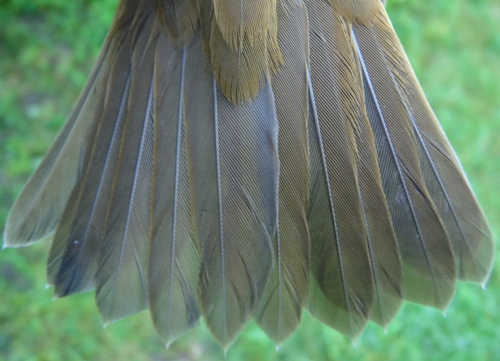
An example of somewhat intermediate rectrices that could fit with either an AHY or HY
Veery; in such a case it is better to be guided by the wing (see corresponding photo above).
Photo by Marcel Gahbauer,
McGill Bird Observatory (QC), August 2009
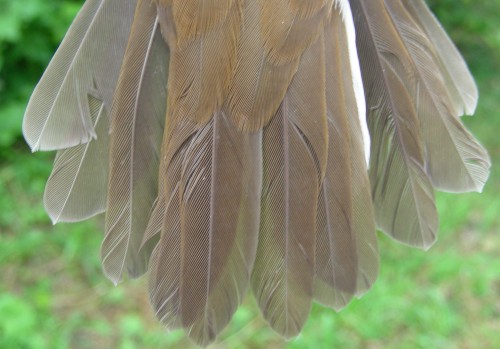
A photo taken during the prebasic molt, with the broad fresh outer rectrices growing in.
Photo by Marie-Anne Hudson,
McGill Bird Observatory (QC), August 2007
RETURN TO AGE/SEX
OVERVIEW
|
JUN - SEP: second-year
unknown |
Until they have completed their first prebasic molt, some individuals can be recognized as SY based on the retention of distinctive juvenile feathers. Most commonly these are pale-tipped juvenile greater coverts, which can sometimes be visible on perched birds, but close examination of the wing and tail are usually required to narrow down the age from AHY to SY.
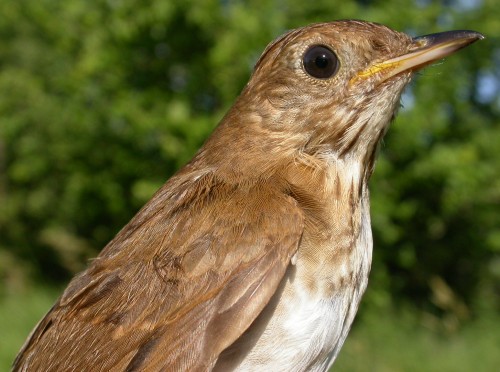
An SY Veery with pale tips on the juvenile outer greater coverts visible from this angle; note
that by this time of year, there is potential for confusion with HY birds with similar features.
Photo by Marcel Gahbauer,
McGill Bird Observatory (QC), July 2005
As in spring, SY individuals in summer have a molt limit within the greater coverts, and p10 is relatively broad, rounded, and long, ranging between 2 mm longer than the primary coverts to 5 mm shorter than them.
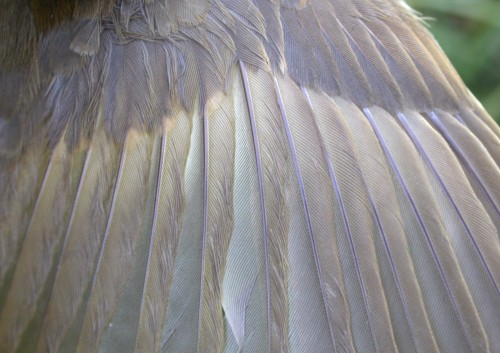
The pale tips on the outer greater coverts identifies them as juvenile feathers; overall they
are quite a bit more worn than would be expected on a HY Veery at this date, but skull
pneumatization should be checked if possible for confirmation of age.
Although not
visible, p10
on this individual was equally long as the primary coverts.
Photo by Marcel Gahbauer,
McGill Bird Observatory (QC), July 2005
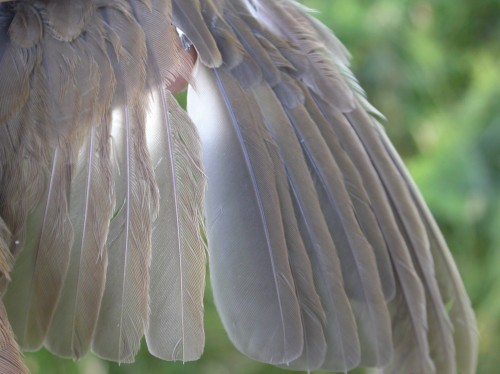
In this case, the photo was taken while the bird was relatively early in its prebasic molt,
with p5 growing in, and the secondaries yet to be replaced. There appear to be faint tips
remaining on some greater coverts, and p10 (although not visible in this photo) was
broad and longer than would be expected on ASY individuals.
Photo by Marcel Gahbauer, McGill Bird Observatory (QC), July 2005
By summer, the relative narrow juvenile rectrices tend to be quite worn, and may provide one of the easiest ways to separate HY and SY individuals with similar wing patterns.
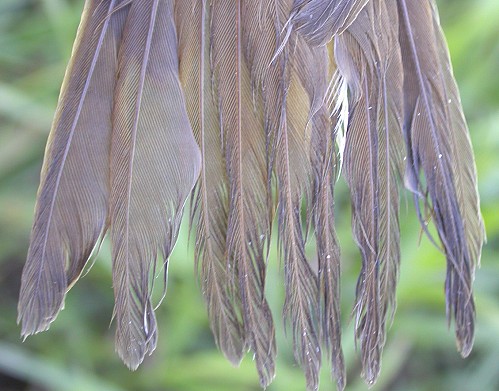
The wear in this example is exaggerated by the feathers being wet, but even so the
narrow shape of the rectrices and the frayed central rectrices is evident.
Photo by Marcel Gahbauer,
McGill Bird Observatory (QC), July 2005
RETURN TO AGE/SEX
OVERVIEW
|
JUL - DEC: hatch-year
unknown |
The key feature for recognizing HY individuals is the presence of pale tips to the retained juvenile greater coverts; these are often, but not always, visible on perched individuals.
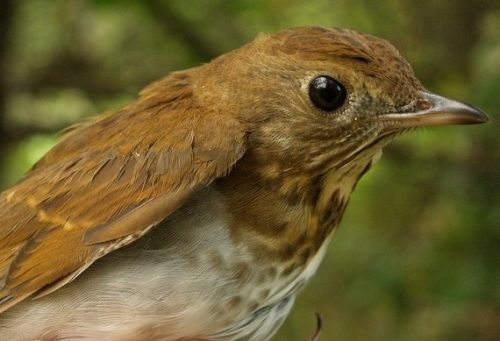
An HY Veery, with pale tips to the greater coverts clearly visible.
Photo by Simon Duval,
McGill Bird Observatory (QC), September 2010
Molt limits occur among the greater coverts of HY birds, but simply the presence of pale-tipped juvenile greater coverts indicates an HY bird (except for some SY birds until their first prebasic molt), and it is often easier to simply look for these feathers. Additionally, p10 is relatively broad and rounded, and is fairly similar to the length of the primary coverts (from 2 mm longer to 5 mm shorter than them).
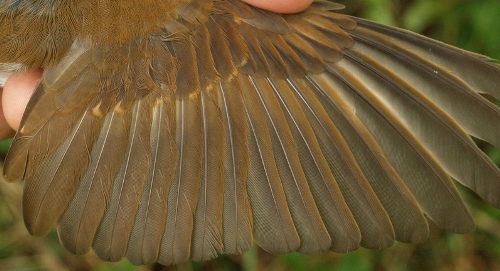
A distinct HY Veery wing, showing a contrast between the somewhat longer and unmarked
innermost two formative greater coverts, and the remaining juvenile greater coverts, all with
a variable amount of pale marking at the tip. Note also that p10 appears to be only a few
mm shorter than the primary coverts.
Photo by Simon Duval,
McGill Bird Observatory (QC), September 2010
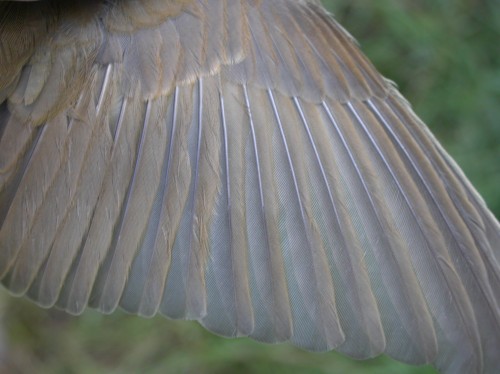
A less obvious example, again with the innermost greater coverts replaced, but with the
retained juvenile greater coverts having a slight band of pale colour at the tips.
Photo by Marcel Gahbauer,
McGill Bird Observatory (QC), August 2005
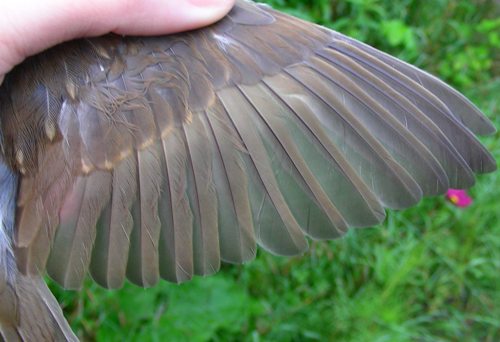
An example of a particularly young Veery that not only has distinct pale tips to the greater
coverts, but also still some of the back feathers.
Photo by Marie-Anne Hudson,
McGill Bird Observatory (QC), August 2008
HY birds typically have narrow and relatively pointed rectrices.
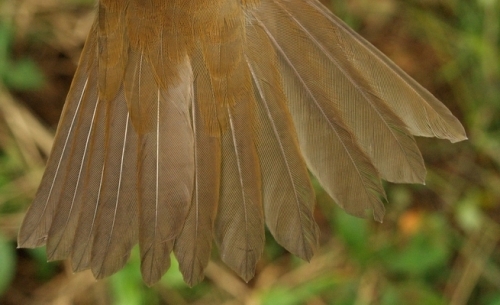
A typical HY Veery tail, with narrow and pointed rectrices.
Photo by Simon Duval,
McGill Bird Observatory (QC), September 2010
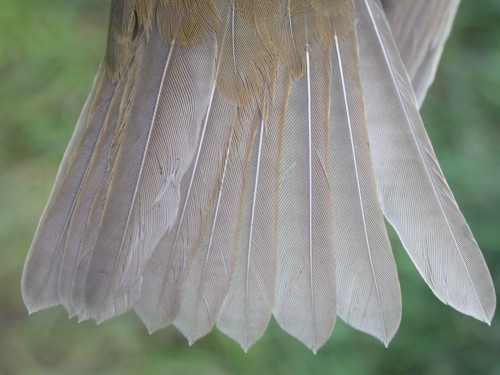
Another HY tail, from an individual with a duller brown plumage.
Photo by Marcel Gahbauer,
McGill Bird Observatory (QC), August 2005
RETURN TO AGE/SEX
OVERVIEW
|
JUN - AUG: juvenile
unknown |
Juveniles prior to their preformative
molt are heavily spotted on the back, shoulder, and head.
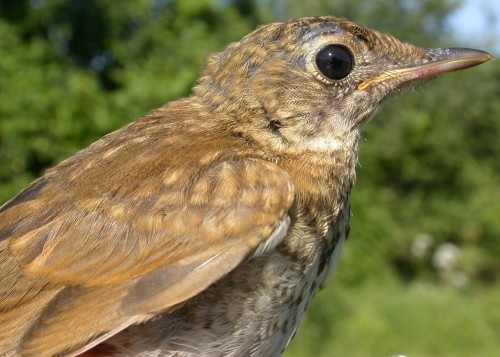
Photo by Marcel Gahbauer,
McGill Bird Observatory (QC), July 2005
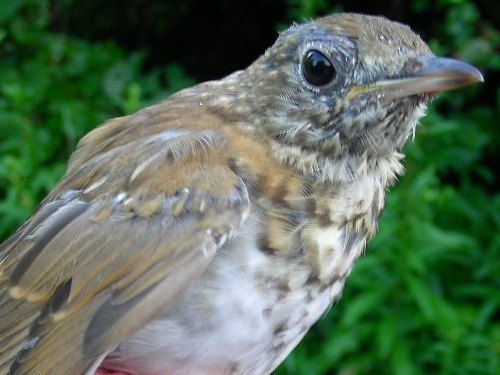
Photo by Marie-Anne Hudson,
McGill Bird Observatory (QC), August 2008
Juveniles usually show pale marks at the tip and/or
along the shaft of all greater coverts, as well as the median coverts..
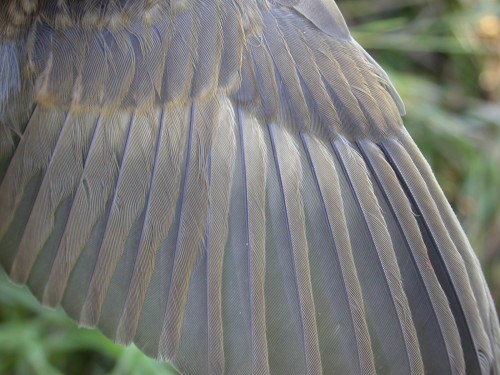
Photo by Marcel Gahbauer,
McGill Bird Observatory (QC), July 2005
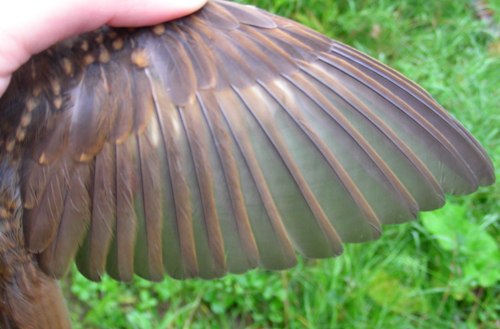
Photo by Marie-Anne Hudson,
McGill Bird Observatory (QC), August 2008
Juvenile rectrices are
relatively narrow and pointed.
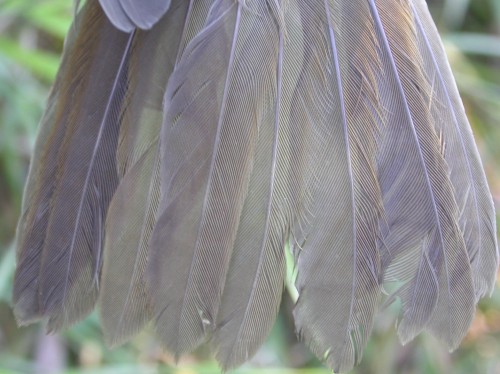
Photo by Marcel Gahbauer,
McGill Bird Observatory (QC), July 2005
RETURN TO AGE/SEX
OVERVIEW
|