Ageing and sexing details:
|
JAN - JUL: after-second-year
unknown |
Age can be difficult to assess in spring. Broad and rounded
rectrices in combination with uniformly dark wings are the best indicators
of ASY.
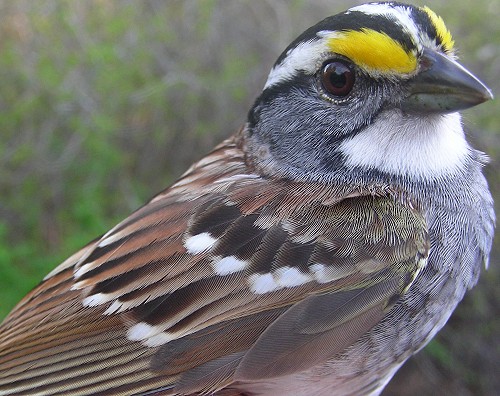
Photo by Marie-Anne Hudson,
McGill Bird Observatory (QC), May 2007
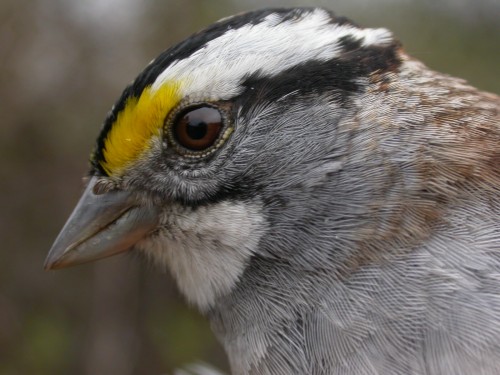
Photo by Marcel Gahbauer,
McGill Bird Observatory (QC), May 2006
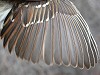
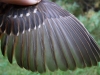
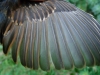
The wing is usually the most reliable clue to age in spring. ASY birds lack a molt limit, and have a dark brown wing relatively uniform in colour and wear, though note that in all ages there are pseudolimits between the darker tertials and adjacent secondaries, as well as between the greater coverts and primary coverts.
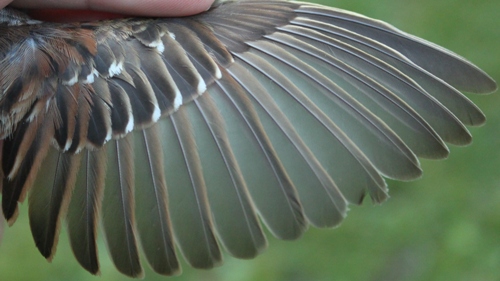
An ASY wing in particularly good condition, showing little wear on any feathers, and a rich
dark tone to all feathers.
Photo by Peter Pyle, Braddock Bay Bird Observatory (NY), May 2010
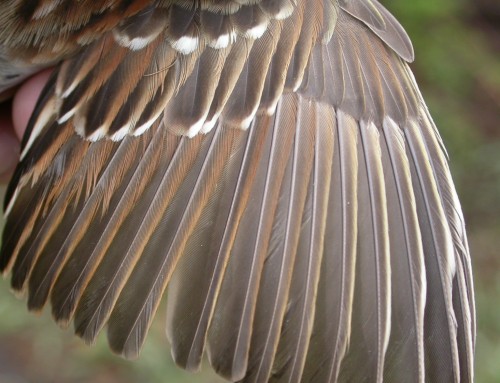
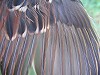
A somewhat more typical wing, showing a more faded overall appearance, but still
quite uniform in colour and wear across all feather tracts.
Photo by Marcel Gahbauer,
McGill Bird Observatory (QC), May 2006
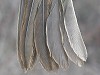
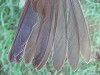
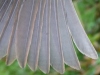
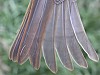
ASY birds have relatively broad and rounded rectrices. However, this should not be used as
a sole criterion of age, as White-throated Sparrows seem particularly liable to lose and
replace their tails prematurely.
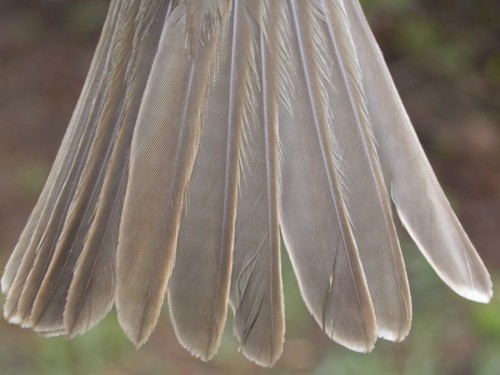
A typical ASY tail, with relatively broad and rounded rectrices, showing only moderate wear.
Photo by Marcel Gahbauer,
McGill Bird Observatory (QC), May 2006
RETURN TO AGE/SEX
OVERVIEW
|
JAN - JUL: second-year
unknown |
Age can be difficult to assess in spring.
Narrow, tapered, and worn rectrices in combination with a molt limit on the wing are the best indicators of SY
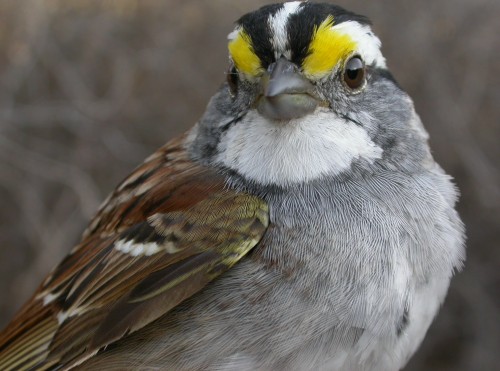
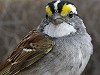
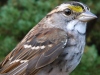
A typical SY white morph bird.
Photo by Marcel Gahbauer,
McGill Bird Observatory (QC), April 2006
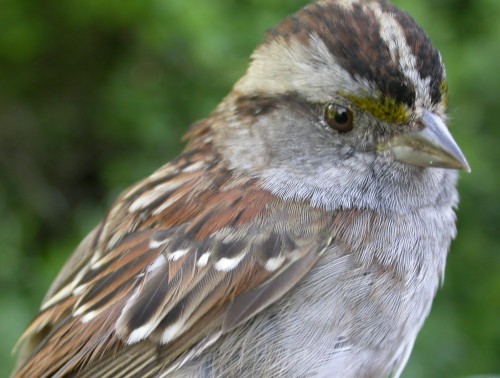
An SY tan morph bird, still with a somewhat grayish iris.
Photo by Marie-Anne Hudson, McGill Bird Observatory (QC), June 2006
The condition of the wing is typically the best clue to age in spring, but there are many intermediates where the presence or absence of a molt limit cannot be reliably determined.
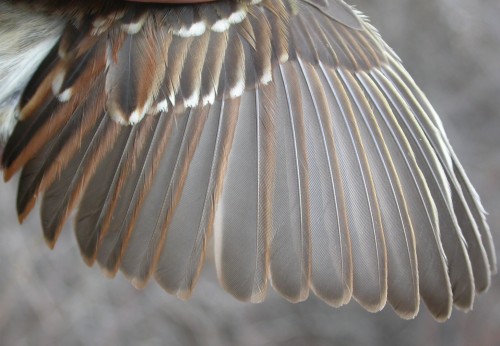
This wing is quite intermediate in appearance, with only a slight contrast between the greater
coverts and the block of primary coverts, primaries, and secondaries, making it difficult to
determine whether this is a true molt limit, or just a pseudolimit. Such a bird should be
considered AHY unless the tail provides distinct evidence for it being SY.
Photo by Marcel Gahbauer,
McGill Bird Observatory (QC), April 2006
A narrow, tapered, and worn tail is a fairly reliable
indicator of an SY White-throated Sparrow.
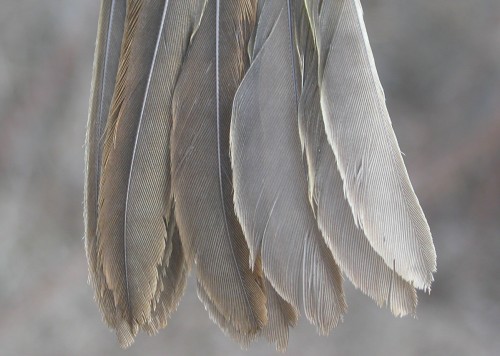
Although not particularly pointed, the rectrices are somewhat narrow, and all show a
considerable amount of fraying, as expected on juvenile feathers by spring.
Photo by Marcel Gahbauer,
McGill Bird Observatory (QC), April 2006
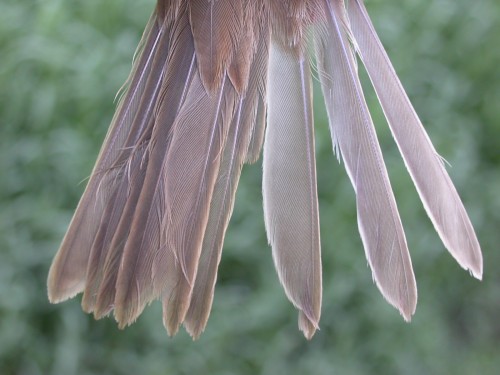
An example featuring somewhat narrower and more pointed rectrices.
Photo by Marie-Anne Hudson, McGill Bird Observatory (QC), June 2006
RETURN TO AGE/SEX
OVERVIEW
|
JUL - DEC: after-hatch-year
unknown |
After-hatch-year birds have a reddish-brown iris and a breast lacking streaks.
While eye colour is quite reliable, it can be difficult to assess
accurately under some light conditions, and so both wing and tail should
be examined too.
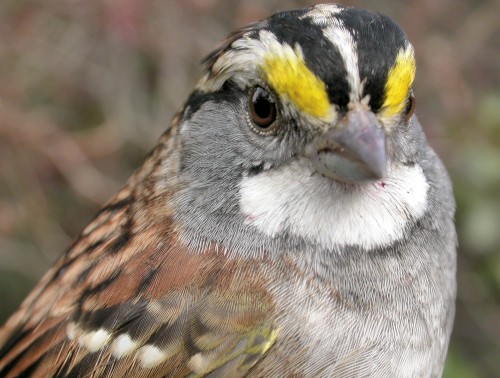
An AHY bird of the white morph.
Photo by Marie-Anne Hudson,
McGill Bird Observatory (QC), September 2005
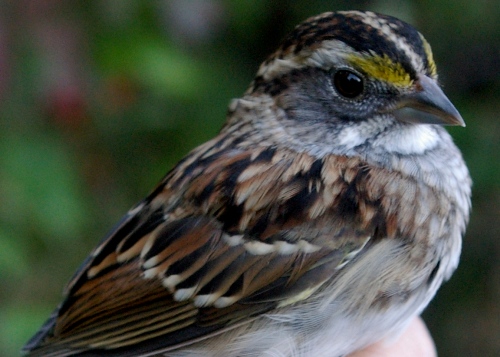
An AHY bird of the tan morph.
Photo by James Junda,
McGill Bird Observatory (QC), September 2008
Primary coverts are broad and rounded, and fairly
similar in colour to the adjacent greater coverts.
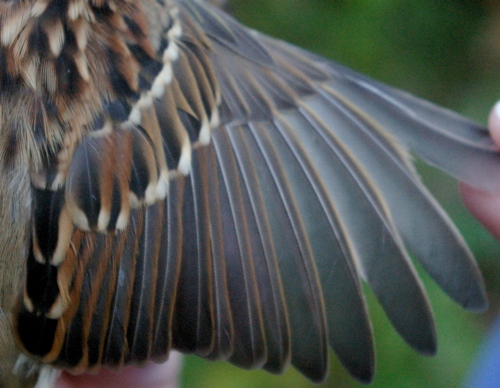
Photo by James Junda,
McGill Bird Observatory (QC), September 2008
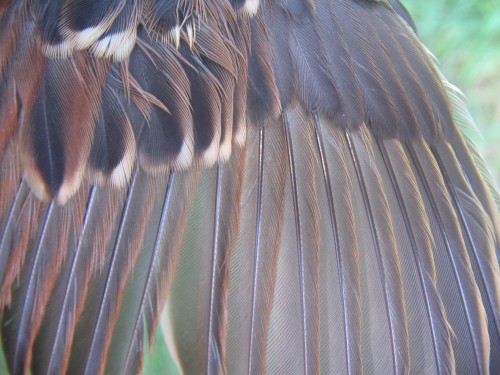
Photo by Marie-Anne Hudson,
McGill Bird Observatory, September 2005
The rectrices of AHY
White-throated Sparrows are broad and fairly rounded.
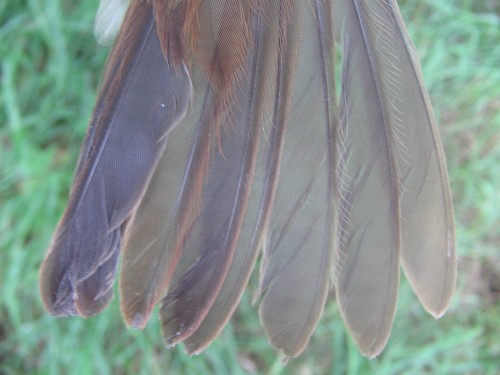
Photo by Marie-Anne Hudson,
McGill Bird Observatory, September 2005
RETURN TO AGE/SEX
OVERVIEW
|
JUL - DEC: hatch-year
unknown |
HY birds have a more grayish iris, and may retain traces of juvenile streaking on the breast. While eye colour is quite
reliable in fall, it can be difficult to assess accurately under some light
conditions, and so both wing and tail should be examined too.
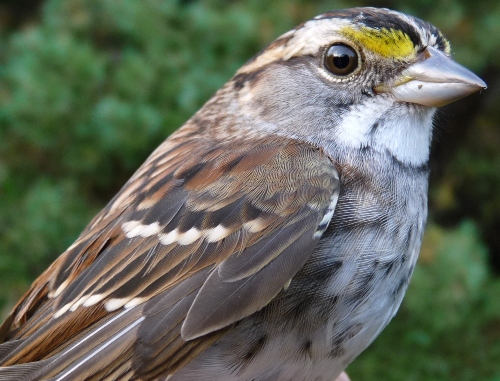
A typical HY bird, with a bit of streaking retained on the breast.
Photo by Marcel Gahbauer,
McGill Bird Observatory (QC), October 2009
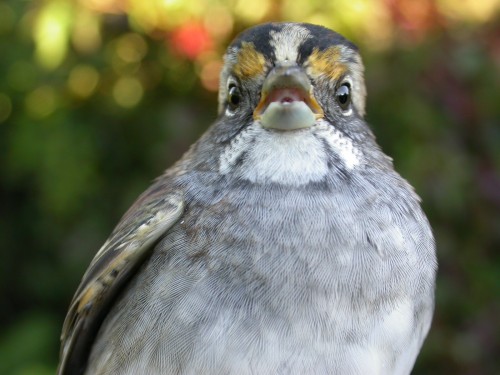
While there is no streaking on the breast of this individual, the angle of the photo
provides a good look at the gray iris.
Photo by Marie-Anne Hudson,
McGill Bird Observatory (QC), September 2005
A subtle molt limit may be visible in fall, with the replaced greater coverts contrasting with the somewhat paler retained juvenile feathers of the primary coverts, primaries, and secondaries.
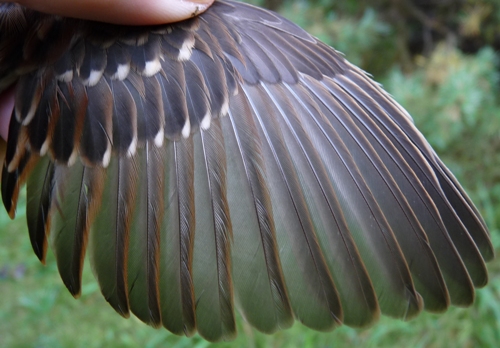
Although the entire wing is fairly dark, note the molt limit, including the difference between
the dark alula covert compared to the rest of the alula and primary coverts.
Photo by Marcel Gahbauer,
McGill Bird Observatory (QC), October 2009
HY White-throated
Sparrows have relatively narrow and pointed rectrices.
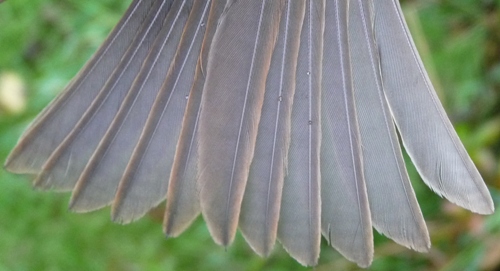
A typical HY tail, showing somewhat pointed rectrices and also with faint growth
bars across the tail.
Photo by Marcel Gahbauer,
McGill Bird Observatory (QC), October 2010
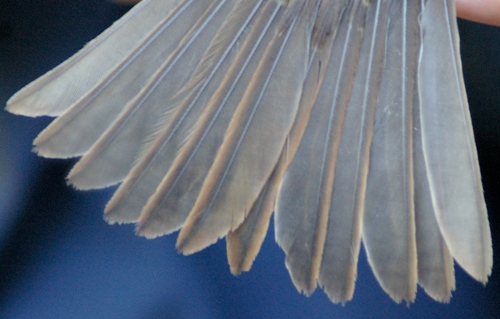
A similar example, but already beginning to show a bit of fraying at the tips of the feathers.
Photo by James Junda,
McGill Bird Observatory (QC), September 2008
RETURN TO AGE/SEX
OVERVIEW
|
JUL - DEC:
juvenile
unknown |
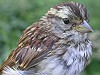
Juvenile White-throated Sparrows are most
easily recognized by the indistinct streaking across the upper breast.
Note that in this plumage, White-throated Sparrows may be easily confused with Song Sparrows - White-throats average slightly larger, but the facial patterns should be examined carefully to ensure correct identification.
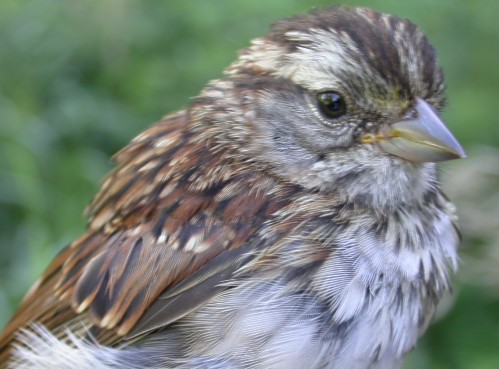
Photo by Marcel Gahbauer,
McGill Bird Observatory (QC), August 2005
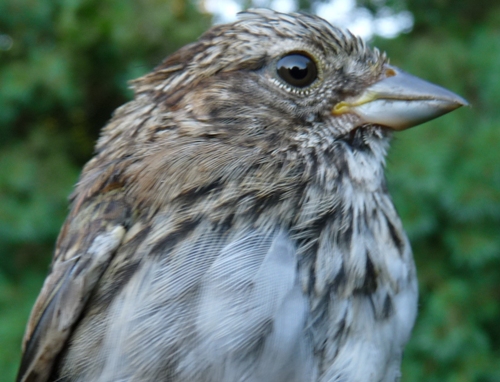
Photo by Marcel Gahbauer,
McGill Bird Observatory (QC), August 2009
Body plumage alone is usually enough to recognize
juveniles, but the very small pale tips on the juvenile greater coverts are
another useful character.
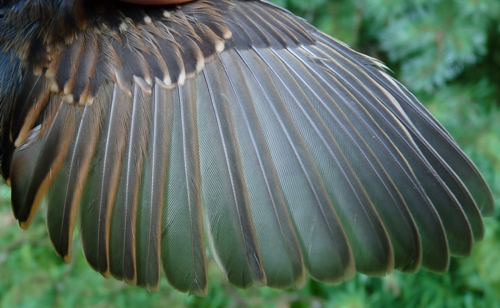
Photo by Marcel Gahbauer,
McGill Bird Observatory (QC), August 2009
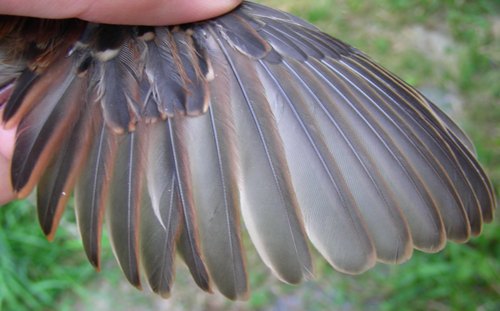
Photo by Marcel Gahbauer,
McGill Bird Observatory (QC), September 2008
The rectrices of
juveniles are relatively narrow, though usually in fairly good condition
because they are fresh. Distinct growth bars are often visible.
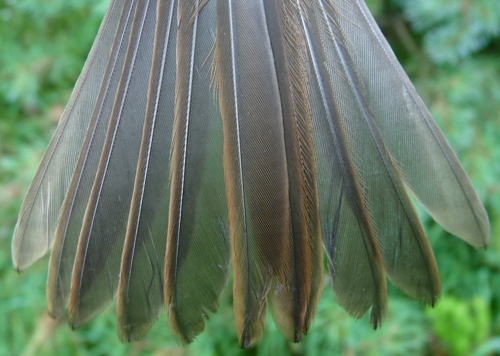
Photo by Marcel Gahbauer,
McGill Bird Observatory (QC), August 2009
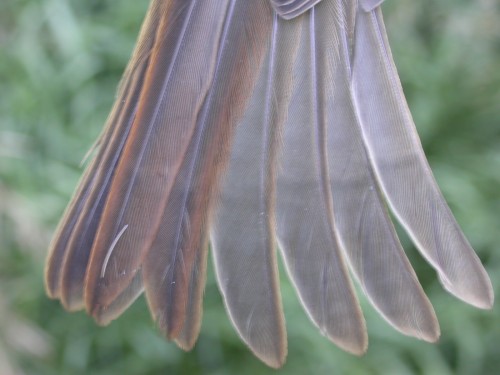
Photo by Marcel Gahbauer,
McGill Bird Observatory (QC), August 2005
RETURN TO AGE/SEX
OVERVIEW