|
September - December: |
|
ASY - M
Primary coverts are an irregular mix of dark
brown (fresh), brown, and very pale brown (worn)
feathers OR are uniformly dark brown and fresh.
Iris deep red. Black moustache present. |
|
|
|
|
ASY - F
Primary coverts are an irregular mix of dark
brown (fresh), brown, and very pale brown (worn)
feathers OR are uniformly dark brown and fresh.
Iris deep red. Moustache region uniform in
colour with the rest of the face. |
|
|
|
|
SY - M
Outer consecutive primary coverts dark brown and
fresh, all other retained primary coverts pale
brown and abraded. Black moustache present.
|
|
|
|
|
SY - F
Outer consecutive primary coverts dark brown and
fresh, all other retained primary coverts pale
brown and abraded. Moustache region uniform in
colour with the rest of the face. |
|
|
|
|
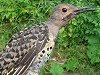
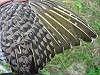
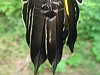
HY - M
Primary coverts paler brown than the rest of the
wing. Iris gray/brown. Black moustache present.
|
 |
 |
 |
|
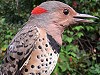
HY - F
Primary coverts paler brown than the rest of the
wing. Iris gray/brown. Moustache region
uniform in colour with the rest of the face.
|
 |
 |
 |
|
Ageing and sexing details:
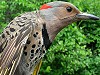
ATY males
have black moustaches and deep red irises. The extent of red in the
crown should not be used for sexing.
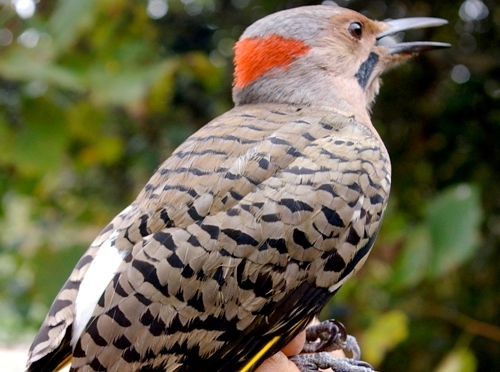
Photo
by James Junda, McGill Bird Observatory (QC), September 2008
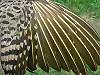
Primary coverts are an irregular mix of dark brown (fresh),
brown, and very pale brown feathers OR are uniformly dark brown. The
secondaries are either uniformly adult with fresh tertials OR have 1-4
retained adult feathers (not symmetrically in both wings), contrasting
only slightly with the replaced feathers. ATYs with isolated, retained
juvenal primary coverts or with 3 generations of primary coverts
sequentially replaced might be reliably aged 4Y, but more study is
needed.
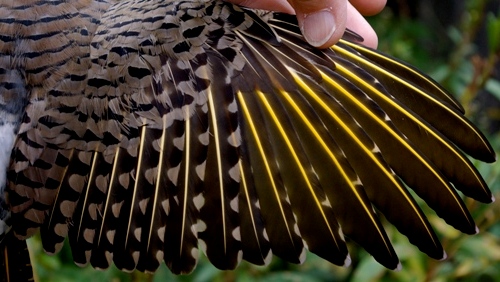
Photo
by James Junda, McGill Bird Observatory (QC), September 2008
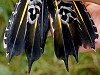
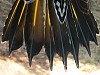
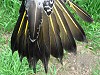
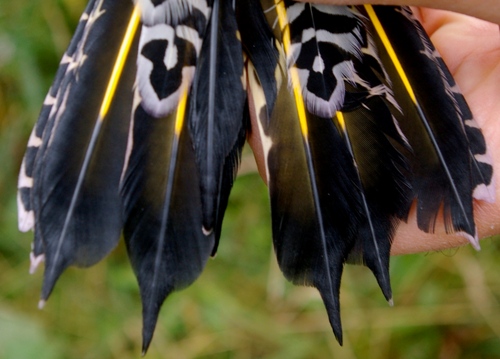
Tails are not terribly useful for ageing or sexing woodpeckers.
Photo
by James Junda, McGill Bird Observatory (QC), September 2008
RETURN TO AGE/SEX OVERVIEW
ATY females do not have black moustaches and have deep red
irises. The extent of red in the crown should not be used for sexing.
Primary coverts are an irregular mix of dark brown (fresh),
brown, and very pale brown feathers OR are uniformly dark brown. The
secondaries are either uniformly adult with fresh tertials OR have 1-4
retained adult feathers (not symmetrically in both wings), contrasting
only slightly with the replaced feathers. ATYs with isolated, retained
juvenal primary coverts or with 3 generations of primary coverts
sequentially replaced might be reliably aged 4Y, but more study is
needed.
Tails are
not terribly useful for ageing or sexing woodpeckers.
RETURN TO AGE/SEX OVERVIEW
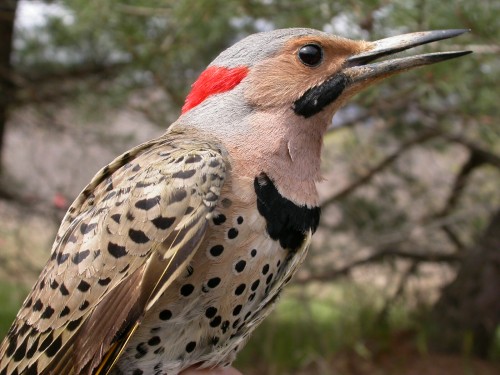
TY males have black
moustaches and have deep red irises. The extent of red in the crown
should not be used for sexing.
Photo
by Marcel Gahbauer,
McGill
Bird Observatory,
May 2005
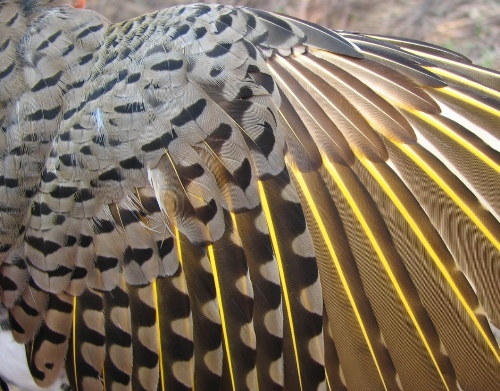
Consecutive outer
1-5 primary coverts are dark brown and fresh. All other retained primary
coverts are pale brown and abraded. In the photo below, the outer 2
primary coverts have been replaced and contrast with the retained inner
coverts. The secondaries are either uniformly adult OR sometimes with
1-4 retained juvenal feathers (symmetrically in both wings), contrasting
markedly with the rest of the wing. Some intermediates may occur that
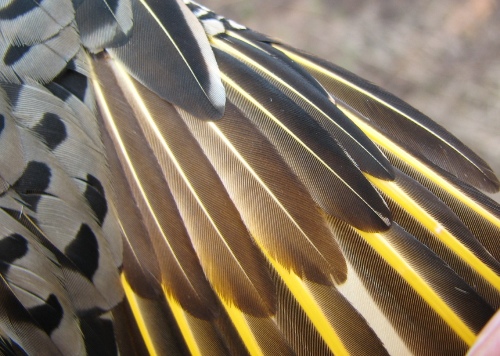
are extremely difficult to age. These should be aged ASY. The third example below is of a Red-shafted (western) Flicker.
Photo
by Barbara Frei, McGill Bird Observatory (QC), April 2008
Photo
by Barbara Frei, McGill Bird Observatory (QC), April 2008
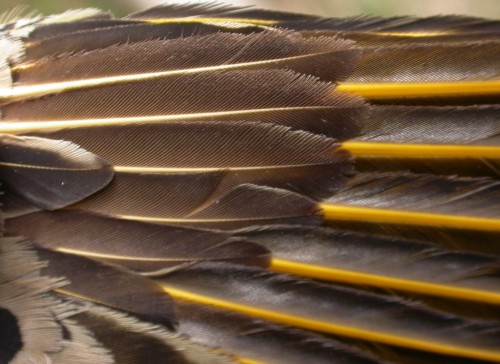
Photo
by Marcel Gahbauer, McGill Bird Observatory, May 2005
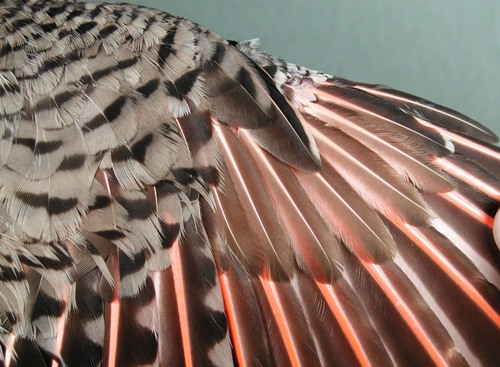
Photo
by Peter Pyle, Big Sur Ornithology Lab (CA), April 2007
Tails are not terribly useful for ageing or sexing
woodpeckers.
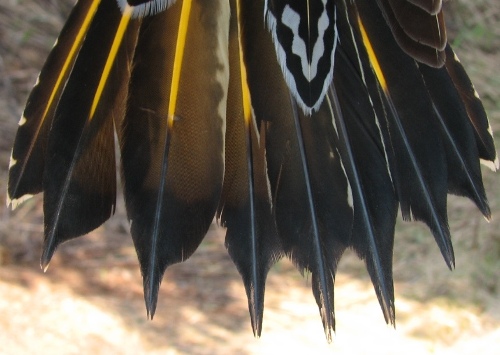
Photo
by Barbara Frei, McGill Bird Observatory (QC), April 2008
RETURN TO AGE/SEX OVERVIEW
TY females do not have
black moustaches. The extent of red in the crown
should not be used for sexing.
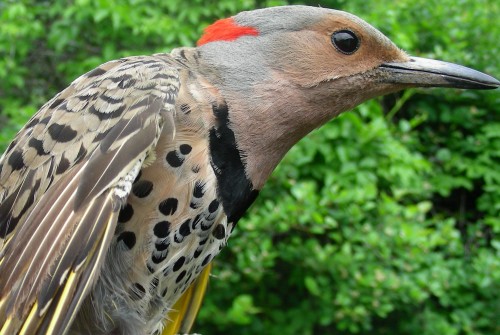
Photo by Marie-Anne Hudson,
McGill
Bird Observatory,
May 2007
Consecutive outer 1-5 primary coverts are
dark brown and fresh. All other retained primary coverts are pale brown
and abraded.
See the second photo below for an enlarged view, showing the
two darker outermost primary coverts.
The secondaries are either uniformly adult OR sometimes
with 1-4 retained juvenal feathers (symmetrically in both wings),
contrasting markedly with the rest of the wing. Some intermediates may
occur that are extremely difficult to age. These should be aged ASY.
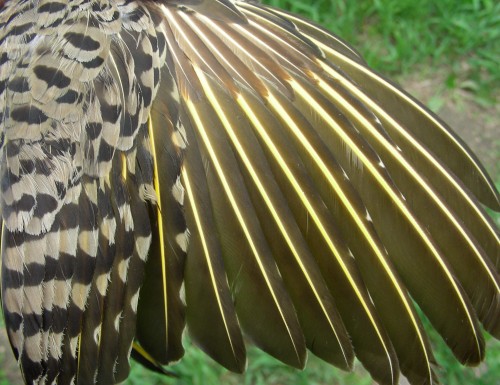
Photo by Marie-Anne Hudson,
McGill
Bird Observatory,
May 2007
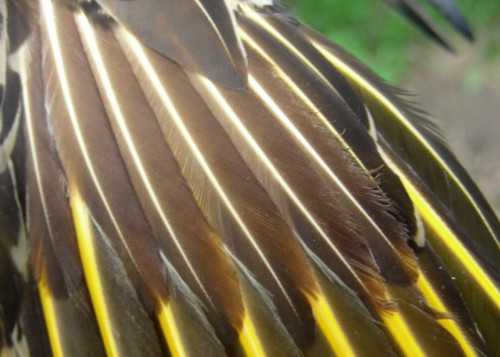
Photo by Marie-Anne Hudson,
McGill
Bird Observatory,
May 2007
Tails are not terribly useful for ageing or sexing woodpeckers.
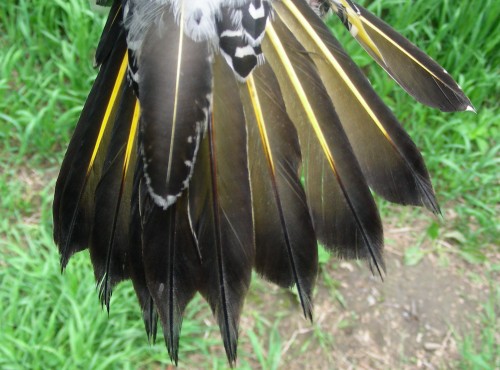
Photo by Marie-Anne Hudson,
McGill
Bird Observatory,
May 2007
RETURN TO AGE/SEX OVERVIEW
SY males have black
moustaches and have gray/brown irises through January. The extent of
red in the crown should not be used for sexing.
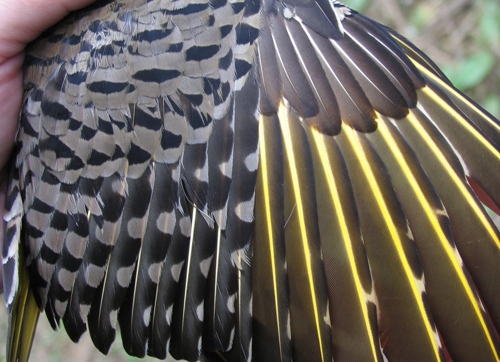
Primary coverts are paler brown than the rest of the wing.
Caution: fresh fall HYs can resemble ASYs with uniform secondaries and
primary coverts. Look for retention of juvenal characteristics through
October: a larger, rounded p10.
Photo
by Peter Pyle, Howell Woods (NC), May 2006
Look for pointed, juvenal rectrices.
RETURN TO AGE/SEX OVERVIEW
SY females do not
have black moustaches and have gray/brown irises through January. The
extent of red in the crown should not be used for sexing.
Primary coverts are paler brown than the rest of the wing.
Caution: fresh fall HYs can resemble ASYs with uniform secondaries and
primary coverts. Look for retention of juvenal characteristics through
October: a larger, rounded p10.
Look for pointed, juvenal rectrices.
RETURN TO AGE/SEX OVERVIEW
ASY males have black moustaches and have deep red irises.
The extent of red in the crown should not be used for sexing.
Primary coverts are an irregular mix of
dark brown (fresh), brown, and very pale brown feathers OR are uniformly
dark brown. The secondaries are either uniformly adult with fresh
tertials OR have 1-4 retained adult feathers (not symmetrically in both
wings), contrasting only slightly with the replaced feathers. ASYs with
isolated, retained juvenal primary coverts or with 3 generations of
primary coverts sequentially replaced might be reliably aged TY, but
more study is needed.
Tails are not terribly useful for ageing or sexing woodpeckers.
RETURN TO AGE/SEX OVERVIEW
ASY females do not have black moustaches and have deep red
irises. The extent of red in the crown should not be used for sexing.
Primary coverts are an irregular mix of
dark brown (fresh), brown, and very pale brown feathers OR are uniformly
dark brown. The secondaries are either uniformly adult with fresh
tertials OR have 1-4 retained adult feathers (not symmetrically in both
wings), contrasting only slightly with the replaced feathers. ASYs with
isolated, retained juvenal primary coverts or with 3 generations of
primary coverts sequentially replaced might be reliably aged TY, but
more study is needed.
Tails are not terribly useful for ageing or sexing woodpeckers.
RETURN TO AGE/SEX OVERVIEW
SY males have black moustaches and have gray/brown irises
through January. The extent of red in the crown should not be used for
sexing.
Consecutive outer 1-5 primary coverts are
dark brown and fresh. All other retained primary coverts are pale brown
and abraded. The secondaries are either uniformly adult OR sometimes
with 1-4 retained juvenal feathers (symmetrically in both wings),
contrasting markedly with the rest of the wing. Some intermediates may
occur that are extremely difficult to age. These should be aged ASY.
Tails are not terribly useful for ageing or sexing woodpeckers.
RETURN TO AGE/SEX OVERVIEW
SY females do not have black moustaches and have gray/brown
irises through January. The extent of red in the crown should not be
used for sexing.
Consecutive outer 1-5 primary coverts are
dark brown and fresh. All other retained primary coverts are pale brown
and abraded. The secondaries are either uniformly adult OR sometimes
with 1-4 retained juvenal feathers (symmetrically in both wings),
contrasting markedly with the rest of the wing. Some intermediates may
occur that are extremely difficult to age. These should be aged ASY.
Tails are not terribly useful for ageing or sexing woodpeckers.
RETURN TO AGE/SEX OVERVIEW
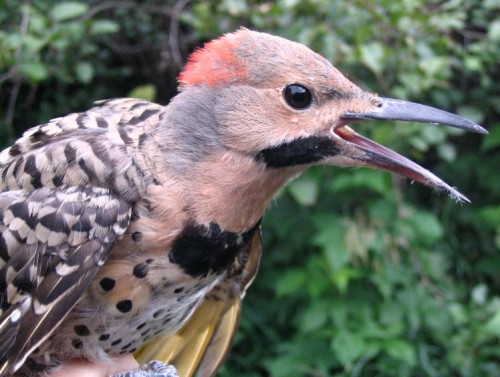
HY males have black moustaches (though they may vary in
intensity as the two photos below illustrate) and have gray/brown irises.
The extent of red in the crown should not be used for sexing.
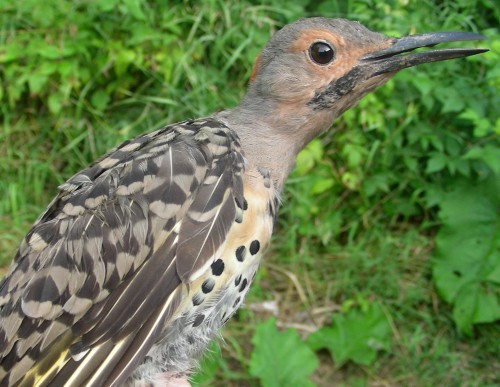
Photo by Marie-Anne Hudson, McGill Bird Observatory,
August 2007
Photo
by Seabrooke Leckie,
McGill Bird Observatory,
August 2006
Primary coverts are paler brown than the rest of the wing.
Caution: fresh fall HYs can resemble ASYs with uniform secondaries and
primary coverts. Look for retention of juvenal characteristics through
October: a larger, rounded p10.
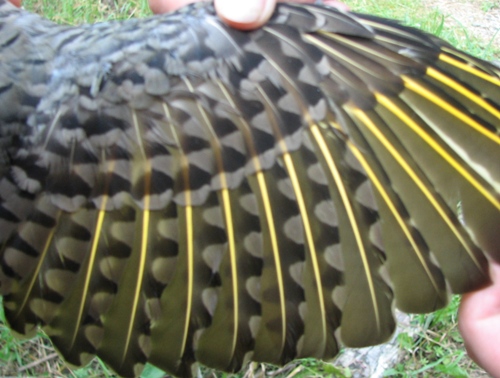
Photo by Barbara Frei,
McGill Bird Observatory,
August 2007
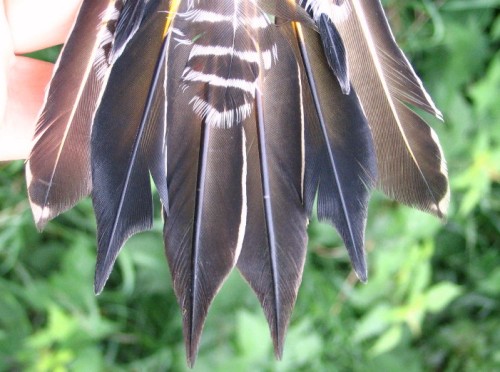
Look for pointed, juvenal rectrices.
Photo
by Seabrooke Leckie, McGill Bird Observatory, August 2006
RETURN TO AGE/SEX OVERVIEW
HY females do not have black moustaches and have gray/brown
irises. The extent of red in the crown should not be used for sexing.
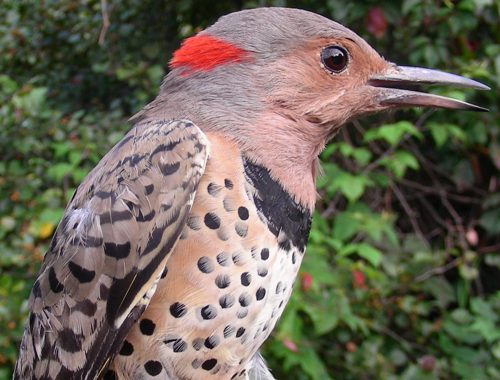
Photo
by Marcel Gahbauer, McGill Bird Observatory (QC), August 2008
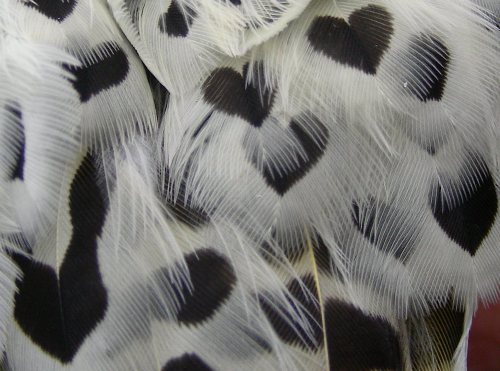
Photo
by Marcel Gahbauer, McGill Bird Observatory (QC), August 2008
Primary coverts are paler brown than the rest of the wing.
Caution: fresh fall HYs can resemble ASYs with uniform secondaries and
primary coverts. Look for retention of juvenal characteristics through
October: a larger, rounded p10.
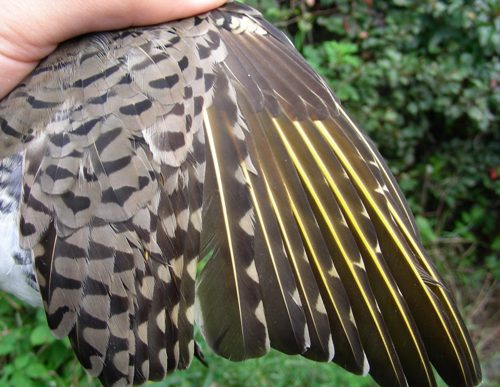
Photo
by Marcel Gahbauer, McGill Bird Observatory (QC), August 2008
Look for pointed, juvenal rectrices.
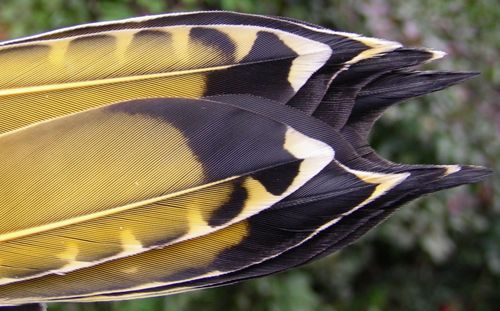
Photo
by Marcel Gahbauer, McGill Bird Observatory (QC), August 2008
RETURN
TO AGE/SEX OVERVIEW