|
Yellow
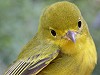
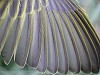
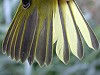
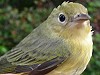
Warbler / Paruline jaune (Dendroica petechia) |
NOTE:
This species account has been moved to Piranga to allow for improved comparison
among examples.
The
updated profile is located at: http://www.natureinstruct.org/piranga/view.php/Canada/A6C0C4A9DCB84453
 |
Introductory notes:
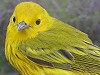
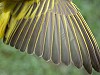
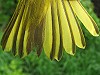
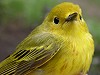
Although common in much of its range, there appears to be a lot of individual variability among Yellow Warblers (some of it perhaps tied to subspecific differences). As such, caution should be exercised when ageing and sexing, taking into account as many features as possible. |
QUICK TIPS:
| 1) Check
the primary coverts - on HY/SY birds they have
minimal edging and are often narrow,
pointed, and quite abraded by spring, while on AHY/ASY
birds they have yellow edging and are broader,
fairly rounded, and relatively fresh
2) Check the
secondaries - on HY/SY birds they are brownish with little
to no yellow edging, while on AHY/ASY birds they
have yellow edging similar to the primary coverts (note that this criterion is most useful in spring, as the differences in fall can be slight)
3) Check
the shape of the outer rectrices - on HY/SY birds
they are fairly pointed and easily abraded, while
on AHY/ASY birds they are broader, fairly rounded,
and more likely to remain fresh; note that colour
pattern can be rather variable and should not be considered reliable except in extreme cases
4)
Only after sex has been determined, use breast streaks to help identify sex - AHY/ASY males have extensive
reddish-brown streaking, SY males and ASY
females tend to have finer, less extensive streaking, and
HY males, AHY females, and HY/SY females have minimal streaking
Species account updated January 2011 |
|
Ageing and sexing guidelines:
Ageing and sexing details:
|
JAN - JUN: after-second-year
male |
In
spring, ASY males are the easiest age/sex class to identify among Yellow
Warblers. The body plumage is uniformly yellow to golden, often with
a distinct orange tinge to the crown, and with broad and extensive reddish streaks on the
breast.
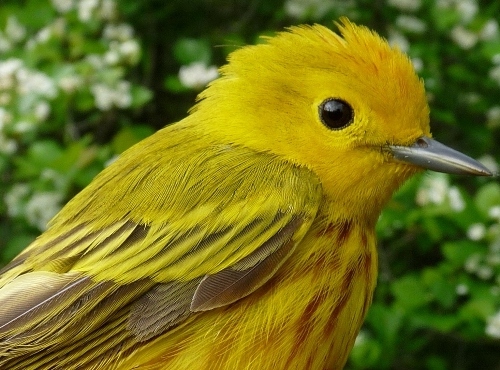
A typical ASY-M, with strong reddish streaks on the breast and a few faint ones in the crown.
Photo by Marcel Gahbauer,
McGill Bird Observatory (QC),
May 2010
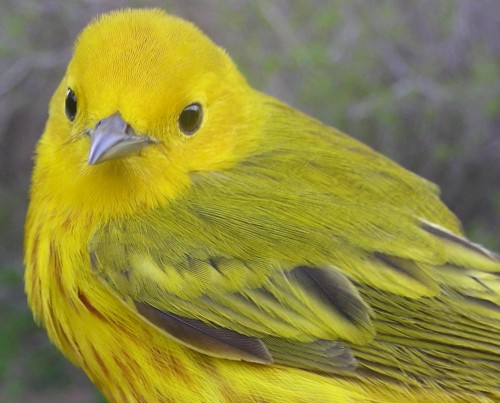
Another ASY-M, this one with only a trace of orange in the crown.
Photo by Marie-Anne Hudson,
McGill Bird Observatory (QC),
May 2007
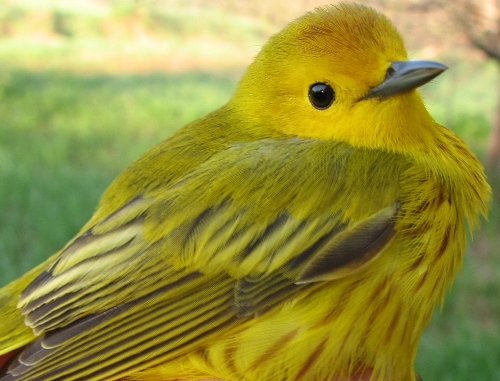
An ASY-M with an especially dark crown; note also the distinct yellow edging to the wing feathers.
Photo by Barbara Frei,
McGill Bird Observatory (QC),
May 2008
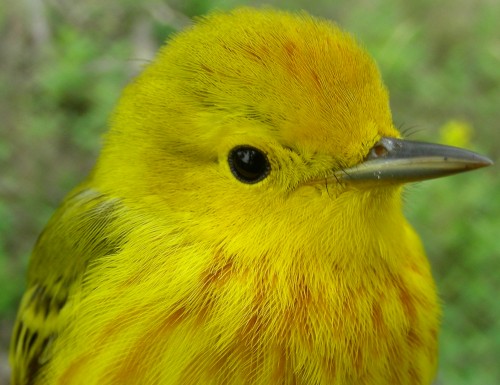
A frontal view, in this case with slightly less distinct breast streaks, but still a dark crown.
Photo by Marcel Gahbauer,
Dinosaur Provincial Park (AB), May 2007
ASY Yellow Warblers have broad and rounded primary coverts with distinct
yellowish edging, as well as yellow edging to the primaries and
secondaries, not contrasting significantly in wear with the tertials.
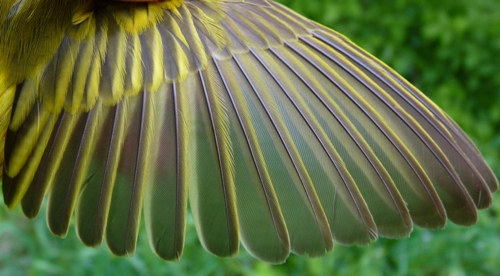
A typical ASY-M wing, with bold and broad yellow borders to the greater coverts, and narrower
but still distinct yellow edging to all primary coverts, primaries, and secondaries.
Photo by Marcel Gahbauer,
McGill Bird Observatory (QC),
May 2010
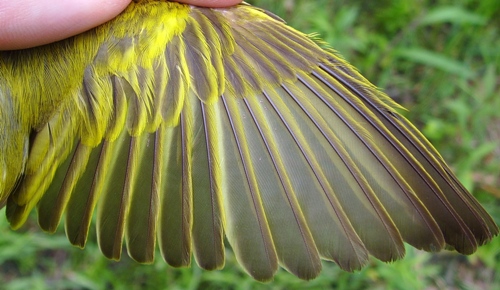
A similar example, but with even more yellow on the wing, especially in the median coverts.
Photo by Peter Pyle, MerryLea (IN), May 2007
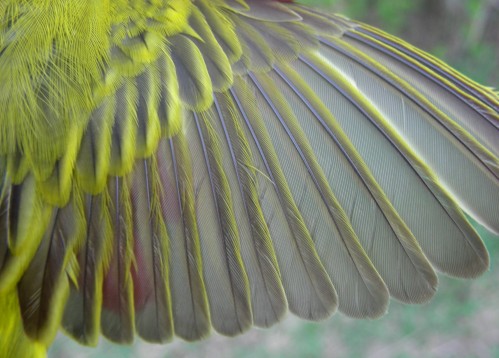
Note the particularly rounded and broad primary coverts in this example.
Photo by Marie-Anne Hudson,
McGill Bird Observatory (QC),
August 2007
Rectrices on ASY male Yellow Warblers are generally broad and rounded, with very little brown on the inner web of the outer rectrices.
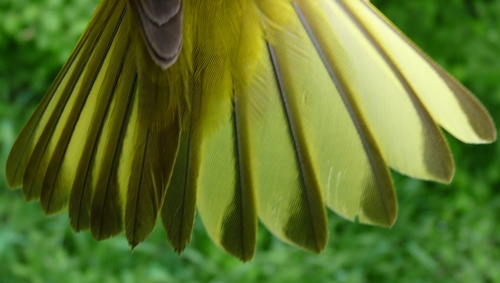
A fairly typical ASY-M tail, featuring broad and rather rounded rectrices, with brown extending
across to the inner web only near the tips.
Photo by Marcel Gahbauer,
McGill Bird Observatory (QC),
May 2010
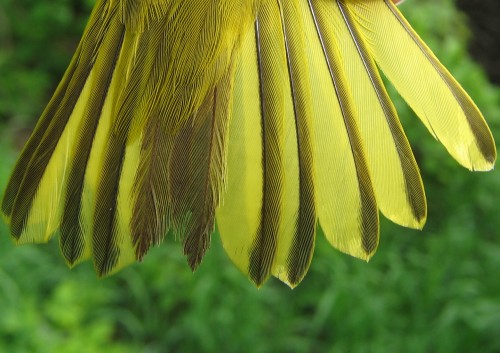
An example showing even less brown on the inner web.
Photo by Marie-Anne Hudson,
McGill Bird Observatory (QC),
May 2006
RETURN TO AGE/SEX
OVERVIEW
|
JAN - JUN: after-second-year
female |
Compared
to ASY males, ASY females have noticeably less red streaking on the
breast, and the crown tends to have a greenish tinge, with at most a trace
of orange. In terms of overall appearance, ASY females are most similar to SY males, and are most
easily confirmed by looking at the wings for the absence of a molt
limit. Note that due to its exposure to the sun, the alula can look
brownish even on ASY birds by spring.
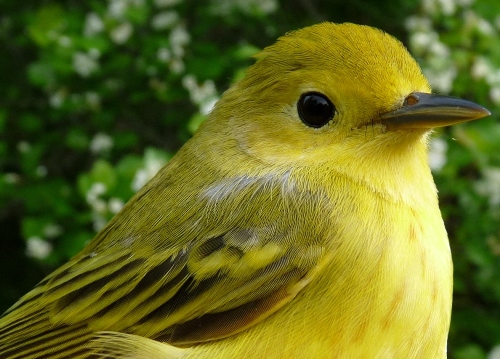
A typical ASY-F, showing faint reddish streaking on the breast and distinct yellow edging
to feathers on the wing.
Photo by Marcel Gahbauer,
McGill Bird Observatory (QC),
May 2010
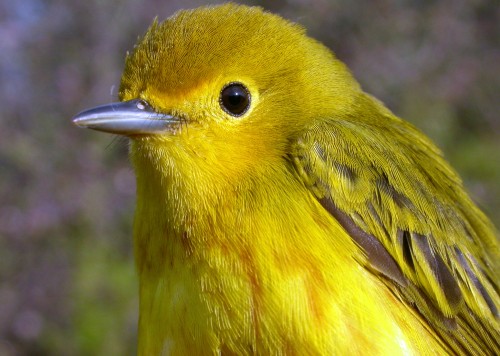
An ASY-F with somewhat more distinct breast streaks, and a hint of orange on the forehead.
Photo by Marcel Gahbauer,
McGill Bird Observatory (QC),
May 2005
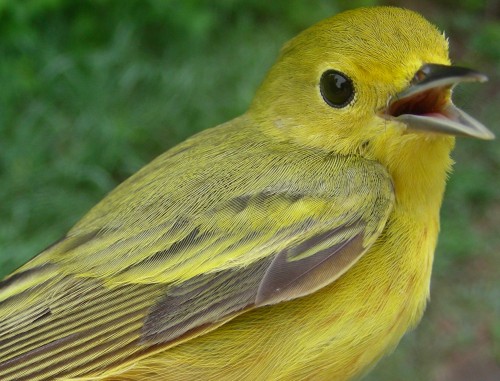
A paler ASY-F, with a rather brownish alula, but known to be in at least its fourth year.
Note that there is still distinct yellow edging on the primaries and secondaries.
Photo by Marie-Anne Hudson, McGill Bird Observatory (QC),
May 2007
In
both sexes, ASY birds lack a clear molt limit. Note the narrow but
distinct yellow edging to the primary coverts, and the broad yellow edging
found on all of the greater coverts.
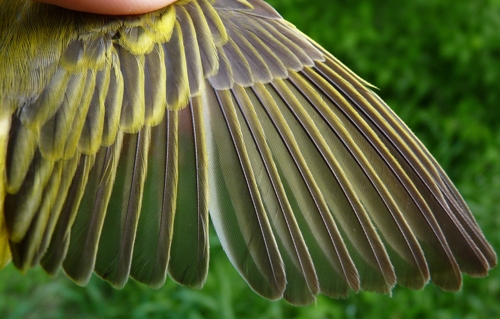
A typical ASY-F wing, slightly browner than an ASY-F, but still showing distinct yellow edging
to all feathers, and lacking any molt limits, as would be apparent in SY individuals.
Photo by Marcel Gahbauer,
McGill Bird Observatory (QC),
May 2010
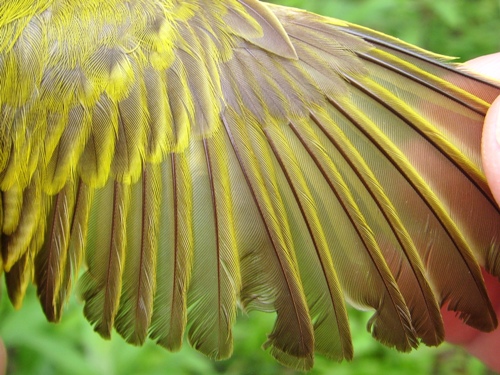
A more yellowish variant.
Photo by Peter Pyle, MerryLea (IN),
May 2005
In
both sexes, the outer tail feathers of ASY birds are fairly broad and
rounded. With females, there is a fair amount of brown on the inner
web, though its shape and extent is somewhat variable.
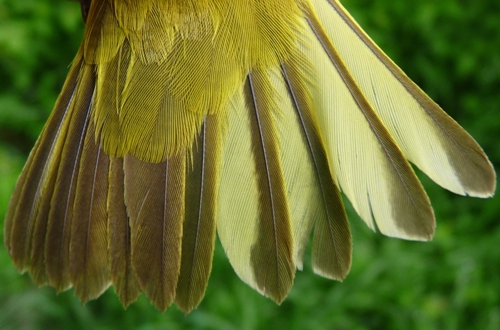
A fairly typical ASY-F tail, showing the broad and relatively rounded outer rectrices, with a
slightly paler yellow tone than on males, and with a bit more brown on the inner web.
Photo by Marcel Gahbauer,
McGill Bird Observatory (QC),
May 2010
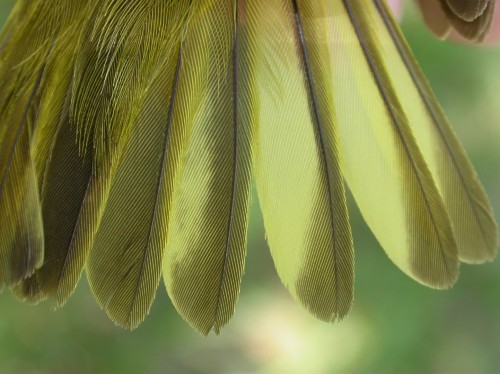
Another ASY-F, with a bit less contrast between the yellow and brown on the tail.
Photo by Marcel Gahbauer,
McGill Bird Observatory (QC),
May 2005
RETURN TO AGE/SEX
OVERVIEW
|
JAN - JUN: second-year
male |
SY
males have a rather variable amount of reddish streaking on the breast, from as little as on an ASY-F to nearly as much as on a typical ASY-M. The crown tends to be more yellow
than on females, contrasting less with the face, but this too can be variable. The tail
and/or wing usually need to be studied to confirm SY males.
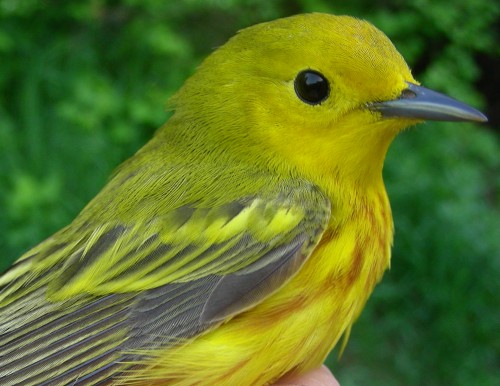
A typical SY-M with fairly strong breast streaking, but browner wings than ASY individuals.
Photo by Marie-Anne Hudson,
McGill Bird Observatory (QC),
May 2007
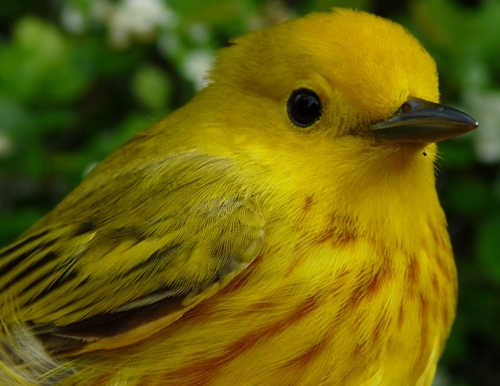
A particularly boldly streaked SY-M, also with a tinge of orange in the crown.
Photo by Marcel Gahbauer,
McGill Bird Observatory (QC),
May 2010
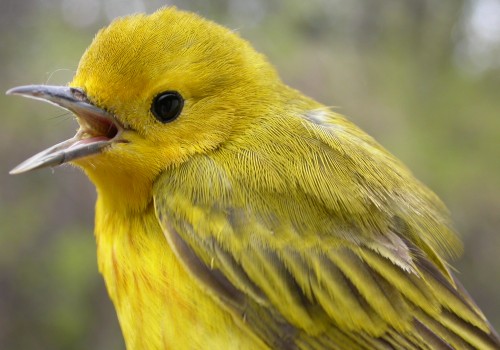
An especially pale SY-M, with only faint breast streaks.
Photo by Marcel Gahbauer,
McGill Bird Observatory (QC),
May 2005
Identifying molt limits on the wing is often the most reliable way to distinguish SY-M and ASY-F Yellow Warblers. This can be confounded somewhat by the alternate molt of the greater coverts, but in general the more brownish, faded, and abraded juvenile feathers of the primary coverts, primaries, and secondaries are apparent in terms of both quality and colour (note too the more limited yellow edging).
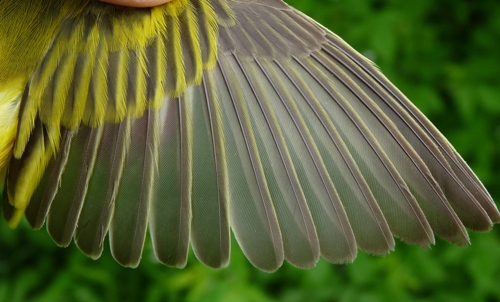
A typical SY-M wing, with all greater coverts and tertials replaced during the prealternate
molt, contrasting strongly with the brown juvenile feathers on the rest of the wing.
Photo by Marcel Gahbauer,
McGill Bird Observatory (QC),
May 2010
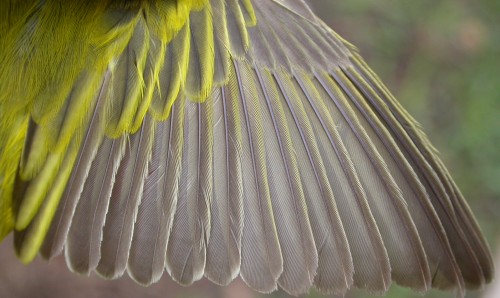
A stronger contrast in this example, with the inner secondaries more worn and showing
even less yellow edging. Note also that in this case the prealternate molt did not replace
all of the greater coverts, as the outermost two are still formative plumage. The presence
of three generations of plumage (juvenile, formative, alternate) as on this bird is also
indicative of SY birds.
Photo by Marcel Gahbauer,
McGill Bird Observatory (QC),
May 2005
Rectrices of SY Yellow Warblers are typically narrower and more tapered than on ASYs, and may also show more wear. The extent of brown on the inner web tends to be more restricted on males than females, as with ASY birds.
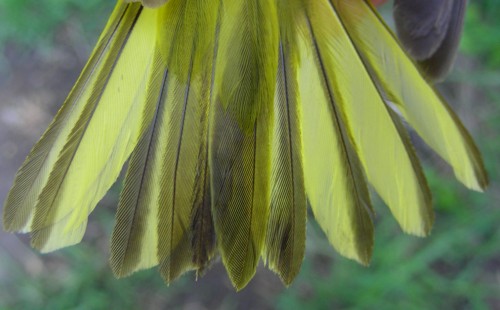
An example showing relatively little wear, and colours only slightly paler than what would
be expected on ASY-M.
Photo by Marie-Anne Hudson,
McGill Bird Observatory (QC),
May 2007
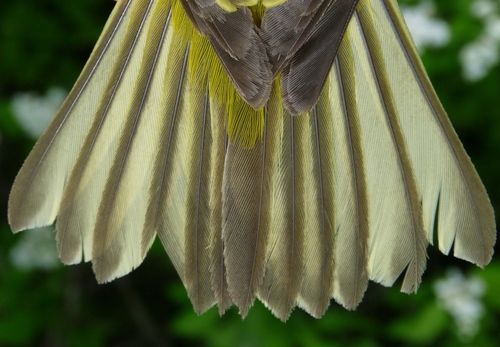
A paler tail (note the contrast with the more yellow uppertail coverts), also showing a bit
more fraying near the tips of some rectrices.
Photo by Marcel Gahbauer,
McGill Bird Observatory (QC),
May 2010
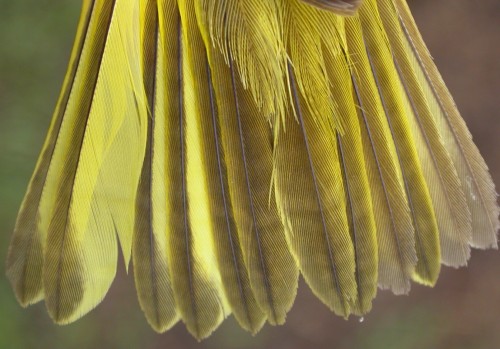
A somewhat unusual case, where most of the rectrices (except for r3 and r5-r6 on the right)
appear to have been replaced, showing the contrast between the paler retained juvenile
feathers and the darker replaced feathers.
Photo by Marcel Gahbauer,
McGill Bird Observatory (QC),
May 2005
RETURN TO AGE/SEX
OVERVIEW
|
JAN - JUL: second-year
female |
SY
females are generally quite easy to recognize by their overall appearance,
which is generally more greenish-yellow than other age/sex combinations,
and with hardly any reddish streaks present on the breast.
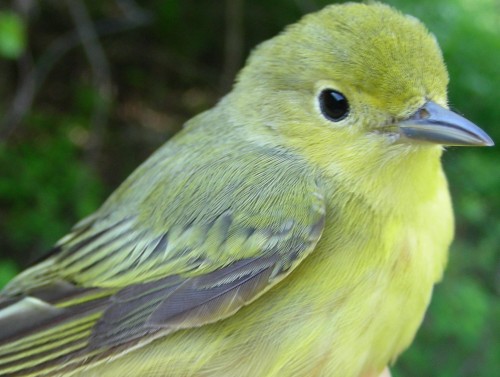
A typically pale SY-F, with only faint streaks on the breast.
Photo by Marie-Anne Hudson,
McGill Bird Observatory (QC),
May 2008
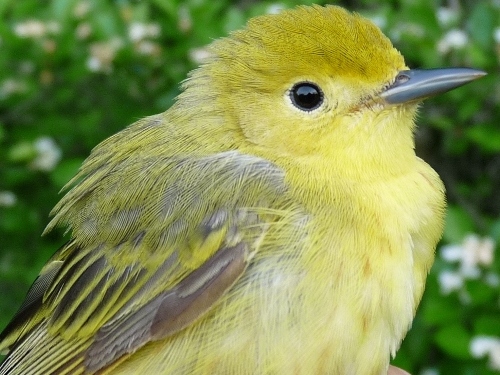
A slightly more yellow individual, especially on the crown, but overall still pale and
with very little reddish streaking on the breast.
Photo by Marcel Gahbauer,
McGill Bird Observatory (QC),
May 2010
SY females have
worn and
tapered primary coverts with only faint yellowish-green edging.
Occasionally there is also a distinct contrast between new,
yellow-edged, tertials and adjacent unreplaced
secondaries without yellow edging.
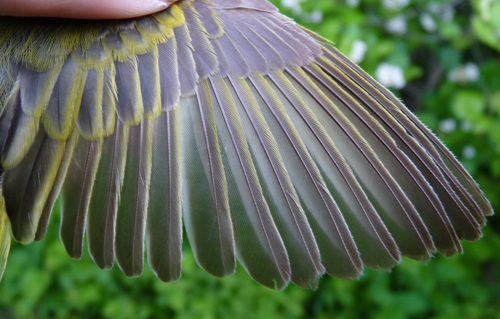
A relatively good condition SY-F wing, showing the general pale appearance with limited
edging, and with a bit of wear visible to the tips of the primaries.
Photo by Marcel Gahbauer,
McGill Bird Observatory (QC),
May 2010
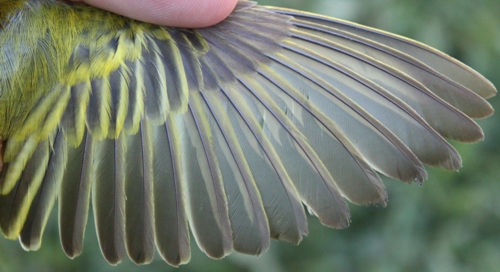
Another example of an SY-F wing in relatively good condition.
Photo by Peter Pyle, Braddock Bay Bird Observatory (NY),
May 2010
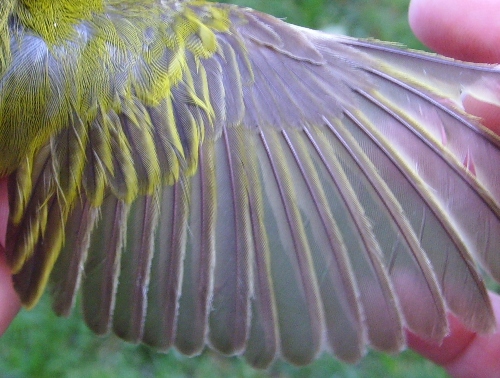
A much more worn example, showing less edging to the feathers, and much more wear on
the primaries and secondaries, especially noticeable as a contrast to the fresh tertials.
Note also the outer two formative greater coverts
that were not replaced during the
prealternate molt, and are both shorter and with paler edging.
Photo by Peter Pyle, MerryLea (IN), May 2007
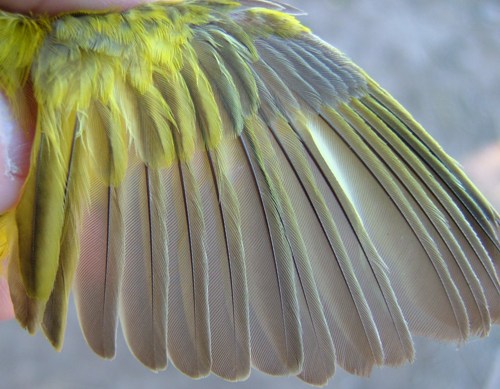
An example from the southwest, showing a more yellowish overall tone to the wing.
Photo by Peter Pyle, Southeast Arizona, June 2007
SY
females typically have more brown on the inner web of the outer tail
feathers than other age/sex combinations. Often it extends at least
halfway up the feather, as in the photo below, but in some
individuals it is more restricted toward the tip.
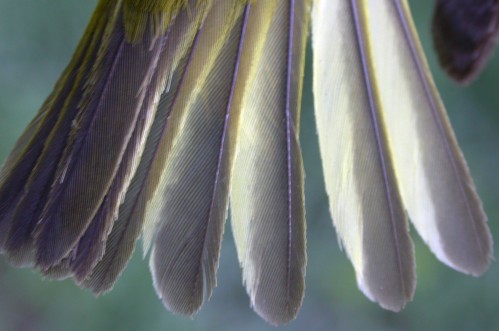
Photo by Marcel Gahbauer,
McGill Bird Observatory (QC),
May 2005
RETURN TO AGE/SEX
OVERVIEW
|
JUN - DEC: after-hatch-year
male |
AHY males
are the only age/sex class that may retain distinct reddish streaks on the
breast during fall migration, but this is not the case for all individuals.
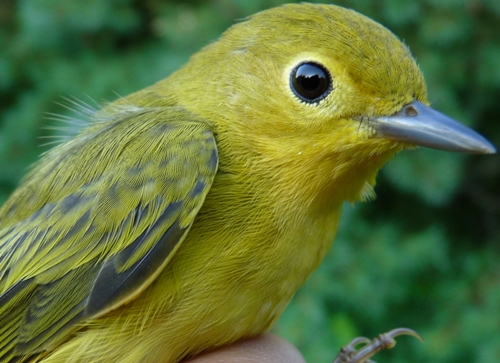
An AHY-M near the end of its prebasic molt, showing only a trace of breast streaking.
Photo by Marcel Gahbauer,
McGill Bird Observatory (QC),
August 2009
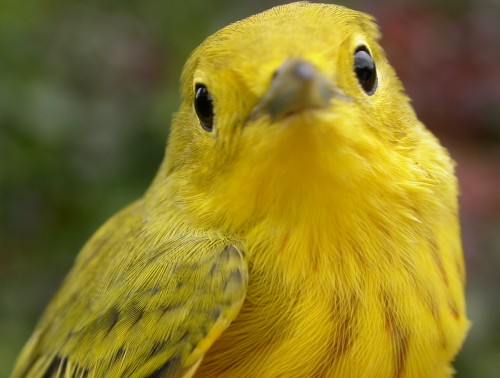
An AHY-M retaining distinct red breast streaks after its prebasic molt.
Photo by Marcel Gahbauer,
McGill Bird Observatory (QC),
September 2005
The wing appears similar for AHY birds of
both sexes. They lack a molt limit, have
distinct yellow edging to the primary coverts, and broad yellow edging
on all of the greater coverts.
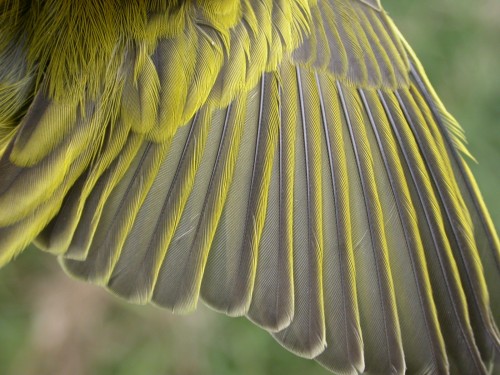
Note the broad and rounded primary coverts and the bold yellow edging to all wing feathers.
Photo by Marcel Gahbauer,
McGill Bird Observatory (QC),
September 2005
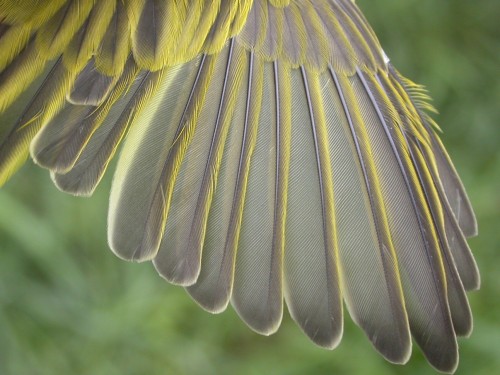
This individual shows similar features, but is still completing its prebasic molt; any Yellow
Warbler observed in molt can generally be assumed to be AHY, as the preformative molt
is limited to the greater coverts, alula, and tertials.
Photo by Marcel Gahbauer, McGill Bird Observatory (QC),
July 2006
In
both sexes, the outer tail feathers of AHY birds are usually fairly broad and
rounded. With males, almost the entire inner web is yellow, with
usually only a small amount of brown near the tip, extending up the
shaft much less than on females. Note that the third photo is of a
male at least 3 years old, showing unusually narrow and pointed
rectrices, though the colour pattern is consistent with that of an older
male.
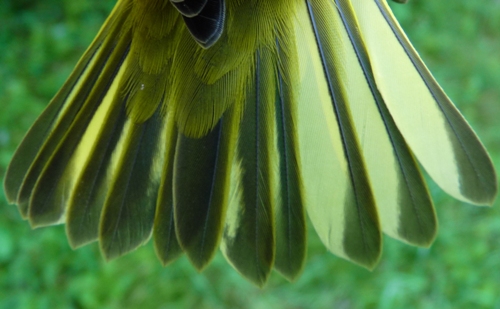
A fairly typical AHY-M tail, although some individuals have even less brown on the inner web.
Photo by Marcel Gahbauer,
McGill Bird Observatory (QC),
August 2009
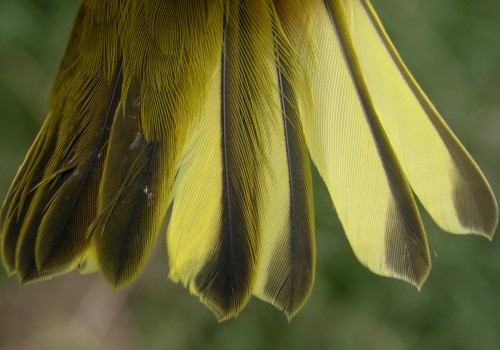
A somewhat unusual shape to the rectrices, still showign the typical broadness, but with
a distinct point at the tip. The pattern of yellow is consistent with AHY-M though.
Photo by Marcel Gahbauer,
McGill Bird Observatory (QC),
August 2005
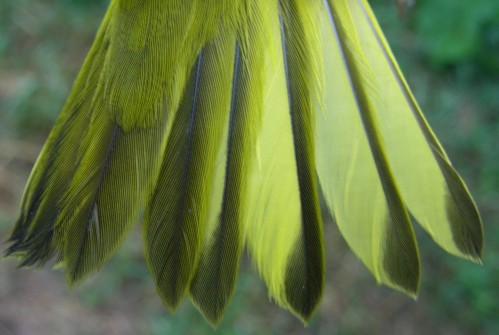
The rectrices in this case are more narrow and tapered, similar to what would be expected
for HY Yellow Warblers, but this individual was at least in his third year, and the extent
of yellow is more consistent with AHY-M than HY-M.
Photo by Marie-Anne Hudson,
McGill Bird Observatory (QC),
August 2007
RETURN TO AGE/SEX
OVERVIEW
|
JUN - DEC: after-hatch-year
female |
Compared
to AHY males, AHY females have little to no reddish streaking on the
breast, and a more green tinge to the crown.
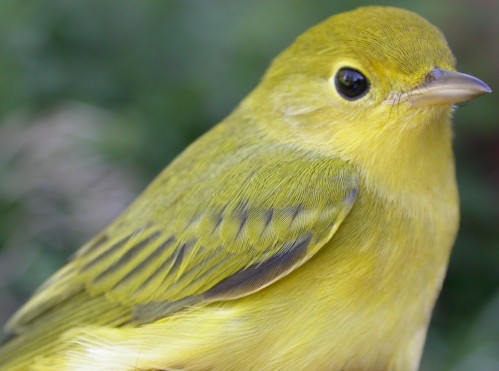
A typical AHY-F, pale greenish-yellow with no breast streaking.
Photo by Marcel Gahbauer,
McGill Bird Observatory (QC),
September 2005
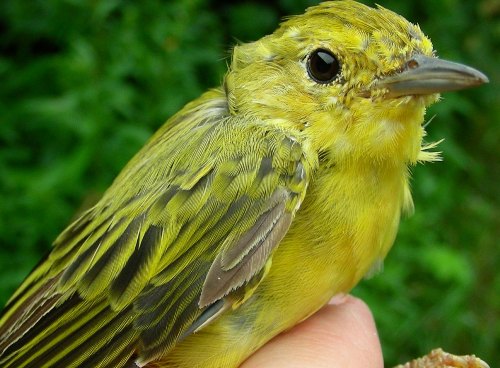
An AHY-F undergoing molt.
Photo by Marie-Anne Hudson,
McGill Bird Observatory (QC),
August 2008
In
both sexes, AHY birds lack a clear molt limit. Note the narrow but
distinct yellow edging to the primary coverts, and the broad yellow edging
found on all of the greater coverts.
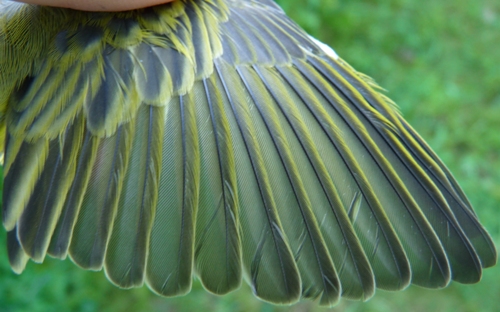
An AHY-F nearing the completion of its prebasic molt; all flight feathers have distinct
yellow edging and the wing is uniformly dark.
Photo by Marcel Gahbauer,
McGill Bird Observatory (QC),
August 2009
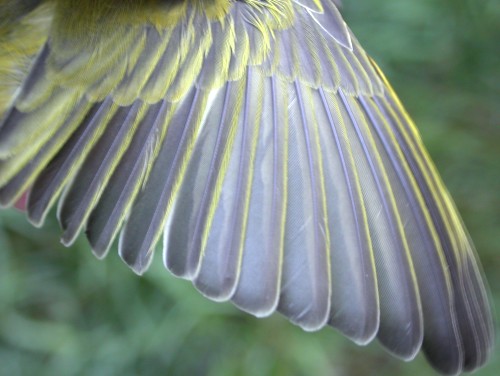
Another AHY-F wing showing uniform colour.
Photo by Marcel Gahbauer,
McGill Bird Observatory (QC),
September 2005
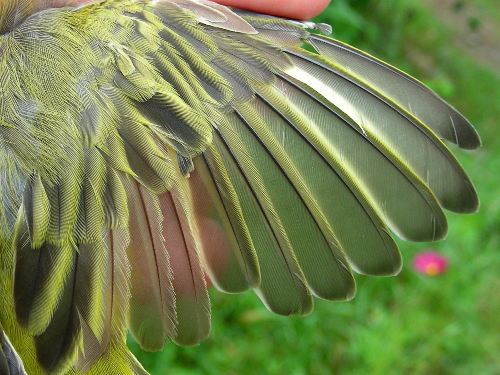
An AHY-F in the midst of molting its primaries and secondaries. The few retained secondaries
and alula are very pale brown and worn, strongly suggesting this is in fact an SY-F.
Photo by Marie-Anne Hudson,
McGill Bird Observatory (QC),
August 2008
In
both sexes, the outer tail feathers of AHY birds are fairly broad and
rounded. With females, there is a fair amount of brown on the inner
web, in comparison to males, where the inner web is almost entirely yellow.
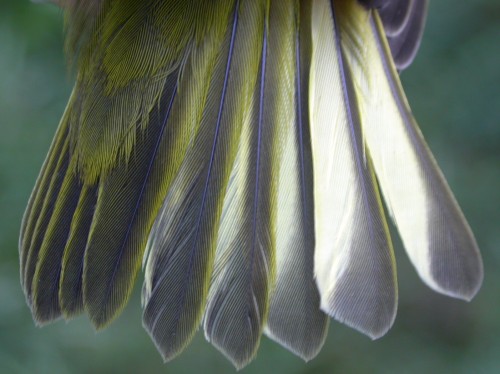
A fairly typical AHY-F tail in terms of shape of the outer rectrices and extent of brown.
Photo by Marcel Gahbauer,
McGill Bird Observatory (QC),
September 2005
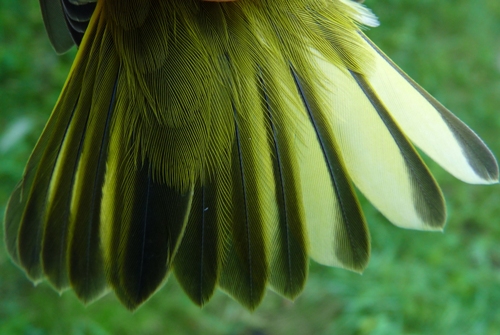
An example with much more limited brown on the inner web, quite similar to some AHY-M.
Photo by Marcel Gahbauer,
McGill Bird Observatory (QC),
August 2009
RETURN TO AGE/SEX
OVERVIEW
|
AUG - DEC: hatch-year
male |
HY
Yellow Warblers are generally greenish above and yellow below, with few
prominent markings. Some males already show faint reddish streaks on
the breast in this plumage, thus if these are present sex can be
determined easily. If they are absent, it may be possible to
determine sex using the tail, but often it will be unknown.
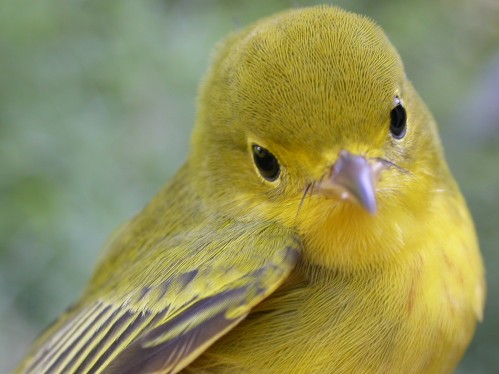
Note the few reddish streaks on the breast, which a HY-F would not have.
Photo by Marcel Gahbauer,
McGill Bird Observatory (QC),
August 2005
HY
Yellow Warblers show minimal pale edging on the primary coverts, and these
become increasingly narrow, tapered, and worn over the course of the fall. The
wing does not provide any information to assist in determining sex.
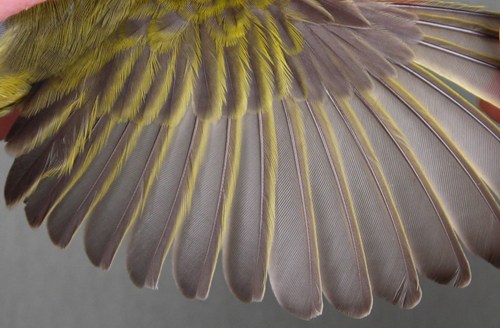
Photo by Peter Pyle,
Big Sur Ornithology Lab (CA),
August 2007
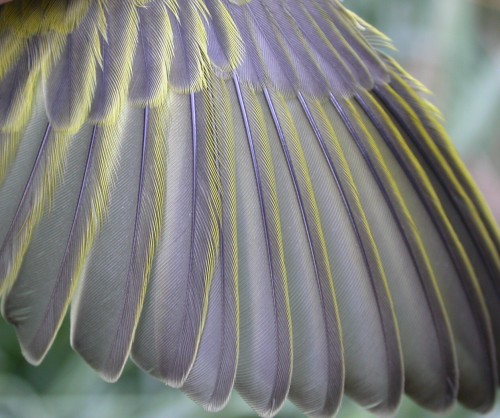
Photo by Marcel Gahbauer,
McGill Bird Observatory (QC),
August 2005
HY
Yellow Warblers tend to have somewhat pointed rectrices; males show a relatively small amount of brown on the inner web of the outer
rectrices. This can be used as an aid to determining sex, but should
be used with caution and preferably not as the only identifying
characteristic.
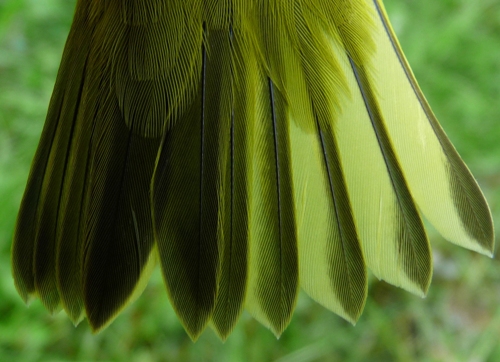
A fairly typical HY-M tail, showing the narrow and tapered shape of fresh juvenile rectrices;
the limited extent of brown is strongly indicative of this being a male.
Photo by Marcel Gahbauer,
McGill Bird Observatory (QC),
August 2009
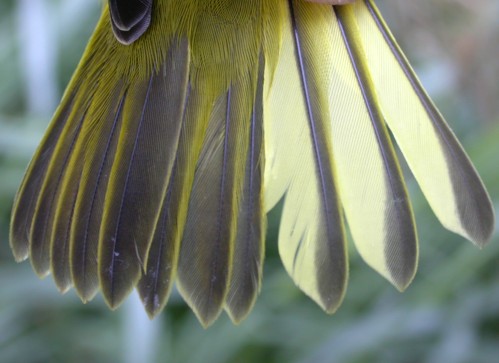
An example with slightly more brown on the tail, but still quite a bit less than would be
expected for most HY-F.
Photo by Marie-Anne Hudson,
McGill Bird Observatory (QC), August 2007
RETURN TO AGE/SEX
OVERVIEW
|
AUG - DEC: hatch-year
female |
Female HY
Yellow Warblers are generally greenish-yellow with a grayish tinge, and lacking
reddish streaks on the breast.
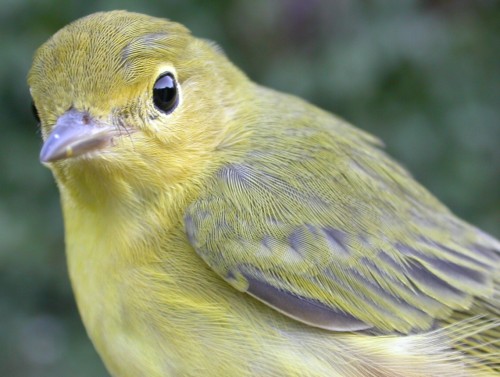
A typical HY-F, very pale grayish-yellow overall.
Photo by Marcel Gahbauer,
McGill Bird Observatory (QC),
August 2005
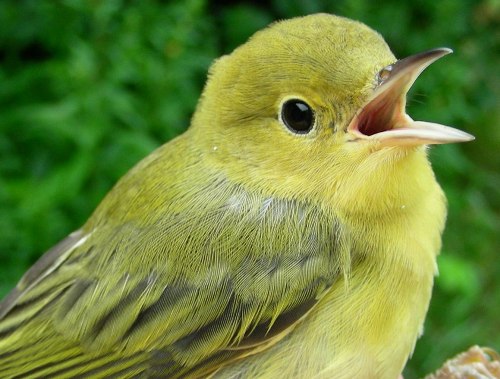
Another relatively pale HY Yellow Warbler, likely a female.
Photo by Marie-Anne Hudson,
McGill Bird Observatory (QC),
August 2008
HY
Yellow Warblers show minimal pale edging on the primary coverts, and these
become increasingly narrow, tapered, and worn over the course of the fall. The
wing does not provide any information to assist in determining sex.
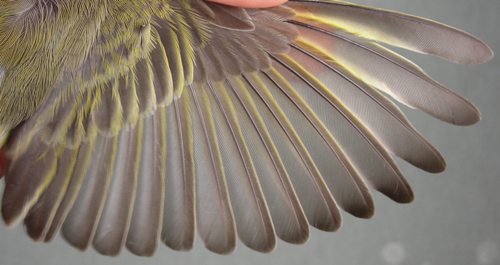
A typical HY-F wing, showing the brownish primary coverts, lacking yellow edging, and
the overall grayish-brown tone of the wing.
Photo by Peter Pyle,
Big Sur Ornithology Lab (CA),
September 2007
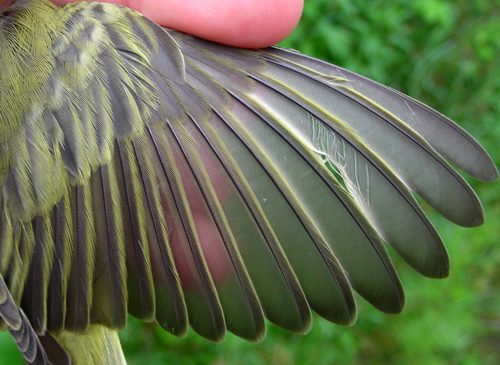
Another HY-F wing, with a touch of narrow greenish-yellow edging to the primary coverts,
but much less than on AHY individuals, and still quite grayish overall.
Photo by Marie-Anne Hudson,
McGill Bird Observatory (QC),
August 2008
HY
Yellow Warblers tend to have somewhat pointed rectrices, and the amount of brown on the inner web is generally more extensive on females than males.
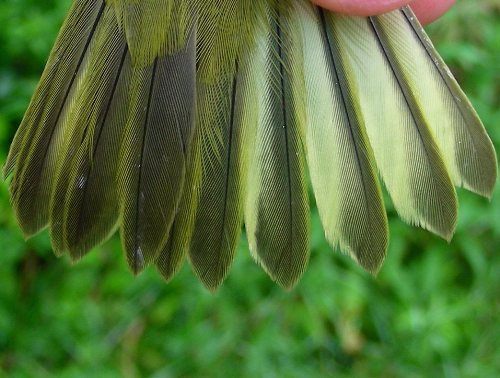
An example with relatively little brown on the tail for a female.
Photo by Marie-Anne Hudson,
McGill Bird Observatory (QC),
August 2008
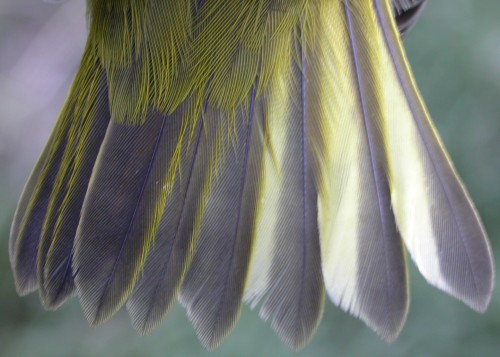
A more typical example, showing both the pointed outer rectrices and a greater amount
of brown on the inner web.
Photo by Marcel Gahbauer,
McGill Bird Observatory (QC),
August 2005
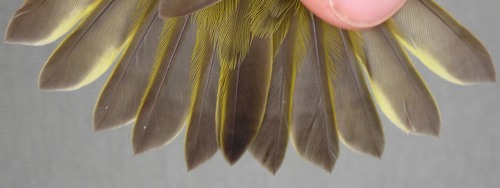
A western example, illustrating the much greater extent of brown on the inner web,
compared to the eastern birds in the previous photos. Note also the dark growth bar
visible across the entire tail.
Photo by Peter Pyle,
Big Sur Ornithology Lab (CA),
September 2007
RETURN TO AGE/SEX
OVERVIEW
|
AUG - DEC: hatch-year unknown |
While sex can be determined for some HY Yellow Warblers (generally males with some reddish breast streaks and/or a relatively dark yellow plumage, and females that are particularly pale grayish-yellow and/or have very extensive brown on the outer rectrices), many HY Yellow Warblers are best left as sex unknown.
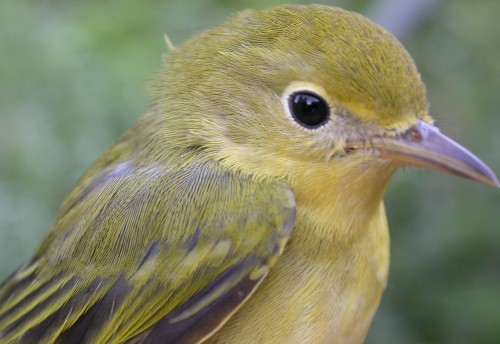
This HY Yellow Warbler is neither pale enough to be recognized as a female, nor yellow
enough to be reliably considered a male, so is best considered sex unknown.
Photo by Marcel Gahbauer,
McGill Bird Observatory (QC),
August 2005
HY
Yellow Warblers show minimal pale edging on the primary coverts, and these
become increasingly narrow, tapered, and worn over the course of the fall. The
wing does not provide any information to assist in determining sex.
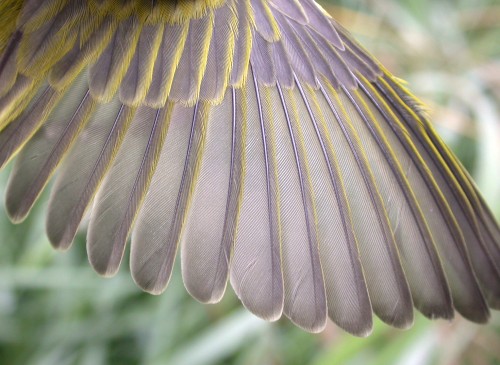
Another example of a HY Yellow Warbler wing, with minimal edging on the primary coverts.
Photo by Marcel Gahbauer,
McGill Bird Observatory (QC),
August 2005
The shape of the rectrices are generally quite reliable for ageing Yellow Warblers, but as examples within the HY-M and HY-F sections illustrate, there is a fair amount of variability in extent of yellow and brown on the outer rectrices, and therefore this should be used with caution as a guide to sexing.
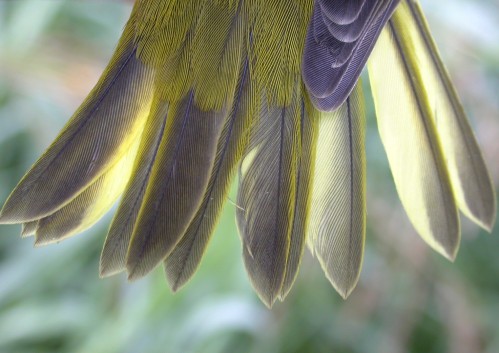
This example shows the classic narrow and tapered shape of HY rectrices. The amount of
brown on the outer rectrices is more suggestive of a female, but may be within the range of
variation of males and would not be enough to determine sex unless all other features
were consistent with female characteristics too.
Photo by Marcel Gahbauer,
McGill Bird Observatory (QC),
August 2005
RETURN TO AGE/SEX
OVERVIEW
|
JUN - AUG: juvenile unknown |
Juvenile
Yellow Warblers are predominantly gray. Small patches of yellow are
usually visible on the face, and there is greenish-yellow edging on the
wings and tail.
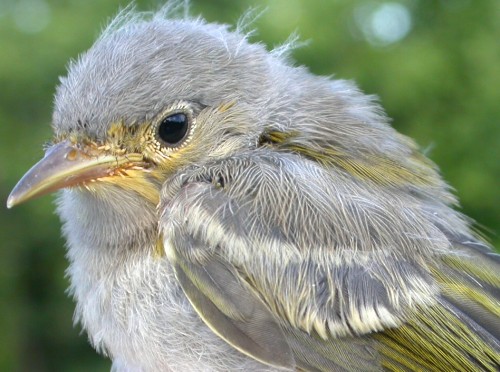
Photo by Marcel Gahbauer,
McGill Bird Observatory (QC),
July 2005
The
wing of juvenile Yellow Warblers is predominantly brown/gray, with dull
yellowish-green edging to the primary coverts and flight
feathers.
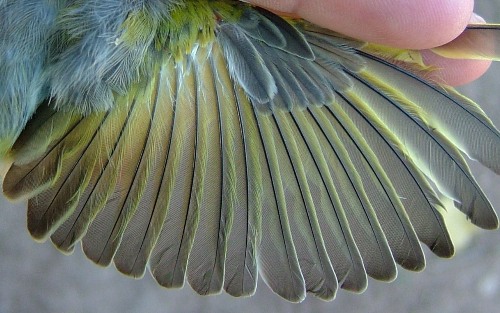
Photo by Peter Pyle, Southeast Arizona, June 2007
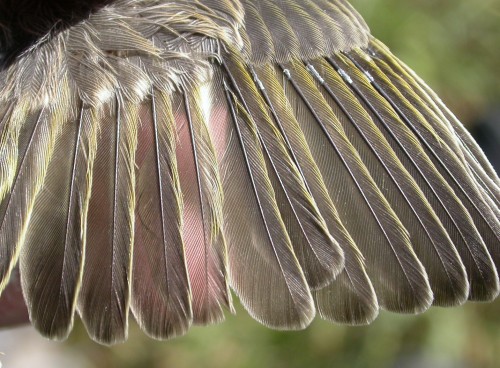
Photo by Marcel Gahbauer,
McGill Bird Observatory (QC),
July 2005
Fledgling
Yellow Warblers leave the nest before their tails are fully grown, thus it
is fairly common to see juveniles with short tails, such as the one shown
below. Note that the feathers are pointed and largely brown, but
with distinct yellow edging.
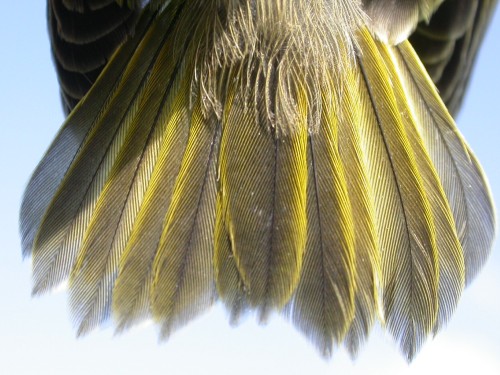
Photo by Marcel Gahbauer,
McGill Bird Observatory (QC),
July 2005
RETURN TO AGE/SEX
OVERVIEW
|