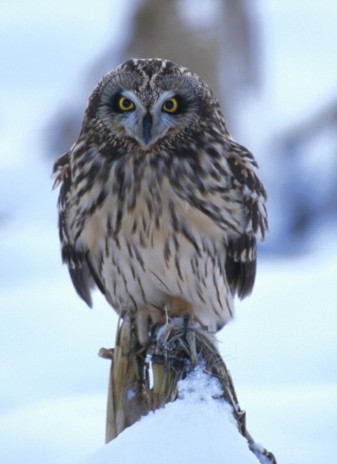
|
|
RESEARCH |
|||||||
Range: The Short-eared Owl also is resident on Cuba and Hispaniola, as well as parts of South America. It breeds across much of Eurasia, with northerly populations generally thought to be migratory.
Behaviour: Vocalizations:
Diet: The typical hunting method is to fly low over the ground, often less than 2 metres up, and usually heading into the wind, breaking up their flight with occasional bouts of hovering, often just before pouncing down on their quarry. Hunting activity often peaks within the last few hours of daylight, but can occur at any time of day or night.
Life
history: Courtship displays begin in late winter - February or March depending on latitude. As they reclaim their nesting territories, they commence flight displays. These involve frequent loud wing-clapping, as well as elaborate aerobatic display flights by the males. These usually see the males rising in circles, hovering for periods, and ultimately diving erratically toward the ground. Later in courtship, males provide females with food prior to mating. Information on nesting is limited, but it appears that the Short-eared Owl makes some effort to build a nest by digging a small scrape in the ground and lining it with available vegetation. In the north part of the Short-eared Owl's range, eggs are laid beginning in early June; further south they may start as early as late March, though May is more typical. As many as 16 eggs are laid, but a range of 5 - 7 is most common. Eggs are an average of 39 mm long and 31 mm wide, weighing just under 20 grams. Incubation commences with the first egg, and lasts 24 - 29 days. It is thought that the female is largely or entirely responsible for incubation. The young weigh approximately 15 grams at hatching, but increase their weight tenfold within just a week and a half. By just over two weeks of age, they are mobile, and sometimes wandering a fair distance from the nest. The actual age of fledging ranges from 24 - 36 days.
Conservation
issues: Analysis of the annual Breeding Bird Surveys in North America from 1966 to 1993 revealed a population decline of over 3% per year. The northeast population appears to be particularly troubled. As the Short-eared Owl has a short lifespan (longevity record of under 4.5 years), such steady declines indicate a serious threat to the survival of the population.
Recommended
references: COSEWIC. 2008. COSEWIC assessment and update status report on the Short-eared Owl Asio flammeus in Canada. Committee on the Status of Endangered Wildlife in Canada. Ottawa. vi _ 24 pp. www.sararegistry.gc.ca/status/status_e.cfm Dechant, J.A., M.L. Sondreal, D.H. Johnson, L.D. Igl, C.M. Goldade, M.P. Nenneman, and B.R. Euliss. 2003. Effects of management practices on grassland birds: Short-eared Owl. (Version 12DEC2003). Northern Prairie Wildlife Research Center, Jamestown, ND. http://www.npwrc.usgs.gov/resource/literatr/grasbird/seow/seow.htm. Herkert, J.R., S.A. Simpson, R.L. Westemeier, T.L. Esker and J.W. Walk. 1999. Response of Northern Harriers and Short-eared Owls to grassland management in Illinois. Journal of Wildlife Management 63: 517-523. Holt, D.W. 1992. Notes on Short-eared Owl (Asio flammeus) nest sites, reproduction and territory sizes in coastal Massachusetts. Canadian Field-Naturalist 106: 352-356. Holt, D.W. 1993. Breeding season diet of Short-eared Owls from Massachusetts. Wilson Bulletin 105: 490-496. Johnsgard, P.A. 2002. North American Owls. Second edition. Smithsonian Institution Press, Washington DC, USA, pp 213-220. USFWS. 2001. Short-eared Owl habitat model. United States Fish and Wildlife Service. Available at http://www.fws.gov/r5gomp/gom/habitatstudy/metadata/short-eared_owl_model.htm. Wiggins, D. 2004. Short-eared owl (Asio flammeus): A technical conservation assessment. USDA Forest Service, Rocky Mountain Region. Available at: http://www.fs.fed.us/r2/projects/scp/assessments/shortearedowl.pdf. Wiggins, D.A., D.W. Holt and S.M. Leasure. 2006. Short-eared Owl (Asio flammeus). The Birds of North America Online (A. Poole, Ed.). Ithaca: Cornell Laboratory of Ornithology; The Birds of North American Online database: http://bna.birds.cornell.edu/BNA/account/Short-eared_Owl/. See also the Links section for a variety of additional online references.
|