|
|
RESEARCH |
|||||||||||||||||||||||||||||||||||||||||||||||||||||||||||||||||||||||||||||||||||||
In this section, we report some of the highlights of our field experiences. Entries are listed in reverse chronological order; scroll down for reports dating as far back as 2003. SPRING 2009 - SUMMER 2010
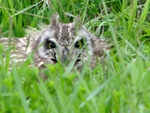
July 17, 2010: Report #11 Also, we are happy to report that in the end all three nests on Amherst Island fledged young. The first nest we discovered, on the Kingston Field Naturalists property at the east end of the island, fledged an incredible five young of six eggs laid! Also, the nest along Front Road, towards the bush, fledged three young, of which two fell victim to what we speculate was a nearby Great Horned Owl. Finally, the most recent nest discovered, just down the road from our residence on South Shore Road, fledged another three juveniles. Thus, we would like to welcome a new generation of eleven Short-eared Owls into the world! We would like to take the opportunity to thank Terry O’Shea, of the Wolfe Island municipal building, for providing us with landowner contact for many sites. His assistance was invaluable to ensuring the success of our habitat surveys. Also, to the many landowners who gave us free range to wander around their property, the importance of their cooperation cannot emphasized enough. We would also like to extend many thanks to Chantal Cloutier for her dedication and hard work in the field. She also made several fantastic suggestions that contributed greatly to this success of this field season! Last but not least, to Janet Scott, our Amherst Island host, for her never-ending warmth, hospitality, love and support… The residents of Amherst Island, both human and feathered, you forever hold a very special place in our hearts!
(click on photos to enlarge) July 3, 2010: Report #10 Last fall, we collaborated with Kurt Hennige of the Kingston Field Naturalists to organize an extensive Short-eared Owl Volunteer Survey Program. Also involved in the partnership were the Lennox & Addington Stewardship Council, Bird Studies Canada and the Ontario Ministry of Natural Resources. Amherst and Wolfe Islands were divided into three survey routes each, with eight or nine stops along each route. Seventeen keen volunteers from the Kingston Field Naturalists surveyed these routes each week from the end of November until the end of March. Along with recording Short-eared Owl sightings, they also recorded all other raptor sightings, and made notes on weather conditions both at the beginning and end of the surveys. The latter will provide important information on the optimal conditions to survey for Short-eared Owls. In addition, this excellent collection of data will serve as the starting point for our study on Short-eared Owl habitat use during the wintering and breeding seasons. Approximately 70 sites were surveyed in total; these sites were selected based on their apparent ‘availability’ to the owls (i.e. we did not survey over forested habitat or Lake Ontario). In the end, we are happy to report that Short-eared Owls ‘used’ almost half of the 70 sites! We defined a ‘used’ site as one where a Short-eared Owl was observed performing any behaviour other than simply flying over the site. Based on these observations, Chantal and I have been conducting extensive habitat surveys within 300 m radii of the survey points to characterize the landscape based on land cover and the presence of roads, water bodies, man-made structures, fences and fencepost type. The goal of this exercise is to eventually describe that which makes a site appealing to Short-eared Owls across seasons, so as to contribute much needed information on critical habitat for this species of Special Concern. The surveys can make for rather long days in the sun, wearing our rubber boots, and slogging through grasses taller than we are, but in the end it is always very satisfying to know that we are helping to fill a void in our understanding of the Short-eared Owl. As well, it’s always a treat to come across the nest of a friendly Savannah Sparrow, walk alongside a slithering Garter Snake or bouncing Northern Leopard Frog, or even to have the company of friendly horses, cows or sheep! We would like to mention the amazing cooperation we’ve experienced with the landowners on both Wolfe and Amherst Islands. We’ve knocked on endless doors to ask for permission to wander across private property, and not once have we been denied access except for the presence of a 1000+ kg bull! It’s been amazing to share our experiences with these wonderful people, but also to learn more about the Short-eared Owl from their experiences on these special islands. It is only hoped that others will eventually pick up the Short-eared Owl torch to continue this necessary work across other parts of its range.
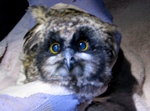
(click on photos to enlarge) June 10, 2010: Report #9 As noted in the previous update, on May 20 we were quite excited to discover our first nest in two years to be located on Wolfe Island. It was in the middle of a fallow field, approximately 100 m from a dirt road with a low traffic volume. It appeared as though the area hadn’t been touched in many years, and since we were in a rush to catch a ferry back to Amherst Island, and the landowner wasn’t yet home from work, we decided to speak with him on our next visit to Wolfe Island. Then, on May 26, we returned to the site only to find that the whole area had been plowed up, and the only evidence of an owl nest that remained were two pellets. To say it was a disappointment would be an understatement, especially after learning that not only had the nest site not been touched for a few years - it hadn’t been in use for almost a decade! This unfortunate incident served the important role of demonstrating all too clearly one of the most likely reasons why the species is in serious decline. Being a ground nester that seems to prefer hay and pasture fields for nesting, the Short-eared Owl is extremely vulnerable to agricultural activity on such lands. Though it is important to note that as we have discovered through endless conversations with landowners, the vast majority of individuals are more than willing to do their part to protect these owls and the habitat they require. Of course, this will require a large effort to communicate the plight of the Short-eared Owl to private landowners as well as the general public – at least on Amherst on Wolfe Islands this has already begun! Thankfully, following this sad event, we were quite happy to have a very successful evening on Amherst Island not long after. The story actually begins back in April, when we had observed an owl using the same area several evenings in a row. We also observed a short courtship, and returned for five consecutive mornings before dawn, as well as several evenings, at the beginning of May to determine whether the site contained an active nest. After eight attempts that yielded no owl activity, we decided to focus our efforts on other active territories. Then, on May 28, while conducting a Grassland Bird Survey in the same general area, we were very surprised to flush a Short-eared Owl out of an apple tree! Could it be that, in the end, there was indeed a nest at this site? After several evenings of waiting in camouflaged clothes in well-concealed locations, we finally witnessed a food delivery indicating there was most likely either a nest, or a young owl! We conducted the ‘rope drag’ over the entire area, but after failing to flush a female owl, we concluded all of the young had pre-fledged and were likely running around in the tall grass. Also, we realized the reason we hadn’t discovered the nest earlier – Apple Tree Andy, as named by Janet, was the most weary owl we had ever encountered, and immediately stopped all activity as soon as we were near, even if it was over 150 meters parked on the road! Though after exercising some stealth and camouflage on what seemed like an undercover mission, we were elated to have our efforts pay off, and capture not one, but TWO juvenile owls on the evening of June 3! We watched for food delivery, and then started walking in the general area until we found the first owl. After banding, feather sampling, measurements and photographs, we thought we might take another look, and much to our surprise came upon a sibling. To say we were happy would be an understatement – we were elated! As normal, we would like to express our thanks to those individuals and groups who have contributed to this project. Dayle Gowan invited Chantal and Kristen to speak about the project during an appearance on the Udder Morning Show on June 7. The Neilson Store Museum and Cultural Centre has invited the girls to present their Short-eared Owl project during a talk on the evening of June 29. It will take place at 7 pm on the island, and will be a general look at the imperiled grassland ecosystem - all are welcome to attend! Finally, we would like to thank Kyle Liptrot, Alex Pereira de Campos, and Dean and Anne Keyes, for assistance in the field, and all of our wonderful landowners on both Amherst and Wolfe Islands for their unwavering cooperation.
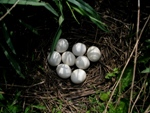
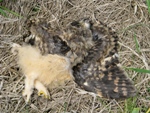
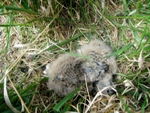
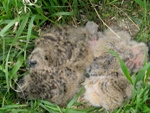
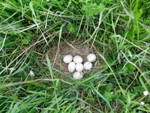
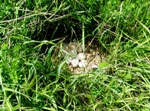
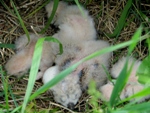
(click on photos to enlarge) May 20, 2010: Report #8 In addition to these trapping efforts, I was very happy to collaborate with Hazel Wheeler for a public presentation on May 16 in Amherstview, entitled ‘Owls that don’t give a hoot – a closer look at Short-eared Owls’. The evening was hosted by the Lennox & Addington Stewardship Council, and was well attended with an audience of approximately fifty. Also, on May 18, I presented similar talk, with slightly more detail, at the Kingston Field Naturalists monthly meeting. This meeting was also well attended, with over 100 audience members, and in a similar fashion to the talk two days prior, involved many thought-provoking questions, especially from the youngest members of the audience! After a quick dash back to Macdonald campus to finish up a few tasks and pack up my field gear, I moved back to the island to settle in for another breeding season. It didn’t take long for activity to be full-swing, and thanks to the incredible effort of 17 volunteers from the Kingston Field Naturalists who had been conducting weekly, standardized surveys on both islands, we already had a good idea of where courtship was likely to be observed. Throughout the month of April, regular checks confirmed those sites that were likely to support a breeding pair(s), and considering the very early and unseasonably warm spring, we anticipated early nesting as well! The real excitement began on May 6 with the arrival of Chantal Cloutier, also from the Macdonald campus of McGill University, who will be working on the project until the completion of fieldwork later this summer. Chantal is the well-deserving recipient of an NSERC Undergraduate Student Research Award, and is particularly interested in owls – a perfect match! Within the short span of just over two weeks, and as the result of lots of watching, waiting, listening, observing, and of course, searching, we’ve been able to confirm two nest sites on Amherst, and one on Wolfe. It’s amazing the difference a full field season of experience can make to one’s productivity and efficiency! The first nest was discovered on May 13, and to our delight contained six young of varying sizes. It was a textbook example of asynchronous hatching, an interesting feature of raptor reproduction whereby eggs are laying at intervals of between one and several days, thus also hatching over the course of the same time period. Upon a second visit to this site on May 18, we discovered only the two youngest owls remained – very exciting to think that four others had already wandered away from the nest! The second nest site was discovered on May 17, and over the course of thirteen hours spent in the same field, from before dawn until well after dark, we experienced both the ultimate highs and, unfortunately, the ultimate lows of wildlife research. This site is not visible from the road, and so we set up camp about 100 metres from the male’s favorite perch. And was he faithful to that perch! Throughout our long visit, he left the fencepost only to feed his mate and young, and rather hesitantly to deal with a few pesky Red-winged Blackbirds and the neighborhood Northern Harrier. Due to a visit the night before, we were aware of at least one young owl that was already hopping around in the tall grass. However, we wanted to be sure the female still wasn’t on a nest and so conducted our most daunting task, the rope drag. It was during this exercise that we discovered a juvenile Short-eared Owl, probably no more than four weeks of age, lying lifeless in the grass. Upon further inspection we found the owl’s neck and wing had been broken, and its eye pierced by what looked like a talon. The culprit was obvious – a Great Horned Owl. Since one had been heard at the site regularly, it seemed quite possible our little friend was just in the wrong place at the wrong time. On a positive note that night, Chantal’s keen observational skills and also vision, enabled us to band, measure and feather sample another juvenile owl from the same brood. It appeared to be slightly younger than the deceased owl, so we know at least two young have pre-fledged from the nest. Unfortunately we were not able to deploy a radio transmitter on the young owl due to its small size, but hopefully such an opportunity is yet to arise this field season! We did our best to limit the time spent handling, not only to decrease stress on the fledgling, but also on the parents who were extremely vocal overhead – so much so that in the darkness of night we were worried about having our hats knocked off! Finally, the third nest was discovered on Wolfe Island on May 20, albeit a very unlikely site! After flushing the male owl from his daytime roost in some old scrubby vegetation fairly close to a large wind turbine, we assumed the nesting female (if present!) would not be hiding out too far away. We continued rope dragging almost to the other end of the field, a distance of over 100 meters. At that time we decided to shift our efforts to another area lying adjacent to the site where we flushed the male. Then, on our last sweep, we flushed a female from a distance of only about five meters…and much to our excitement discovered another well-camouflaged nest containing eight eggs! While there is always more to report, we shall keep some of our recent Short-eared Owl observations for the next update. In the meantime, we would like to make a sincere thank you to all of the members of the Kingston Field Naturalists who have been actively involved in this project between November and March. Also, to Kurt Hennige who has been an excellent collaborator on the volunteer-based surveys, and Steve Pitt of the Lennox & Addington Stewardship Council who has also provided much appreciated logistical support. Hazel Wheeler and David Okines of Bird Studies Canada and the Prince Edward Point Bird Observatory, respectively, for sharing their equipment and expertise in the field. Also, to Janet Scott, our wonderful host, for her ongoing support and top-notch accommodations, and to Chantal Cloutier for her interest, dedication, and arguably ‘good luck charm’! Dayle Gowan invited Kristen to appear as a guest on the Udder Morning Show on April 26, which was an excellent opportunity to spread the word on the plight of the Short-eared Owl. Finally, to all of the wonderful landowners on Amherst and Wolfe Islands for the amazing willingness to work together! Until the next time, cheers to a new generation of Short-eared Owls…
(click on photos to enlarge) December 4, 2009: Report #7 On November 1, our wonderful host Janet Scott received a call from a fellow islander indicating that she had six Short-eared Owls hunting in her yard at dusk. Indeed, upon arrival at the same site on November 4, it was all Kristen could do to get off the ferry and to the site before sunset to catch the acrobatic, and quite vocal foraging of the same group of owls. They appeared from a wooded area of low brush (i.e. hawthorn and lilac) interspersed with jack pine, and proceeded to hunt in the small yard and surrounding pastureland, often perching on a few apple trees right beside the house. Our presence did not deter the owls in the least, and on a couple of occasions they flew within a couple feet of Kristen’s head! An intense search of the area to locate a roost was unsuccessful, however it is likely that the owls were roosting in an adjacent area that was inaccessible due to the presence of a large bull...one of the many challenges to face when working with a grassland species! One week later, on November 13, Kristen was fortunate to be accompanied by her summer field assistant, Catherine, for a weekend-long effort to capture the same group of owls mentioned above. Using a combination of mist nets, an audio lure, and Bal-chatri traps baited with live, wild mice, the owl girls placed themselves strategically in rather prickly hiding spots in the bushes to wait for the owls’ arrival. While interest was shown in both the mice and the audio lure, avoidance of the mist nets and traps reinforced once again what a serious challenge it is to catch these sneaky birds. However, the trip did prove successful in that the owl team located seven Short-eared Owls foraging on a different area of the island. Throughout the fall, Kristen has been working with Kurt Hennige of the Kingston Field Naturalists Club to set up volunteer-based roadside surveys to be conducted weekly between November and March. On November 24, the first day of standardized surveys, an incredible 30 owls were seen during a one and a half hour survey covering approximately one-quarter of Amherst Island. As a result, Kristen visited the island again during the first week of December, and was very happy to have the assistance and company of fellow graduate student, Tiffany Gilchrist. The pair attempted trapping in the area where the largest concentrations have been reported, but once again, despite the owls flying low to investigate the traps, none responded by going for the bait. It may simply be that the owls are not yet hungry enough to go for a meal in a funny looking trap – we will thus try again once winter has settled in fully and natural prey becomes more scarce. Short-eared Owl reports have been coming in from many difference corners of Amherst Island, including areas where owls have not yet been observed over the course of this project. There have even been a few reports of owls on Wolfe Island, which may indicate an increasing vole population with the potential for breeding activity next spring! We would like to thank all of the wonderful residents of both islands who have been sending in their observations, and in particular, our survey volunteers who have taken on this project with a level of enthusiasm and dedication we could have only ever imagined! As well, Hazel Wheeler and Debbie Badzinski of Bird Studies Canada, and in particular Steve Pitt of the Lennox & Addington Stewardship Council have all been very helpful in providing assistance and advice in the organizational stages of our volunteer surveys. We thank Janet Scott for her never-ending hospitality and support, as well as Catherine Doucet, Marcel Gahbauer, Tiffany Gilchrist and David Bird for their enthusiasm and assistance in the field. Stay tuned for more news in the New Year! July 27, 2009: Report #6 - part 1, James Bay (written by Kristen) The primary species of interest was the Yellow Rail (Coturnicops noveboracensis), which meant most of the time was spent in vast coastal marshes dominated by Chaffy Sedge (Carex paleacea) that averaged 60 to 90 cm in height. The areas surveyed were generally quite wet, since the Yellow Rail breeds in grassy marshes, boggy swales and damp fields, and in general, ‘likes to get its feet wet’ (M. Peck, pers. comm.). Their call is very reminiscent of two stones being struck together in a ‘tick-tick, tick-tick-tick’ pattern, and as their calls travel very well across the open landscape, locating individuals by sound was significantly easier than by sight! An extremely secretive bird that seems to shun sunlight, our few visual observations consisted of brief glimpses as the rails flushed and flew very close to the vegetation. However, thanks to some creative thinking by the second group that worked further north in the Fort Albany area, one rather friendly Yellow Rail was actually captured and held briefly for photographing! In the end, over 300 Yellow Rails were heard by the two teams between June 29 and July 12, despite various challenges including close black bear encounters, having to build bridges over flooded rivers once the almost four foot tide came in, a broken water filter, weight restrictions that placed tight limitations on food and gear, and last but not least, the endless armies of mosquitoes, black flies and moose flies! In addition to research on the Yellow Rail, other species of interest included the Black Tern (Chlidonias niger), Red Knot (Calidris canutus), and of course, Kristen’s reason for traveling with the team, the Short-eared Owl. Between eight and ten owls were observed in total, generally in the transition zone between the wet marshy areas described above and the dense willow and alder thickets found further inland. In every case, the owl simply flushed from a distance of between 50 and 100 meters, did not vocalize or display any other territorial behavior, and set down well out of view. Very few voles were observed along the James Bay coast, and an avid birder in Moosonee confirmed our suspicions of a lack of food by noting many fewer raptor observations this year. Thus, despite previous studies that have reported the Short-eared Owl diet to often consist of over 90% vole species (i.e. Microtus spp.), it was difficult not to wonder whether the owls may take alternative prey when their preferred source of food is almost non-existent. No evidence of breeding was observed, though a group of biologists with the Ministry of Natural Resources reported a nest on Akimiski Island a couple weeks earlier. With the knowledge that the vole cycle follows a different schedule on Amherst Island, Wolfe Island and the Kingston mainland, speculation that the same may be true along the James Bay lowlands seems well founded. In addition, following the discovery of nine flight feathers at one roost site, it seemed quite obvious that though the Short-eared Owls may not have had enough food to breed, there must have been sufficient resources for at least one individual to begin molting earlier than expected rather than to delay molting. Regarding speculation on alternative prey, the areas abounded with wood, leopard and chorus frogs (Rana sylvatica, Rana pipiens and Pseudacris triseriata), various shorebirds, and of course, the Yellow Rail…
(click on photos to enlarge) Kristen would like to extend her sincerest thanks to Mark Peck for inviting her along on this fantastic learning adventure, and to the other members of the crew for their incredible efforts to provide detailed Short-eared Owl observations. Feathers were collected that will expand the geographic coverage of the stable isotope analysis element of this project, and through observations of this species in a very different habitat, much was learned in terms of its general ecology and adaptability. However, as is often the case with wildlife research, Kristen returned from this experience with more questions than answers! July 27, 2009: Report #6 - part 2, Amherst and Wolfe Islands (written by Catherine) Of course, we also kept a sharp eye on our Short-eared Owls by monitoring daily using our binoculars and radio-tracking equipment. We were able to get a good signal from our owl that was outfitted with a transmitter until July 7; the individual was monitored for just less than a month indicating that the rather new ‘figure 8’ rump-mount method of attachment may be a useful technique for this species. Until July 7 we had been observing the siblings in a tight family unit in the tract of land where they fledged, but all seemed to leave the area together around July 8. This behaviour seemed to occur almost simultaneously with haying in the nearby fields, though whether or not it was a case of correlation rather than causation remains to be seen. Then started the challenging task of relocating the owls by traveling around the island with our hand-held receiver and antenna. We suspect the family unit may have moved closer to the freshly cut hayfields as it seems a better hunting ground for inexperienced juveniles which were still quite dependent on their parents when last observed. These shorter fields were therefore our first target as we were rather sceptical that the owls would leave for the mainland so early in the season, especially when the voles are still in abundant supply. Having the full team united again on July 16, we continued to focus our efforts on relocating the owls by walking through fields of Amherst both morning, afternoon and evening. On several occasions our hopes were dashed when weak signals in different locations seemed to be coming from the electric fences! Nevertheless, we did observe an owl foraging low and skirmishing with a Great Blue Heron on July 22. Even though it wasn’t the radio-tagged individual, the fact that at least one is sticking around gives us hope that others might be still be on Amherst Island just waiting to be found! We would like to extend a million thanks to Janet Scott, as well as Francine Boudreau and Michel Doucet who very kindly acted as both chauffeurs and assistants to Catherine during Kristen’s absence. As well, Dayle Gowan very kindly invited Catherine as a featured guest on the July 13 edition of the Udder Morning Show on Amherst Island Public Radio, and Terry Culbert did the same on the July 27 edition. Lance Eves very willingly shared his vast knowledge of changing land use and ecological diversity on Amherst Island over the past few decades. Finally, the owl team would like to announce an upcoming talk at the Amherst Island Museum and Cultural Center on July 31 at 7:00 pm, entitled “Owls that don’t give a hoot!”. All are welcome! June 27, 2009: Report #5 We’re happy to report that the owl we banded on June 10th is wearing her radio transmitter well, and is not showing any sign of changes in behaviour since we applied the unit. Though the signal is relatively low while she is roosting on the ground, once she is in the air we are almost swamped by the signal at around 1 km. This is a good sign for the next stage of the project where we will try to track movements of individual owls in the fall and winter months, with the ultimate goal of determining whether or not the same individuals stay on Amherst Island year round. On a rather grim note, we are very sorry to report the loss of the latest nest that when last visited on June 9th, contained five young and two remaining eggs. We returned to the site on June 16th, and found a completely empty nest with no sign of any eggs, young, or adults. Subsequent visits at dawn and dusk again yielded no sign of any owl activity; it is quite clear that this nest fell victim to predation. While we made every effort to limit our disturbance to the nest, it is well known that ground-nesting species like the Short-eared Owl are easy targets for both avian and mammalian predators. Earlier in May we had seen a weasel not far from the nest site, and following discussions with our very helpful and sympathetic landowner, we learned that a family of raccoons had been living in an old shed approximately 500 meters away. Unfortunately, we will never know what caused this nest to fail, but it is becoming clearer all the time that declines of the Short-eared Owl are probably due to a number of reasons, hopefully some of which this project will help to better identify and describe. From June 28 to July 16, Kristen Keyes will be joining Mark Peck from the Royal Ontario Museum and his team for three weeks of research in the southern James Bay district of northern Ontario. He has very graciously offered Kristen the opportunity to continue this Short-eared Owl project as a sideline project to his focus species, the Yellow Rail, and thus we extend many thanks to him for this wonderful opportunity! In Kristen’s absence, Catherine Doucet, with the assistance of Janet Scott and Alison Beamish, will be continuing work on Amherst Island; their time, effort and interest is truly unsurpassed. Finally, we thank Steve Pitt of the Lennox-Addington Stewardship Council, and Peter Good of the Kingston Field Naturalists for the assistance during evening fieldwork on June 16th – it is always a pleasure to see others enjoy the company of the Short-eared Owl as much as we do! (click on photos to enlarge) June 14 , 2009: Report #4 Around 11 am on June 1st, we flushed another female from a different site on the island, and discovered just how determined some mothers can be to stay with their nests! The only indication we had of the nest was a single flap of her wings as the rope went over top; we even approached to a distance of about six meters before she flushed. To our utter delight, we found a very well concealed nest complete with a healthy clutch of seven eggs. The landowners informed us that a few days later they would be putting their herd of beef cattle to pasture in the same field where we had discovered the nest – somewhat of a dilemma indeed. Thankfully, after further discussion, our very helpful, considerate landowners very kindly agreed to allow us to fence off one-third of the field until the young hatch and get on their way in a few weeks time. As of June 9th, the nest contained five young Short-eared Owls with two eggs still to hatch, and the oldest uttering the ‘pssssss-sip’ food begging call! Once shifting our focus back to the site where we discovered the young owl roosting on the ground, and following many hours of observation, it seems that we do in fact have two nests on two territories separated by a fence lined with many tall trees. Such close proximity may reflect that fact that this summer Amherst Island is experiencing a ‘vole plague’, and thus the owls can survive on relatively smaller territories that they would during a crash year. One territory currently has a pair actively defending what appears to be young that have traveled away from the nest on foot, though our efforts to listen for food begging in the evening hours has so far not proven fruitful in locating and capturing the young. Though on the adjacent territory, as of June 11th we have what we believe to be three young of the year in flight! By calculation, incubation of this nest must have begun in early April, which means the female sat through at least one snowstorm and a couple of severe rainstorms earlier this spring. Though slightly frustrated at the fact that we missed the nesting period at this site, we have shifted our focus to trying to catch the three young owls that seem to be very curious little children indeed. After three nights of sitting and waiting in the company of millions of mosquitoes, and wondering whether we would ever out-smart this owls, on June 10th the result of months of preparations came together and we captured our first owl! Our technique, oddly enough, was to set up a box of 4 x 12 m-100 mm mesh mist nets in the adjacent field to where we had been seeing the young roosting by day. While it would be ideal to work directly in that field, we have a friendly bull hanging out with his herd and figured it best to keep our distance. So, taking turns, Catherine and I would lie in the middle of the nets, covered with a blanket, and utter the food begging ‘pssssss-sip’. Just after 9 pm, the three young came over to investigate, and before we knew it, we had one in our nets! After taking a couple of deep breaths, we proceeded through our task of taking morphological measurements, plumage assessments, blood and feather samples, and attaching a radio transmitter to our very healthy little owl of 398 g. We are happy to report that our owl is flying well, and we’ve been getting full signal on our hand-held receiver. We’ve been continuing our trapping attempts on a daily basis, but it would appear that the owls have become accustomed to our mist nets, and so we have started to switch techniques, including the use of a stuffed Short-eared Owl and recording as a decoy. Hopefully we’ll have more exciting news from the field in our next update! The list of folks we would like to thank for their contributions to this project continues to grow; we are indebted to our wonderful landowners for their continuing support and assistance, even if it means us taking up precious pasture or delaying their bull being put to pasture! Also, Janet Scott for not only continuing to contribute to this project in any and every way imaginable, but also for keeping the owl team very well fed! As well, Janet and the staff and students at Amherst Island Public School for inviting us to their school for a presentation on Short-eared Owls, and giving us the valuable opportunity to educate a new generation on the importance of helping out this imperiled species. We greatly appreciated the volunteer assistance of Alison Beamish and Theone Cooper during both afternoon and evening fieldwork, and once again acknowledge Catherine Doucet not only for the incredible positive energy and enthusiasm she has brought to this project, but also for her very creative ideas and thoughtful suggestions along the way. It was a pleasure to chat about our project with Dayle Gowan on the June 8th edition of the Udder Morning Show, and we thank Denver Holt of the Owl Research Institute for a lengthy telephone conversation regarding trapping techniques. This project recently received funding from the Ontario Species at Risk Stewardship Fund, and we thank Steve Pitt of the Lennox-Addington Stewardship Council for facilitating the grant application. Amherst Island continues to be an exceptionally warm, friendly and unique place and like the Short-eared Owls, we can see why it would be an easy place to call home!
(click on photos to enlarge) May 31, 2009: Report #3b (click on photos to enlarge) May 28, 2009: Report #3 On May 20, we shifted our search to a second site also where courtship was observed earlier this spring. Shortly after entering the site two owls began to circle and bark fairly high (~ 60 feet) overhead, and completely unknowingly, we flushed a third owl, this time a relatively dark individual, from a distance of no more than two meters. We did not find any evidence of nesting in the immediate area, nor in the vicinity of a second raspberry thicket where the same dark individual was seen later in the day. Following further observations during sunrise and sunset, we are confident that two males and one female may currently occupy this territory! May 20 proved to be a very busy day in the field – we spent the evening at another site where three owls were observed well into the night, until our eyes were crossed from looking through the binoculars! The first individual remained perched in the top of a tall tree until thirty minutes after sunset when it proceeded to forage in the surrounding hay fields. At around the same time, we witnessed courtship with frequent wing clapping between two individuals in another hay field approximately 500 meters west of the first owl. To cap off what was already an excellent day of owl field biology, we were treated to a Great-horned Owl visible against the horizon in the sun’s last few threads of light. In summary, we suspect that the first nesting attempt by some Short-eared Owls this season may have been interrupted by the severe storm reported on May 14, or that the cool nights we’ve been experiencing have been sufficient to delay nesting completely. This speculation is further supported by the observed ratio of male to female Northern Harriers observed in the week prior to May 14 being significantly skewed towards the former, while after that date we’ve suddenly been seeing a somewhat equal sex ratio. Whichever the case, we’re keeping a keen eye on activity during the periods surrounding sunrise and sunset in an attempt to determine when we should proceed with our nest searches so as to cause as little disturbance as possible. We would like to thank the following people who have contributed to this project over the past week; Lance and Vince Eves, Reta Brown, and Doug Williamson for not only granting us permission to trek across their land, but also for providing us with very valuable information on nest encounters in previous years. Ian Murray for providing us with a variety of maps that will contribute greatly to our understanding of the layout of Amherst Island both past and present. Geoff Matthews for sharing his vast knowledge of the history, geology, geography, and especially flora and fauna of this beautiful island, along with granting us access to his impressive library collection! Finally, in a true example of Amherst Island hospitality, we thank Maureen McGinn for the very kind gesture of bringing us freshly baked chocolate chip cookies on the evening of May 24 as we sat in her field waiting for our ever elusive study species to grace us with its presence!
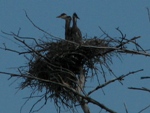
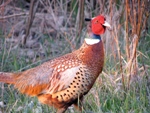
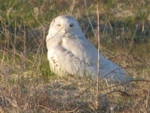
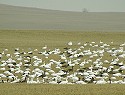
(click on photos to enlarge) May 16, 2009: Report #2 While we have been conducting evening visual searches on Wolfe as well as Amherst Island, we have yet to locate any Short-eared Owls on the former. Though on Amherst, we were quite satisfied to find an owl at one site shortly after sunset on May 11. This individual followed our Volkswagen Golf approximately 750 meters to a second site; a behaviour that we suspect may represent active defense of a territory and hopefully a nesting female! We located owls at two different sites within the hour preceding sunset on May 12, and two days later we were treated to an observation at 10:00 am of what we feel was the same ‘territorial male’ described above. On May 15 we put in a full day searching for nests at a site we are confident might support a nesting pair of Short-eared Owls. It was a rather tiring day, as we realized very early into the exercise that lugging a 150-foot long rope across an open field is by no means a trivial task! While we didn’t flush any owls, we did manage to flush a female Mallard, at least confirming that our approach should help us to locate ground-nesting females. We made the most of our time in the field by adding to our growing collection of owl pellets, and enjoying the presence of a new family of Red Fox, several new families of Canada Geese, and a few surprisingly late-lingering Rough-legged Hawks and Snowy Owls whose presence indicates voles are still plentiful on Amherst! We would like to thank the following people who have contributed to this project over the following week; Catherine Doucet for her much appreciated positive energy and willingness for any task; Janet, Sandy, Debbie, Rachel and Rebecca Scott for assisting with evening visual surveys; Dean and Anne Keyes for donating their time and facilities to the construction of several key pieces of equipment; and finally, Tom and Jackie Sylvester and Doyle and Elly Gowan for delivering a lovely loaf of fresh wood-fired bread, and serving up an absolutely delicious meal, respectively, to the very hungry and slightly bedraggled owl team! May 9, 2009: Report #1 Since April 26, we have been out every night from about two hours before to thirty minutes after sunset searching for owls in areas based on the advice of local birders, as well as in areas that we feel may be suitable for hunting and/or nesting. While most of the surveys have been roadside in nature, we have also walked a couple of fields that are less visible from the road, though these reconnaissance missions on foot have yet to reveal any owls. While we also conducted surveys from thirty minutes before dawn to two hours after dawn from April 26 to May 4, we decided to abort these surveys due not only to low productivity (i.e. only two owls seen), but also to due the limited capacity of two observers! As of May 9, we have seen Short-eared Owls on seven different sites around Amherst Island, with courtship behaviour at four of the sites. This behaviour has been observed most frequently in the thirty minutes preceding and/or following sunset, and in one instance involved four individuals. As well, encounters with Northern Harriers seem to be rather common, and on a few occasions we were alerted to the presence of owls based on the activities of the harriers! We have also seen aggressive interactions with a pair of Red-tailed Hawks nesting in what appears to be a defended Short-eared Owl territory. Finally, on the morning of May 9, we had one individual, which we speculate to be a male, fly over from a tree-top perch about 200 meters away, only to circle directly overhead of us while barking. This observation, combined with that of two lone owls seen perched on fence-posts during the last couple of evening surveys may suggest that nesting has begun! We would like to thank our full-time field assistant, Catherine Doucet, for her endless energy and enthusiasm since arriving on the island April 30, and Janet Scott for the incredible warmth and hospitality she’s extended since the MRF owl crew has invaded her home. Her knowledge of the island’s geography, history, and avian diversity is unsurpassed, and we greatly appreciate her sharing not only this valuable information, but also her time, as she has been out scouting for owls with us almost every evening! Finally, a big thank you to Kurt Hennige of the Kingston Field Naturalists for his advice on key areas to search for Short-eared Owls, as well as his keen eye, and that of his intern, Josh, during our evening survey on May 5. Last but not least, thanks to Dayle Gowan of Amherst Island Public Radio for inviting us on his show, and to all of the friendly folk here on this beautiful island who have been keeping their eyes peeled for Short-eared Owls…we will look forward to getting more of your reports of potential encounters with this fascinating species! No photos of Short-eared Owls yet, but here are some of Amherst Island's other prominent avian residents:
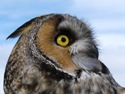
(click on photos to enlarge) WINTER 2009 In preparation for an expanded field research program starting in spring 2009, MRF Executive Director Marcel Gahbauer and graduate student Kristen Keyes conducted some preliminary lab and field studies in February 2009. February 25, 2009: Memorable highlights were many, but the spectacular evening flights of Short-eared Owls were arguably the most impressive, given our objectives. On Sunday evening we headed out along a variety of gravel sideroads, and by around an hour before sunset, the first Short-eared Owl came into view, coursing back and forth, low across a field nearly a mile away. Moving on, we spotted another before long, this one flying high and wing-clapping, then chasing away a Northern Harrier and a Rough-legged Hawk as if already defending a territory. Further south again, we found at least five Short-eared Owls together over a field. One of the males appeared to be pursuing a low-flying female at times, but for the most part, the four males were high in the sky, performing intricate courtship flights with lots of wing-clapping and barking. On the way back, we found another field with five Short-eared Owls, plus a couple of Northern Harriers, plus a couple of lone owls along the fence lines, for a total of at least 16 in the span of just over an hour. On Tuesday evening we tried a somewhat different route and found half a dozen Short-eared Owls, some of them again dazzling us with their aerial displays. A remarkable area, and a great training ground for becoming familiar with how to search out Short-eared Owls during the breeding season. We can only hope the southern Ontario population will put on a similar show for us later this spring.
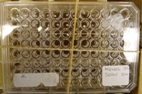
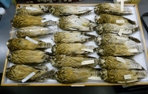
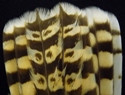
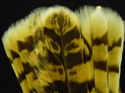
(click on photos to enlarge) February 20, 2009: As we discovered, the sample preparation technique is not particularly technical, but it does demand care and patience to get the tiny amounts accurately prepared. For our trial run, we were sampling feathers from just two Short-eared Owls, testing multiple feathers from each bird to evaluate whether there is any variation within and/or between feathers that may be important to know before launching fully into our field program - whereas these two specimens were road-kill victims, on live birds we want to collect as few (and as small) samples as possible. The first step in sample preparation is the easiest, simply soaking the feather sample in a chemical wash. After that is where the sharp eyesight and patience become necessary. The samples are ultimately fed into a spectrometer that will determine the relative proportion of isotopes (in our case regular hydrogen vs. deuterium), which in turn can be compared to known distributions of isotopes across the continent to indicate the geographic origin of the sample. However, the spectrometer requires that the feathers be "packaged" in a small metal pellet. This involves measuring out a tiny amount (0.33 to 0.37 mg) of feather material, stuffing it inside a tiny silver capsule, and then folding, pounding, and eventually squeezing it until it is a tiny compressed ball. Getting the first couple of samples done was quite a challenge, but fortunately we got the hang of it fairly quickly, and with teamwork were able to get the process down to around 4-5 minutes per feather. Now we eagerly await the results...
February 18, 2009:
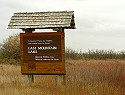
(click on photos to enlarge) FALL 2007 After nearly two years of planning and pilot research on captive owls, MRF launched its first satellite transmitter on a wild Short-eared Owl in October 2007. MRF Research Director Marcel Gahbauer describes below his experiences in the field; click here for details on the subsequent movements of this female owl. October 17, 2007: The original plan had been to return Skor to the location in the Porcupine Hills where she had been found injured. However, that would have entailed a long drive, and given the habitat in the area and timing of her injury, we rationalized that Skor may well have been on migration when hit, and therefore returning her to that location made little sense. Rather, we decided to release her in an area likely to provide suitable habitat. The first place that came to mind as being known for Short-eared Owls was Last Mountain Lake, a National Wildlife Area about 90 minutes southeast of Saskatoon. Upon arrival at Last Mountain Lake, I spent 15-20 minutes scouting the area for other birds. There were many hundreds of Sandhill Cranes flying around, a good variety of ducks, coots, and grebes in patches of open water, and a handful of American Pipits on the ground. I didn't see any raptors, though I expected Northern Harriers might be around. I removed Skor from her carrying cage and did a final thorough inspection of her. As expected after a full rehab program, she appeared to be in great health, with good quality feathers and nice muscle tone. I also checked out the fit of the transmitter and harness, to verify that they remained securely in place while in transit. Satisfied that she was ready to head off on her own, I released her ... holding my breath to see where she would go. Skor's initial flight was very short indeed - she landed on the ground only 10 metres away. From there, she spent several minutes taking stock of her surroundings - glancing at the Sandhill Cranes passing overhead, giving herself a good shake, and perhaps wondering for a moment or two just what to do with her newly refound freedom. Her next movement was a typical low Short-eared Owl flight, never more than a metre or so above ground. Over the next hour, she made a few more short flights, gradually taking her farther from view and into slightly deeper grasses. Eventually fog and then darkness rolled in and I lost sight of her. After that, it was a long drive home in the dark for me, wondering where Skor would head off to, and hoping that her transmitter would reveal some little known secrets about Short-eared Owl movements.
(click on photos to enlarge) SUMMER 2005 This summer MRF is again surveying the southern Ontario population of Short-eared Owls, this time focusing on the Amherst Island / Quinte area which appears to be the last area remaining with any regular concentration of breeding pairs (report to follow). In addition, MRF Research Director Marcel Gahbauer had the opportunity to survey parts of southern Labrador for Short-eared Owls while conducting more general bird surveys. July
15, 2005: For a week in early July, I was hired as part of a team to conduct breeding bird surveys in Labrador. The bulk of our work took place in southwestern Labrador, west of Churchill Falls. Since part of our mandate was to search for raptors, we spent many hours conducting low-level helicopter flights. The landscape in the area is largely a mix of spruce forest, taiga (predominantly lichen ground cover with scattered small spruce and tundra-acclimated shrubs), fens / string bogs, and lakes. The fens would seem to offer particularly suitable habitat for Short-eared Owls - a mix of low vegetation and somewhat taller shrubs, large open areas for hunting, and an apparently good prey base in the form of small birds and mammals. Despite the apparent availability of habitat, we did not spot any Short-eared Owls. Of course, since they were not the focus of this study, it is possible that some were present and were missed, as we did not conduct any surveys in the evening or at night. Nonetheless, it was a disappointing result. In speaking with other biologists in the region, we learned of at least one small population in a coastal wetland, but the general impression was that it is considered an uncommon bird at best. SUMMER 2004 To date, MRF's focus has been primarily on the southern Ontario population of Short-eared Owls, for which there is fairly good historical documentation, allowing us to evaluate changes in distribution over time. However, it is evident that the wintering population far exceeds the breeding population, and it has been speculated that many of these additional birds may come from the Hudson Bay lowlands of northern Ontario. MRF Research Director Marcel Gahbauer recently had an opportunity to visit that area as part of an Ontario Breeding Bird Atlas survey team, and reports as follows: June
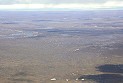
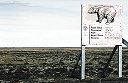
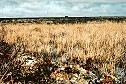
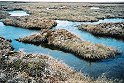
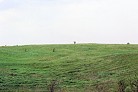
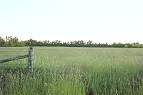
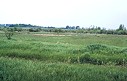
28, 2004: I was visiting Polar Bear Provincial Park as part of a team of three responsible for collecting data for the Ontario Breeding Bird Atlas. Our task was to cover as much ground as possible on foot, documenting breeding evidence for all species in the area (we ended up surveying roughly 55 square kilometres, walking over 150 kilometres in total). I selected this particular trip with the expectation that it would give me a good opportunity to observe breeding Short-eared Owls in what is thought to be their Ontario stronghold, and to compare their distribution and behaviour in this area with what we have seen in southern Ontario. Our base camp was located approximately 12 kilometres south of the Hudson Bay coast, between the Brant River and a large inland lake that was still 90% ice covered upon our arrival on June 15. The landscape was virtually flat, and aside from the occasional hardy white spruce or tamarack, also treeless. Visibility therefore was excellent, and larger birds could be seen flying from kilometres away - though it became difficult to identify them at such distances. While we never saw the park's namesake, some other mammals were spotted regularly. Caribou were plentiful, and we observed Arctic Foxes on several occasions. On the other hand, small mammals were incredibly scarce. Between the three of us, we spotted a single lemming on this trip, and we never saw any voles or other small rodents at all. It comes as little surprise then that we saw only one Short-eared Owl. These birds are known to be highly nomadic, and it is strongly suspected that their movements are tied closely to prey availability. With small mammals appearing to be at the low point of their natural cycle in this area, the owls are presumably elsewhere this summer. Interestingly, a good number of Northern Harriers were seen throughout our stay, though we observed successful hunts on very few occasions. Fortunately, this limited resource did not affect all of the birds in the area. In total we observed 74 species, for 45 of which we were able to document probable or confirmed evidence of breeding attempts. However, even for many of them it was a tougher year than usual. This was apparently the coldest/latest spring in the area in over 30 years, and the cold and wet weather throughout much of our stay was taking its toll, as we found some dead birds, and observed that among the more common species, only a handful of individuals were showing interest in nesting. A fierce four-day storm with high winds and a mixture of rain, freezing rain, and snow came through toward the end of our stay, and we suspect that it will have reduced the likelihood of successful nesting even further for most species. Of course species which come to this area in summer are adapted to harsh conditions, and some year-round residents such as the Willow Ptarmigans were likely able to survive the unusually cold weather without too much trouble. We suspect that the Short-eared Owls too may have fared alright by moving on to alternate sites early in the season, upon recognizing a shortage of prey in this area. Whether they have located higher rodent populations elsewhere in enough time to breed successfully this year will remain a mystery for now, but only strengthens our conviction that we need to track the movements of some individual Short-eared Owls to learn more about the timing and direction of their travels. The small sample of photos below illustrates the habitat typical of the Hudson Bay lowlands. If you have any questions about the area, or experiences of your own to share from elsewhere in the arctic, please e-mail me.
(click on photos to enlarge) WINTER 2003/04 March
17, 2004: February
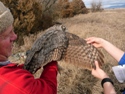
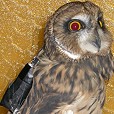
27, 2004: Once again, the owl was a pleasure to work with, remaining calm as we secured the harness in place. The photos below illustrate the design and placement of the harness. It is important to note that the backpack in use is NOT a real transmitter, nor are actual transmitters this large. This test unit was intentionally enlarged in all dimensions (as well as in weight) to allow us a better chance of seeing whether it causes stress in any manner whatsoever. If this owl proves to be entirely unaffected by the test unit, then we can be confident that a slimmer, lighter, and more aerodynamic backpack is unlikely to pose any problems for wild birds. As with the first test bird two months ago, this owl was quite disinterested in her new backpack, and paid it little attention after we released her back into her cage. Once again, we look forward to news from the Owl Foundation staff about how she is faring.
(click on photos to enlarge)
December
28, 2003: At any given time, the Owl Foundation is home to roughly 200 owls, housed in an elaborate network of cages that allow the birds to establish their own territories, select their own mates, and generally engage in behaviour as natural as possible within a captive environment. Many of the birds are permanent residents due to a variety of injuries, but there are also always many short-term visitors which are returned to their point of origin for release once they have recovered fully. Kay currently has several Short-eared Owls on site, and invited us to visit and have a look at them. Since satellite telemetry has never yet been attempted with Short-eared Owls, we need to test how they cope with a harness and backpack in a controlled environment before working with wild birds. While we can pattern our methods after those used successfully on other species, we need to ensure for ourselves (and for the satisfaction of government bodies who regulate research on species at risk) that the design is perfectly safe for Short-eared Owls. The best way to do that is to equip a captive bird with a mock transmitter and observe its behaviour. The Owl Foundation, with its full time staff and array of video cameras set up to monitor the birds, is an ideal setting for such a trial, and we are grateful that Kay agreed to help us with it. Unfortunately, at the moment none of the Short-eared Owls are ideal candidates for such a trial, due to the nature of their injuries. However, we agreed that as a first step, we would put our trial unit on a female with a permanently damaged left wing. This won't tell us how well an owl flies while wearing a backpack, but will permit us to monitor how well the harness is accepted, whether the fit is appropriate, and how the behaviour of the bird is affected by it, if at all. The female Kay selected for us was most cooperative. Naturally most of the birds at the Owl Foundation have a greater degree of familiarity with people than they would in the wild, but all the same we were pleasantly surprised at how calm she was while we handled her. The attachment process went smoothly, and before long we were able to put the owl back in a temporary holding chamber, where she could be observed overnight before being returned to her usual enclosure. She showed little initial interest in the harness or backpack, other than preening a bit of the neoprene under her feathers. Kay has promised to keep us updated on her behaviour over the weeks to come. November
25, 2003: Our plan is to affix transmitters to the owls in backpack fashion, using a soft neoprene harness to provide a sturdy fit while allowing for flexibility. However, it is critical that such a harness is designed with the proper dimensions such that it fits the bird as well as possible. We had hoped to take measurements from owls banded during the summer, but since that was not possible we've now found a very acceptable "plan B". Michel Gosselin, curator of birds at the Canadian Museum of Nature, kindly offered us an opportunity to browse through the bird collection this morning. We selected a dozen Short-eared Owls, including a mix of male, female, and unknown birds. For each we carefully measured the neck and chest, then assembled a quick-and-dirty harness from cloth strips that we could use to test for fit. Of course we realize there's a world of difference between live birds and these specimens, many of which have somewhat unnatural sizes and shapes as a result of how they were prepared. Nonetheless, this exercise has prepared us well for the next step in the process, which will be testing the harness design on a captive Short-eared Owl. SUMMER 2003 MRF's primary focus for the summer of 2003 was to survey the southern Ontario Short-eared Owl population to assess the current distribution of breeding birds and describe the habitat they are using (as well as the formerly occupied sites no longer in use). Tips on historical nest sites and recent sightings have been provided to MRF by the Ontario Breeding Bird Atlas and the Natural Heritage Information Centre, as well as by individual birders across the province. Biologists Marcel Gahbauer and Leslie Hunt followed up on these reports to identify currently active Short-eared Owl territories for further monitoring. Below are some reports on our experiences over the course of our field work. Due to the rarity of Short-eared Owls and the fact that much of our work takes place on private property through the cooperation of local landowners, we will not identify any locations precisely in these reports. However, to provide some context for these observations, we will at least attempt to indicate the general regions in which we are working.
At this site we saw an adult Short-eared Owl in flight four weeks ago. The vegetation in the area it was seen is predominantly bird's foot trefoil, red clover, purple vetch, and grasses (mostly timothy), with patches of sedges and meadowsweet in slightly wetter areas. For the most part, the species composition of this field is similar to nearby pasture lands, and probably reflects the history of this patch as well.
July 29, 2003:
July 17, 2003: Roughly 20 minutes before sunset, the harriers all seemed to disappear. Presumably they simply settled in the taller grasses around the perimeter of the field, but as on past occasions, we were unable to actually see where they ended up. If we weren't more focused on keeping an eye open for early-flying Short-eared Owls, we would probably be following the harriers more closely! It was around 9:45 pm when we heard our first Short-eared Owl in the distance. Slowly approaching the area where it seemed to be, we heard the calls of at least two different individuals, which sounded like juveniles calling for food. However, they fell silent again, and it was almost an hour before we had any further activity. At that point, we saw one of the owls fly across the road, illuminated by the nearby lights - probably the best view of a flight we have had at night. It found a nearby perch, and then after a few minutes set off hunting again, so we suspect this was likely an adult. Shortly thereafter, we heard the distinct barking calls again, and realized that at least one of the owls was quite close to us, though we couldn't see it. As the calls became fainter again, we noticed that at least in part, the vocalizations were being made while in flight. Clearly the juveniles here have fledged, though by the amount of vocalizing we heard, they are not yet fully independent of their parents. Our final sighting of the night was one of the owls swooping over an area of taller grass and suddenly dropping down into it, presumably pouncing on prey. The owl didn't come back up, so it was likely successful - whether it was an adult enjoying a meal of its own, or a juvenile having early success at hunting was impossible to tell in the weak moonlight. After having visited several historically active sites where Short-eared Owls appear to be absent this year, a night like this with observations of both adults and juveniles is very encouraging. It wasn't a perfect night though, as we were unable to catch any of the owls for banding. Whereas wind and rain have been problems for us at other sites, tonight we were up against a very different challenge - a field full of voles! This made it relatively unlikely that the owls would find our mice before the voles, suggesting that we need to adapt our strategies somewhat before returning here for one more try before the young reach full independence.
July 16, 2003: Tonight we were back in the Quinte area, doing a follow-up visit at the site where we heard young Short-eared Owls a month ago. The timing of nesting, hatching, fledging, independence, and dispersal is poorly known for Short-eared Owls in Ontario, and identifying these better is among our goals. Much of that detail will require monitoring with telemetry, planned for future phases of this project. However, just by observing active nest sites such as this one we can begin to estimate a rough timeline for southern Ontario. In this case, we neither saw nor heard any owls tonight in over four hours of monitoring. Most likely this indicates that the young which were so vocal on our previous visit have become independent, and have either dispersed, or remain present, but are no longer vocally advertising their presence since they have no need to broadcast their location to their parents (and potential predators) anymore. Of course it's also possible that predators did get them in the interim; that distinction we will be unable to make until we begin to track individuals in detail.
July 12, 2003: Our home base for most of the week was the Carden Alvar, a large area east of Lake Simcoe dominated by grasslands and featuring a variety of prairie plants. Recognized as an Important Bird Area, it is home to significant populations of several birds otherwise uncommon to rare in southern Ontario, including Loggerhead Shrike, Grasshopper Sparrow, Clay-coloured Sparrow, Upland Sandpiper, Sedge Wren, and many more. While there have been no summer reports of Short-eared Owls here for the past three years, they did occur previously. The habitat remains unchanged (and apparently suitable), so this presents us with a good opportunity to assess presence/absence with respect to habitat, and to compare this to other sites where Short-eared Owls are still present. Midweek, we spent a couple of nights setting out our traps at a marsh northwest of Lake Simcoe. Short-eared Owls had been seen there on a couple of occasions this spring, and apparently bred there in the past too. After several weeks of working in dry fields, it was a somewhat unusual sensation to be sitting in the midst of a wetland as we monitored our traps! Not only were the mosquitoes more abundant than usual, but also the nocturnal bird life was much more varied - the Black Terns and Sandhill Cranes argued late into the night, while the Pied-billed Grebes, Marsh Wrens, and Virginia Rails all gave their calls at regular intervals. At one point the first evening a Great Horned Owl flew past our vantage point, and we also caught glimpses of a couple of more distant birds which could have been Short-eared Owls. However, it was windy both nights, and we questioned whether the owls would be attracted to our traps if they couldn't hear the mice running around inside. Whether for that reason or others, we came away empty-handed with respect to the owls - though at least we were able to add several confirmations of breeding to the Ontario Breeding Bird Atlas. We wrapped up the week with a daytime survey of a large area of suitable habitat west of Kingston which has supported a significant Short-eared Owl population over the years. Not surprisingly, the habitat is among the best we have seen, in terms of quality and size. We observed three families of Northern Harriers, and will return to these sites after dusk to determine whether Short-eared Owls are also present, as is sometimes the case.
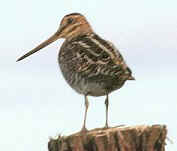
July 6, 2003: The habitat in this area looks great for Short-eared Owls. Much of the land is taken up by abandoned fields, dominated by vetch, daisies, clover, bird's foot trefoil, and the aforementioned strawberries. Scattered across the landscape are several small wetlands, providing enough habitat for the Virginia Rail and Marsh Wrens which kept us company long into the night - and in a much more pleasant manner than the clouds of mosquitoes which also remained with us at all times. Also nearby are a couple of active pastures with lower vegetation that might also appeal to the owls for hunting. The challenge in a place like this is to choose where to put the traps - there is so much suitable habitat for the owls that there is no guarantee they will be hunting in any given area on the nights we are present. The best we could do was scatter our traps in good-looking spots and hope for the best, then retreat to a central location to wait and monitor. At some point after midnight, we caught a glimpse of a bird in flight and heard it thud down into the grasses just a few metres away. A quick investigation showed it to be a Wilson's Snipe - it promptly took off again, but as I followed it with my headlamp to confirm its identity, it swung back around and returned to land almost at my feet! Over the next couple of hours, it flew off and returned several more times, seemingly unperturbed by our proximity. Around 3 a.m. we finally pulled in our traps for the night and headed to our tents for some much-needed sleep - little did we know that just a few hours later, the morning sun would be heating our tents like ovens, making further rest impossible! After a quick breakfast, we explored the area further - and in doing so, caught sight of a Short-eared Owl in flight over an adjacent field, being vigorously chased by half a dozen Red-winged Blackbirds! Unfortunately, we weren't able to determine where the owl had taken off from, nor where it landed, due to a grove of trees which obstructed our view. Nevertheless, it looks like we were a bit too far east with our traps, and hopefully returning and shifting our efforts a bit further west will yield better results.
July 3, 2003:
June 29, 2003: Unfortunately for us, as fascinating as the lightning was to watch, it also crept steadily closer over time. Only a bit over an hour after setting out our traps, the rain began pelting down, and with the expectation that the lightning would be soon to follow, we decided to play it safe and pack things in for the night. In doing so, we came to the somewhat obvious realization that mice walking on wet leaves make nowhere near as much noise as mice walking on dry leaves; consequently the chances of capturing an owl in the rain would likely be much lower (and perhaps it could be expected in general that owls have more difficulty in hunting when it is wet).
June 27, 2003: Tonight we made our first trapping attempt at a site west of Ottawa where local residents have reported seeing Short-eared Owls this spring. The mice did their job well, running about in their cages and making themselves heard. But tonight at least the owls (if present at all) seemed to prefer wild prey. At one point we heard a squeal that could well have been a just-pounced-upon Meadow Vole, so chances are that a predator of some kind (quite possibly an owl) was in the area at least.
June 25, 2003: Once again we were without a moon, though the ever-increasing abundance of fireflies seemed to be trying to make up for the lack of light, with some fields constantly flickering with the flashes of hundreds (if not thousands) of them. However, the unusually quiet night must have been due to other factors. Most likely, it was at least somewhat due to the lingering warm temperatures from a heat wave in the mid-30s Celsius (mid-90s Fahrenheit) that has enveloped eastern Ontario for the past three days. A cooler weather system should be arriving within a couple of days, and hopefully with that the odds of finding owls will again improve!
June 22, 2003: However, our string of interesting celestial observations continues. Following up on our aurora borealis show last week, we realized last night that (despite clear weather and star-filled skies) we now haven't seen the moon in a full week - no wonder it has been so difficult to spot owls in flight! Then this evening just before sunset, a meteorite streaked through the sky west of us, a bright green ball disappearing as suddenly as it came into view. Even the insects are getting into the theme of illumination - over the past week we have seen an incredible number of fireflies at almost all of the sites we have visited. Last night we came across another interesting insect, a katydid giving its loud grating call long after dark. Our list of non-avian nocturnal sounds therefore continues to grow - though frogs & dogs remain by far the most common 'auditory interference' we are encountering while trying to pick out the owl calls.
June
19, 2003: June
18, 2003: Once again, Bobolinks, Eastern Meadowlarks, Savannah Sparrows, and Wilson's Snipes were among the most common and conspicuous of the birds sharing the habitat of the owls. At one location we were also lucky to find a family of four Northern Harriers hunting over a large field ... and sure enough, when we returned to the same spot an hour after sunset, two Short-eared Owls were vocalizing at the same site. Also of note in the Quinte area especially were the large numbers of Eastern Phoebes and Brown Thrashers - the latter walking on the roads more often than not! Driving home, we were presented with one of the unexpected benefits of late night field work - a nice display of aurora borealis dancing in the sky to the north of us! The 'show' lasted several minutes, and was a wonderful way to rejuvenate us for the last little bit of the home stretch. June
14, 2003: Once again, we found a fair amount of suitable habitat - not always exactly at the sites where Short-eared Owls have nested in the past, due to rotating land use patterns, but usually in the same general area. However, as suitable as it seems to our eyes, the owls seem to feel otherwise - night after night we have come away from apparently good sites without seeing or hearing any of them. We have also spent a fair amount of time at each site during the day - not so much looking for evidence of Short-eared Owl presence, but assessing the habitat and checking for other indicator species. In particular we have been on the lookout for Northern Harriers, which over much of North America share habitat with Short-eared Owls and are in a sense their diurnal counterpart. To our dismay, we have only found a single male harrier over the past week, which seems like a bad omen for the owls, given that in general the harrier remains a considerably more widespread species in Ontario.
Short-eared Owls are believed to be at least somewhat nomadic in their breeding habits, adjusting their distribution in accordance with prey abundance and/or other factors. Based on our observations this week, it appears that southwestern Ontario is not attractive to them this year, and we will likely focus our remaining efforts more on eastern Ontario as a result. That being said, chances are that at least a few owls remain somewhere within southwestern Ontario, and we would be happy to hear from anyone who might know of currently active sites - please e-mail us if you do have any sightings from this spring / summer. June
4, 2003: Despite this, local observers have told us that sightings so far this year have been few and far between, and our experience reflected that. Of all the sites we visited, we were able to confirm the presence of Short-eared Owls at only one of them. However, it's a start, and hopefully several other sites will follow shortly. May
22, 2003:
|